If you have any questions, you are always welcome to contact us. We'll get back to you as soon as possible, withing 24 hours on weekdays.
Customer service
All questions about your order, return and delivery must be sent to our customer service team by e-mail at yourstore@yourdomain.com
Sale & Press
If you are interested in selling our products, need more information about our brand or wish to make a collaboration, please contact us at press@yourdomain.com
Help
If you have any questions, you are always welcome to contact us. We'll get back to you as soon as possible, withing 24 hours on weekdays.
Customer service
All questions about your order, return and delivery must be sent to our customer service team by e-mail at yourstore@yourdomain.com
Sale & Press
If you are interested in selling our products, need more information about our brand or wish to make a collaboration, please contact us at press@yourdomain.com
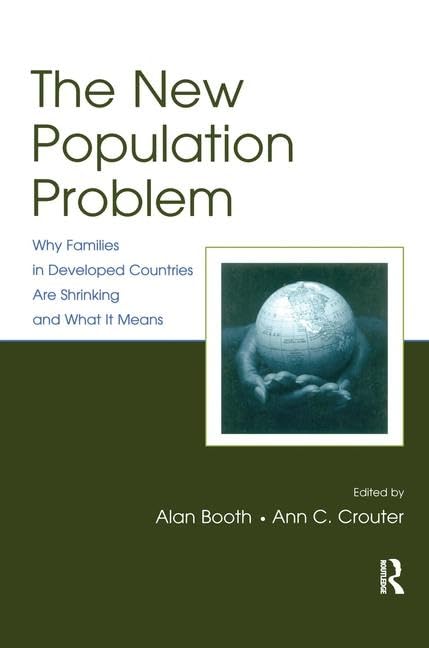
This book is based on the presentations and discussions from a national symposium on 'Creating the Next Generation: Social, Economic, and Psychological Processes Underlying Fertility in Developed Countries,' held at the Pennsylvania State University in 2003. The papers address some of the antecedents and consequences of the recent steep declines in fertility in developed countries from different theoretical and disciplinary angles. While fertility rates are still high in some lessdeveloped parts of the world, the new population problem with many countries in Europe, Asia, and North America is declining fertility. With fertility decline comes a reshaping of the population pyramid. The topic of fertility decline is interesting not only at the level of the individuals and couples, but also at the level of the societies that must come to grips with their longterm implications.Divided into four Parts, the text:*looks at contemporary trends in U.S. fertility, thus setting the stage for the entire volume;*discusses social and cultural values and attitudes;*analyzes fertility decisions in different countries; and*focuses on the possible longterm consequences of current fertility trends for individuals, families, and societies.
⚠️ WARNING (California Proposition 65):
This product may contain chemicals known to the State of California to cause cancer,
birth defects, or other reproductive harm.
For MAP (Minimum Advertised Price) violations and Intellectual Property (IP) or Trademark concerns, please contact:
support@ergodebooks.com
⚠️ California Proposition 65 Warning: Some products sold on this website may expose you to chemicals known to the State of California to cause cancer, birth defects, or other reproductive harm. For more information, visit www.P65Warnings.ca.gov.