
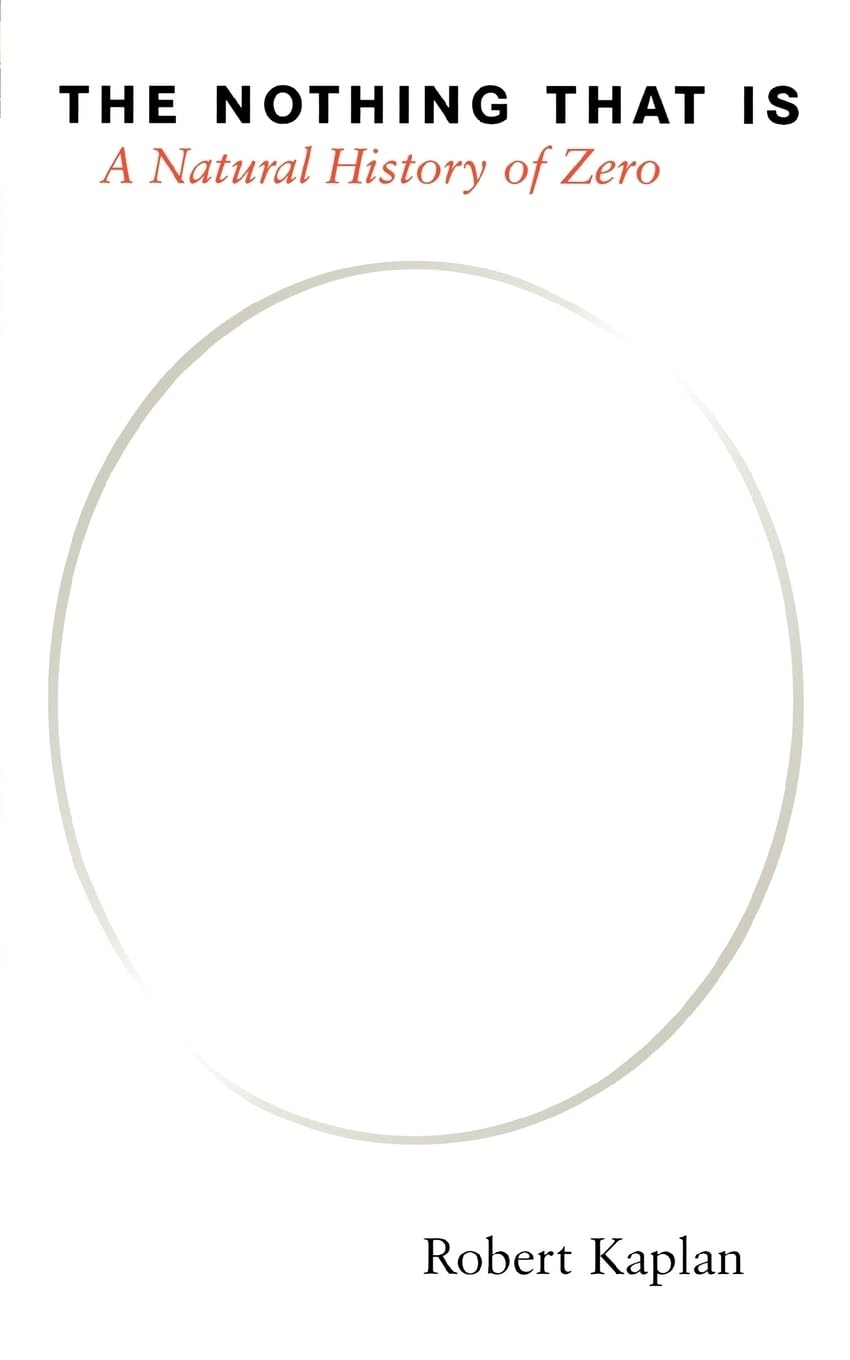
Title
The Nothing That Is: A Natural History Of Zero,New
Sold by Ergodebooks, an authorized reseller.
Returns accepted within 30 days | support@ergodebooks.com
Shipping Information
- Free Standard Shipping — United States only
- Processing Time: 3–5 business days
- Estimated Delivery: 6–10 business days after dispatch
- Double-boxed, fully insured & discreetly packaged
- Tracking number sent via email once dispatched
Returns & Refund
Returns accepted within 30 days of delivery.
Damaged or Defective Item
Free return shipping + replacement or full refund
Wrong Item Received
Free return shipping + replacement or full refund
Change of Mind
Return shipping at customer's expense · 25% restocking fee applies
Payment Option

A Symbol For What Is Not There, An Emptiness That Increases Any Number It'S Added To, An Inexhaustible And Indispensable Paradox. As We Enter The Year 2000, Zero Is Once Again Making Its Presence Felt. Nothing Itself, It Makes Possible A Myriad Of Calculations. Indeed, Without Zero Mathematics As We Know It Would Not Exist. And Without Mathematics Our Understanding Of The Universe Would Be Vastly Impoverished. But Where Did This Nothing, This Hollow Circle, Come From? Who Created It? And What, Exactly, Does It Mean?Robert Kaplan'S The Nothing That Is: A Natural History Of Zero Begins As A Mystery Story, Taking Us Back To Sumerian Times, And Then To Greece And India, Piecing Together The Way The Idea Of A Symbol For Nothing Evolved. Kaplan Shows Us Just How Handicapped Our Ancestors Were In Trying To Figure Large Sums Without The Aid Of The Zero. (Try Multiplying Clxiv By Xxiv). Remarkably, Even The Greeks, Mathematically Brilliant As They Were, Didn'T Have A Zeroor Did They? We Follow The Trail To The East Where, A Millennium Or Two Ago, Indian Mathematicians Took Another Crucial Step. By Treating Zero For The First Time Like Any Other Number, Instead Of A Unique Symbol, They Allowed Huge New Leaps Forward In Computation, And Also In Our Understanding Of How Mathematics Itself Works.In The Middle Ages, This Mathematical Knowledge Swept Across Western Europe Via Arab Traders. At First It Was Called 'Dangerous Saracen Magic' And Considered The Devil'S Work, But It Wasn'T Long Before Merchants And Bankers Saw How Handy This Magic Was, And Used It To Develop Tools Like Doubleentry Bookkeeping. Zero Quickly Became An Essential Part Of Increasingly Sophisticated Equations, And With The Invention Of Calculus, One Could Say It Was A Linchpin Of The Scientific Revolution. And Now Even Deeper Layers Of This Thing That Is Nothing Are Coming To Light: Our Computers Speak Only In Zeros And Ones, And Modern Mathematics Shows That Zero Alone Can Be Made To Generate Everything.Robert Kaplan Serves Up All This History With Immense Zest And Humor; His Writing Is Full Of Anecdotes And Asides, And Quotations From Shakespeare To Wallace Stevens Extend The Book'S Context Far Beyond The Scope Of Scientific Specialists. For Kaplan, The History Of Zero Is A Lens For Looking Not Only Into The Evolution Of Mathematics But Into Very Nature Of Human Thought. He Points Out How The History Of Mathematics Is A Process Of Recursive Abstraction: How Once A Symbol Is Created To Represent An Idea, That Symbol Itself Gives Rise To New Operations That In Turn Lead To New Ideas. The Beauty Of Mathematics Is That Even Though We Invent It, We Seem To Be Discovering Something That Already Exists.The Joy Of That Discovery Shines From Kaplan'S Pages, As He Ranges From Archimedes To Einstein, Making Fascinating Connections Between Mathematical Insights From Every Age And Culture. A Tour De Force Of Science History, The Nothing That Is Takes Us Through The Hollow Circle That Leads To Infinity.
⚠️ WARNING (California Proposition 65):
This product may contain chemicals known to the State of California to cause cancer, birth defects, or other reproductive harm.
For more information, please visit www.P65Warnings.ca.gov.
- Q: How many pages does this book have? A: This book has two hundred forty pages. It's a paperback edition published by Oxford University Press.
- Q: What are the dimensions of 'The Nothing that Is'? A: The book measures seven point nine nine inches in length, five inches in width, and zero point five four inches in height.
- Q: Who is the author of this book? A: The author is Robert Kaplan. He explores the history of zero and its significance in mathematics.
- Q: What is the main topic of 'The Nothing that Is'? A: The book discusses the history and impact of the concept of zero. Kaplan reveals how zero shaped mathematics and human thought.
- Q: Is this book suitable for beginners in mathematics? A: Yes, it is suitable for beginners. Kaplan’s engaging writing style makes complex ideas accessible to a general audience.
- Q: How does this book explain the concept of zero? A: Kaplan explains zero as a paradoxical symbol representing nothingness. He traces its evolution from ancient civilizations to modern mathematics.
- Q: What is the binding type of this book? A: The book is bound in paperback. This makes it lightweight and easy to handle for reading.
- Q: Is there any adult content in this book? A: No, there is no adult content in this book. It is focused on mathematical history and theories that are appropriate for all ages.
- Q: How should I care for this paperback book? A: To care for this book, keep it dry and store it upright. Avoid exposing it to direct sunlight to prevent fading.
- Q: What if I receive a damaged copy of the book? A: If you receive a damaged copy, contact the seller for a replacement or refund. Most sellers have a return policy for damaged items.
- Q: Can I find this book in libraries? A: Yes, many libraries carry 'The Nothing that Is'. You can check your local library’s catalog for availability.
- Q: Is this book recommended for higher education courses? A: Yes, it is often recommended for courses in mathematics and philosophy. Its historical context enriches the understanding of mathematical concepts.
- Q: What makes this book unique in its subject matter? A: This book uniquely combines history, humor, and anecdotes to explore the concept of zero. Kaplan connects mathematics with human thought and culture.
- Q: Does this book include illustrations or diagrams? A: No, this book does not include illustrations or diagrams. It primarily consists of text that explains the concepts of zero.
- Q: What genre does 'The Nothing that Is' belong to? A: The book belongs to the genre of science history, specifically focusing on mathematics. It appeals to both science enthusiasts and casual readers.
- Q: Is there a glossary of terms in this book? A: No, this book does not have a glossary of terms. However, the author explains concepts clearly throughout the text.