
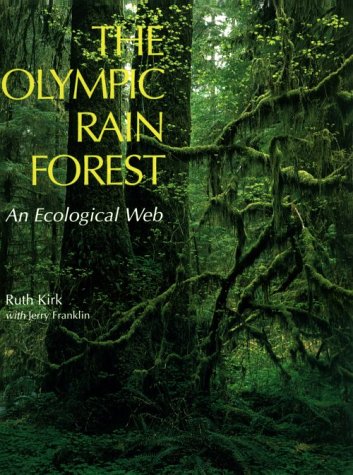
Title
The Olympic Rain Forest: An Ecological Web,New
Sold by Ergodebooks, an authorized reseller.
Returns accepted within 30 days | support@ergodebooks.com
Shipping Information
- Free Standard Shipping — United States only
- Processing Time: 3–5 business days
- Estimated Delivery: 6–10 business days after dispatch
- Double-boxed, fully insured & discreetly packaged
- Tracking number sent via email once dispatched
Returns & Refund
Returns accepted within 30 days of delivery.
Damaged or Defective Item
Free return shipping + replacement or full refund
Wrong Item Received
Free return shipping + replacement or full refund
Change of Mind
Return shipping at customer's expense · 25% restocking fee applies
Payment Option

The forest of the northwest coast of North America accounts for two thirds of the world's temperatezone rain forest, which is a fraction of the size of the more publicized tropical rain forest but is currently being lost at a comparable rate. Coming at a time of public concern and controversy regarding the future of the forest, this book provides a fresh examination of the natural dynamics that have produced the remarkably lush growth characterizing roughly two thousand miles of coast from Coos Bay, Oregon, to the gulf of Alaskaa stretch of greater northsouth ecological sameness than exists anywhere else on earth. The rain forest valleys of Washington's Olympic Peninsula stand out as the showpiece of this region. Because the forest's productivity and sheer biomass per square mile are among the world's greatest, it is recognized as a National Park, a World Biosphere Reserve, and a World Heritage Site.Pointing out that ecology and economics share the same root (oikos, meaning 'home'), this book evokes the forest's beauty and intricacy while summarizing scientific understanding of components and interactions. We learn that moldering logs produce their own moisture as a byproduct of decay, and are virtual reservoirs as well as storehouses of nutrientsqualities that contribute to their role as the rain forest's famed nurse logs, which act as seedbeds for oncoming generations of spruce and hemlock. We also learn that fallen trees affect stream flow and crucially influence the wellbeing of aquatic organisms (including fish) and that, washed downriver, they modify both beach character and life in the ocean near river mouths.The unique ecological web of this ancient forestwhich has existed for at least five thousand yearsincludes the peculiar aboveground rooting of maple trees, which actually feed from the mossy 'upholstery' covering their trunks and branches; the role of elk as 'landscape gardners' preventing the understory from becoming a thicket; and a newly discovered life community within the gravel zone of river bottoms and out under the forest floor.'Many of the spruce and hemlock trees we walk among today were alive when men like Sir Francis Bacon and Johannes Kepler first recognized the value of objective data over mystical portents,' write authors Ruth Kirk and Jerry Franklin. 'They have been pushing their roots through the soil and wafting seeds into the air throughout the entire existence of science.'This book will be welcomed by resident Northwesterners and travelers as well as by all who are interested in nature. Its prose is both broadly readable and scientifically sound. More than 100 color photographs catch the variety and grandeur of this magnificent forest.
⚠️ WARNING (California Proposition 65):
This product may contain chemicals known to the State of California to cause cancer, birth defects, or other reproductive harm.
For more information, please visit www.P65Warnings.ca.gov.