
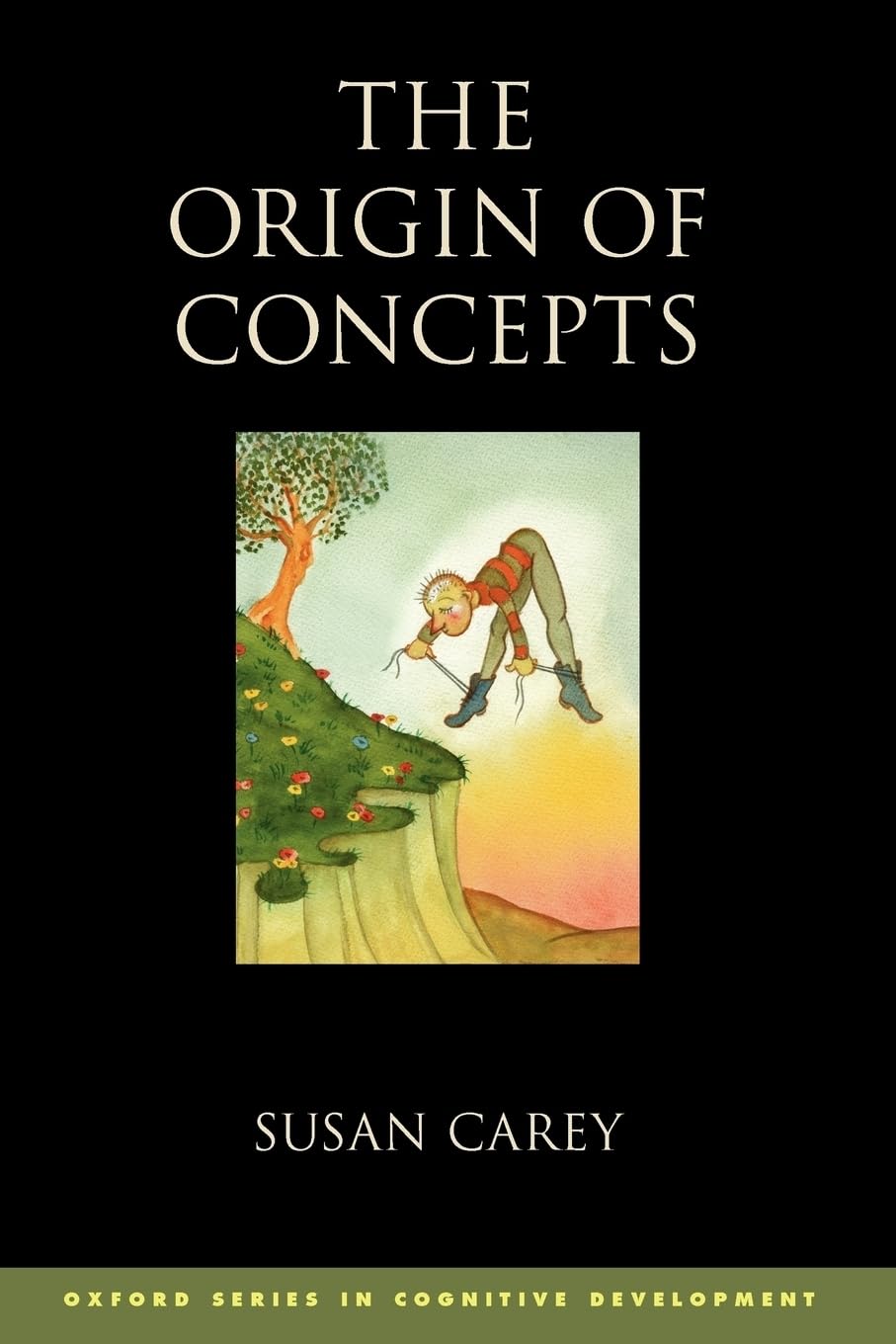
Title
The Origin Of Concepts (Oxford Series In Cognitive Development),Used
Sold by Ergodebooks, an authorized reseller.
Returns accepted within 30 days | support@ergodebooks.com
Shipping Information
- Free Standard Shipping — United States only
- Processing Time: 3–5 business days
- Estimated Delivery: 6–10 business days after dispatch
- Double-boxed, fully insured & discreetly packaged
- Tracking number sent via email once dispatched
Returns & Refund
Returns accepted within 30 days of delivery.
Damaged or Defective Item
Free return shipping + replacement or full refund
Wrong Item Received
Free return shipping + replacement or full refund
Change of Mind
Return shipping at customer's expense · 25% restocking fee applies
Payment Option

Only Human Beings Have A Rich Conceptual Repertoire With Concepts Like Tort, Entropy, Abelian Group, Mannerism, Icon And Deconstruction. How Have Humans Constructed These Concepts? And Once They Have Been Constructed By Adults, How Do Children Acquire Them? While Primarily Focusing On The Second Question, In The Origin Of Concepts , Susan Carey Shows That The Answers To Both Overlap Substantially.Carey Begins By Characterizing The Innate Starting Point For Conceptual Development, Namely Systems Of Core Cognition. Representations Of Core Cognition Are The Output Of Dedicated Input Analyzers, As With Perceptual Representations, But These Core Representations Differ From Perceptual Representations In Having More Abstract Contents And Richer Functional Roles. Carey Argues That The Key To Understanding Cognitive Development Lies In Recognizing Conceptual Discontinuities In Which New Representational Systems Emerge That Have More Expressive Power Than Core Cognition And Are Also Incommensurate With Core Cognition And Other Earlier Representational Systems. Finally, Carey Fleshes Out Quinian Bootstrapping, A Learning Mechanism That Has Been Repeatedly Sketched In The Literature On The History And Philosophy Of Science. She Demonstrates That Quinian Bootstrapping Is A Major Mechanism In The Construction Of New Representational Resources Over The Course Of Childrens Cognitive Development.Carey Shows How Developmental Cognitive Science Resolves Aspects Of Longstanding Philosophical Debates About The Existence, Nature, Content, And Format Of Innate Knowledge. She Also Shows That Understanding The Processes Of Conceptual Development In Children Illuminates The Historical Process By Which Concepts Are Constructed, And Transforms The Way We Think About Philosophical Problems About The Nature Of Concepts And The Relations Between Language And Thought.
⚠️ WARNING (California Proposition 65):
This product may contain chemicals known to the State of California to cause cancer, birth defects, or other reproductive harm.
For more information, please visit www.P65Warnings.ca.gov.
- Q: How many pages does this book have? A: This book has five hundred ninety-eight pages. It provides an in-depth exploration of cognitive development and conceptual understanding.
- Q: What is the binding type of this book? A: The book is a paperback. This makes it flexible and lightweight, ideal for reading and portability.
- Q: What are the dimensions of this book? A: The book measures nine point one inches in length, six point one inches in width, and one point three inches in height. This size is convenient for both reading and storage.
- Q: Who is the author of this book? A: The author of this book is Susan Carey. She is known for her significant contributions to cognitive science and philosophy.
- Q: What is the main topic of this book? A: The main topic is cognitive development and how concepts are formed and acquired by children. It delves into the philosophical implications of these processes.
- Q: Is this book suitable for beginners in cognitive science? A: Yes, the book is suitable for beginners. It presents complex ideas in an accessible way, making it a great introduction to conceptual development.
- Q: How can I apply the concepts discussed in this book? A: You can apply the concepts by observing children's cognitive development in real life. The book provides frameworks to understand how children acquire new ideas.
- Q: What age group is this book aimed at? A: The book is aimed at adults and professionals interested in cognitive development. It is not specifically designed for children.
- Q: Can I use this book for academic research? A: Yes, this book is suitable for academic research. It offers valuable insights and references that can support scholarly work.
- Q: How should I store this book to keep it in good condition? A: Store the book upright in a cool, dry place. Avoid direct sunlight to prevent fading and ensure it remains in good condition.
- Q: Are there any cleaning instructions for this book? A: No, there are no specific cleaning instructions for this book. However, it’s best to keep it away from moisture and extreme conditions.
- Q: What if the book arrives damaged? A: If the book arrives damaged, you can return it for a replacement or refund. Make sure to contact customer support for assistance.
- Q: Is there a warranty for this book? A: No, there is no warranty for this book. However, return policies typically cover issues like damage during shipping.
- Q: How does this book compare to other cognitive science books? A: This book offers a unique perspective on cognitive development by focusing on conceptual understanding. It stands out for its depth and clarity.
- Q: Is this book a good resource for teachers? A: Yes, this book is a good resource for teachers. It provides insights into how children think and learn, which can inform teaching practices.
- Q: What are the key themes discussed in this book? A: Key themes include conceptual discontinuities, core cognition, and the mechanisms of learning. These themes are explored in relation to child development.