
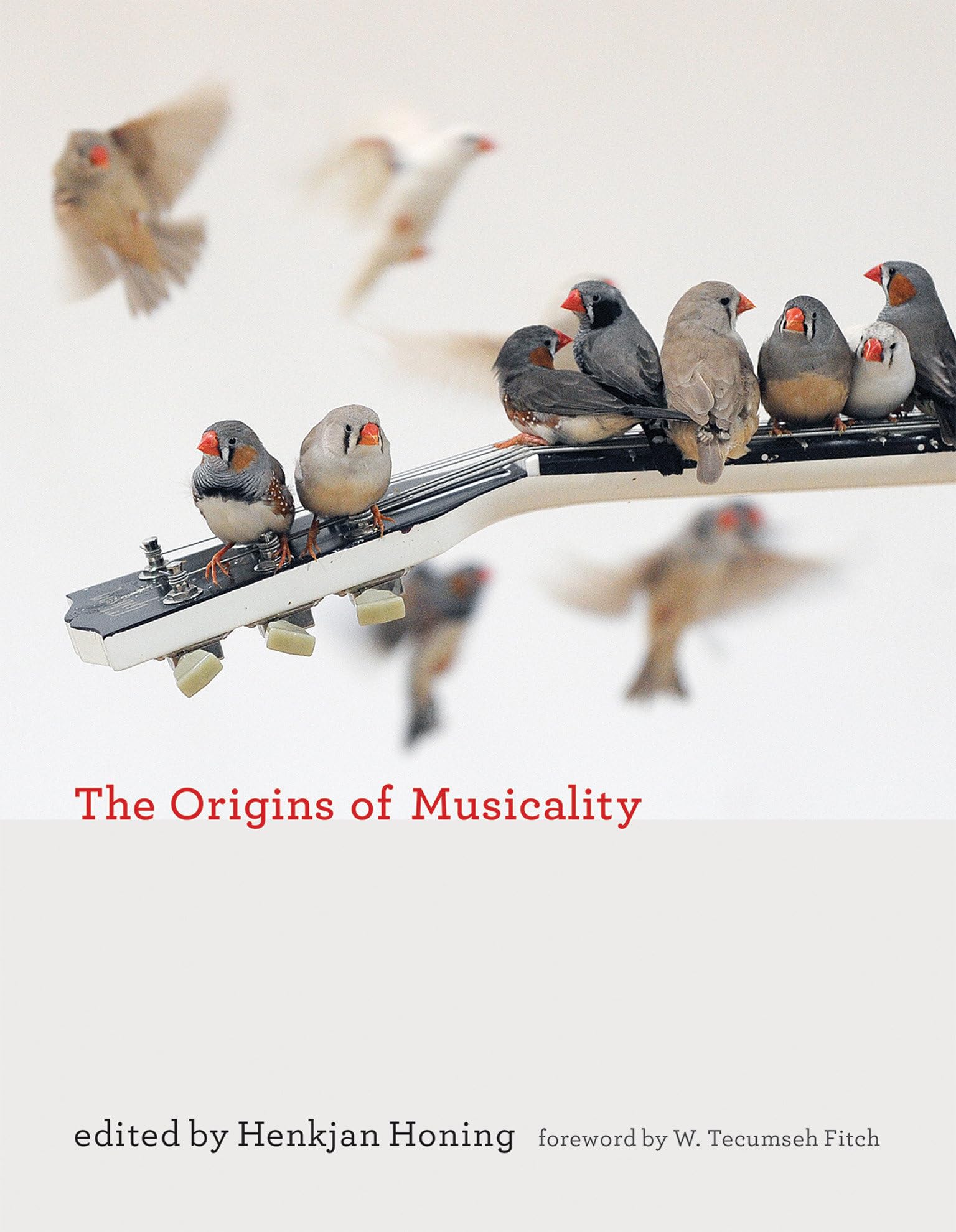
Title
The Origins Of Musicality (Mit Press)
Sold by Ergodebooks, an authorized reseller.
Returns accepted within 30 days | support@ergodebooks.com
Shipping Information
- Free Standard Shipping — United States only
- Processing Time: 3–5 business days
- Estimated Delivery: 6–10 business days after dispatch
- Double-boxed, fully insured & discreetly packaged
- Tracking number sent via email once dispatched
Returns & Refund
Returns accepted within 30 days of delivery.
Damaged or Defective Item
Free return shipping + replacement or full refund
Wrong Item Received
Free return shipping + replacement or full refund
Change of Mind
Return shipping at customer's expense · 25% restocking fee applies
Payment Option

Interdisciplinary Perspectives On The Capacity To Perceive, Appreciate, And Make Music.Research Shows That All Humans Have A Predisposition For Music, Just As They Do For Language. All Of Us Can Perceive And Enjoy Music, Even If We Can'T Carry A Tune And Consider Ourselves Unmusical. This Volume Offers Interdisciplinary Perspectives On The Capacity To Perceive, Appreciate, And Make Music. Scholars From Biology, Musicology, Neurology, Genetics, Computer Science, Anthropology, Psychology, And Other Fields Consider What Music Is For And Why Every Human Culture Has It; Whether Musicality Is A Uniquely Human Capacity; And What Biological And Cognitive Mechanisms Underlie It.Contributors Outline A Research Program In Musicality, And Discuss Issues In Studying The Evolution Of Music; Consider Principles, Constraints, And Theories Of Origins; Review Musicality From Crosscultural, Crossspecies, And Crossdomain Perspectives; Discuss The Computational Modeling Of Animal Song And Creativity; And Offer A Historical Context For The Study Of Musicality. The Volume Aims To Identify The Basic Neurocognitive Mechanisms That Constitute Musicality (And Effective Ways To Study These In Human And Nonhuman Animals) And To Develop A Method For Analyzing Musical Phenotypes That Point To The Biological Basis Of Musicality.Contributorsjorge L. Armony, Judith Becker, Simon E. Fisher, W. Tecumseh Fitch, Bruno Gingras, Jessica Grahn, Yuko Hattori, Marisa Hoeschele, Henkjan Honing, David Huron, Dieuwke Hupkes, Yukiko Kikuchi, Julia Kursell, Marielaine Lagrois, Hugo Merchant, Bjrn Merker, Iain Morley, Aniruddh D. Patel, Isabelle Peretz, Martin Rohrmeier, Constance Scharff, Carel Ten Cate, Laurel J. Trainor, Sandra E. Trehub, Peter Tyack, Dominique Vuvan, Geraint Wiggins, Willem Zuidema
⚠️ WARNING (California Proposition 65):
This product may contain chemicals known to the State of California to cause cancer, birth defects, or other reproductive harm.
For more information, please visit www.P65Warnings.ca.gov.
- Q: How many pages does this book have? A: This book contains three hundred sixty-four pages. It provides an extensive overview of musicality from various interdisciplinary perspectives.
- Q: What is the binding type of this book? A: The binding type is paperback. This makes it lightweight and easy to handle for reading.
- Q: What are the dimensions of this book? A: The dimensions are seven point zero five inches in length, zero point seven five inches in width, and nine point zero two inches in height.
- Q: Who is the author of 'The Origins of Musicality'? A: The author is Henkjan Honing. He is renowned in the field of musicology and cognitive science.
- Q: What topics does this book cover? A: It covers topics such as the biological and cognitive mechanisms of musicality, its evolution, and cross-cultural perspectives.
- Q: Is this book suitable for beginners in music studies? A: Yes, this book is suitable for beginners. It provides foundational insights into the nature of musicality and its significance across cultures.
- Q: Can I read this book if I have no musical background? A: Yes, you can read this book without a musical background. It is designed to be accessible to a wide audience interested in the subject.
- Q: How should I care for this paperback book? A: Keep it in a dry place and avoid exposure to moisture. Handle it gently to prevent bending or tearing of the pages.
- Q: Is there any specific storage recommendation for this book? A: Store it upright on a shelf with other books. This will help maintain its shape and prevent damage.
- Q: What should I do if the book arrives damaged? A: If the book arrives damaged, contact the seller for a return or exchange. Ensure you have your order details ready for a smooth process.
- Q: Is there a return policy for this book? A: Yes, there is a return policy. Check with the seller for specific terms regarding returns and exchanges.
- Q: Does this book include contributions from multiple authors? A: Yes, it includes contributions from various scholars across different fields, enhancing the interdisciplinary nature of the content.
- Q: Can this book be used for academic research? A: Yes, this book is suitable for academic research. It presents scholarly perspectives valuable for studies in musicology and cognitive science.
- Q: Is this book part of a series? A: No, 'The Origins of Musicality' is a standalone volume. However, it complements other works in the field of music studies.
- Q: Are there illustrations or diagrams in this book? A: No, this book primarily consists of text and scholarly contributions without illustrations or diagrams.