
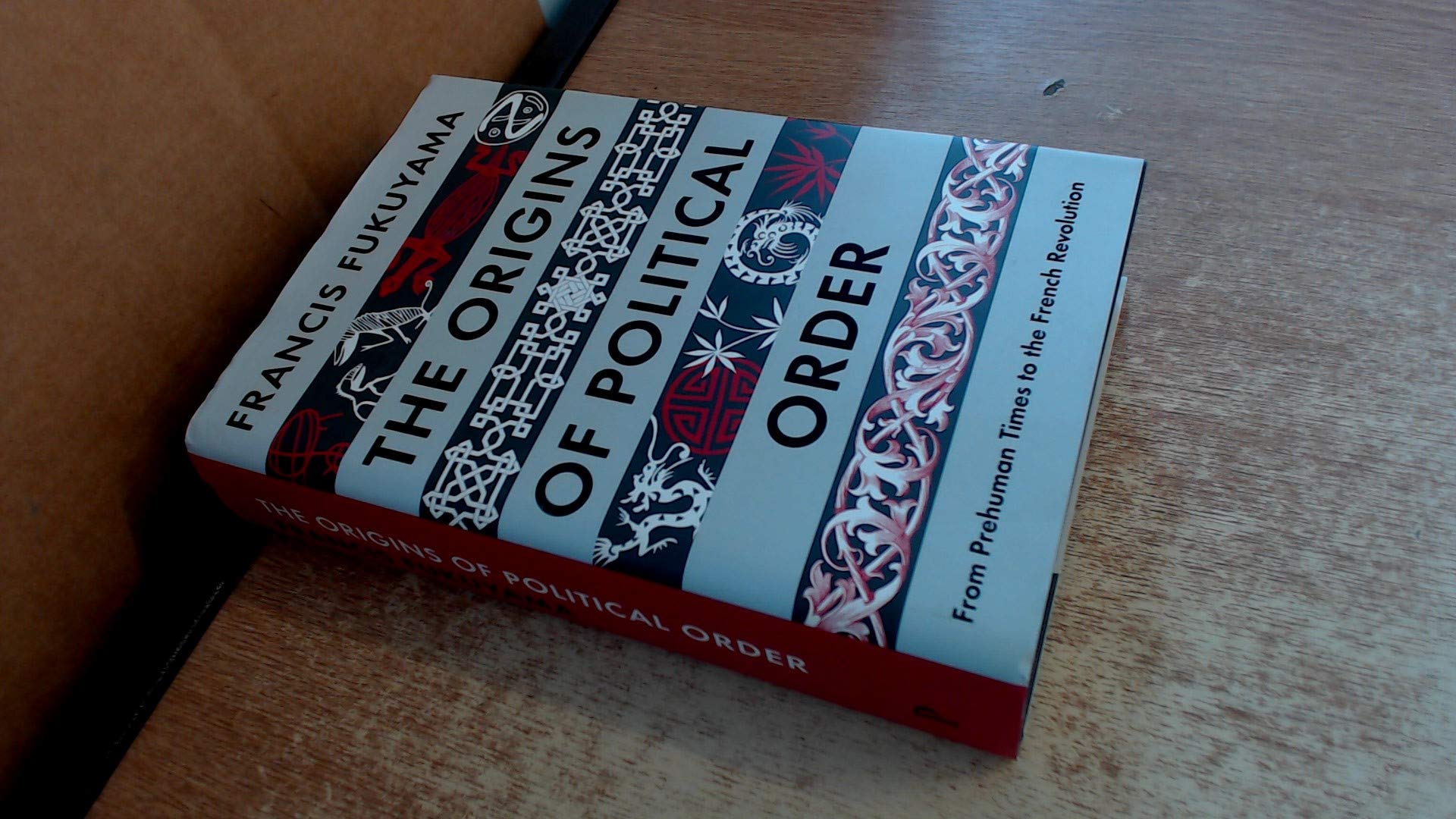
Title
The Origins of Political Order: From Prehuman Times to the French Revolution,Used
Sold by Ergodebooks, an authorized reseller.
Returns accepted within 30 days | support@ergodebooks.com
Shipping Information
- Free Standard Shipping — United States only
- Processing Time: 3–5 business days
- Estimated Delivery: 6–10 business days after dispatch
- Double-boxed, fully insured & discreetly packaged
- Tracking number sent via email once dispatched
Returns & Refund
Returns accepted within 30 days of delivery.
Damaged or Defective Item
Free return shipping + replacement or full refund
Wrong Item Received
Free return shipping + replacement or full refund
Change of Mind
Return shipping at customer's expense · 25% restocking fee applies
Payment Option

Virtually all human societies were once organized tribally, yet over time most developed new political institutions which included a central state that could keep the peace and uniform laws that applied to all citizens. Some went on to create governments that were accountable to their constituents. We take these institutions for granted, but they are absent or are unable to perform in many of todays developing countrieswith often disastrous consequences for the rest of the world.Francis Fukuyama, author of the bestselling The End of History and the Last Man and one of our most important political thinkers, provides a sweeping account of how todays basic political institutions developed. The first of a major twovolume work, The Origins of Political Order begins with politics among our primate ancestors and follows the story through the emergence of tribal societies, the growth of the first modern state in China, the beginning of the rule of law in India and the Middle East, and the development of political accountability in Europe up until the eve of the French Revolution.Drawing on a vast body of knowledgehistory, evolutionary biology, archaeology, and economicsFukuyama has produced a brilliant, provocative work that offers fresh insights on the origins of democratic societies and raises essential questions about the nature of politics and its discontents.
⚠️ WARNING (California Proposition 65):
This product may contain chemicals known to the State of California to cause cancer, birth defects, or other reproductive harm.
For more information, please visit www.P65Warnings.ca.gov.
- Q: What is the main theme of 'The Origins of Political Order'? A: The main theme of 'The Origins of Political Order' is the development of political institutions throughout history, exploring how societies transitioned from tribal organization to complex political systems, including the establishment of states and accountable governments.
- Q: Who is the author of this book? A: The author of 'The Origins of Political Order' is Francis Fukuyama, a well-known political theorist and author.
- Q: When was 'The Origins of Political Order' published? A: 'The Origins of Political Order' was published on April 12, 2011.
- Q: What is the format of this book? A: This book is available in hardcover format.
- Q: How many pages does the book contain? A: 'The Origins of Political Order' contains 608 pages.
- Q: What type of insights does Fukuyama provide in the book? A: Fukuyama provides insights drawn from various disciplines, including history, evolutionary biology, archaeology, and economics, to analyze the origins of political institutions.
- Q: Is this book suitable for readers interested in political theory? A: Yes, the book is suitable for readers interested in political theory, history, and the evolution of political institutions.
- Q: Does the book discuss contemporary political issues? A: Yes, Fukuyama discusses contemporary political issues by examining how historical political institutions have shaped modern governance, particularly in developing countries.
- Q: Is this book part of a series? A: Yes, 'The Origins of Political Order' is the first volume in a two-volume work by Francis Fukuyama.
- Q: What can readers expect to learn from this book? A: Readers can expect to learn about the historical development of political systems, the significance of political accountability, and the challenges faced by modern political institutions.