
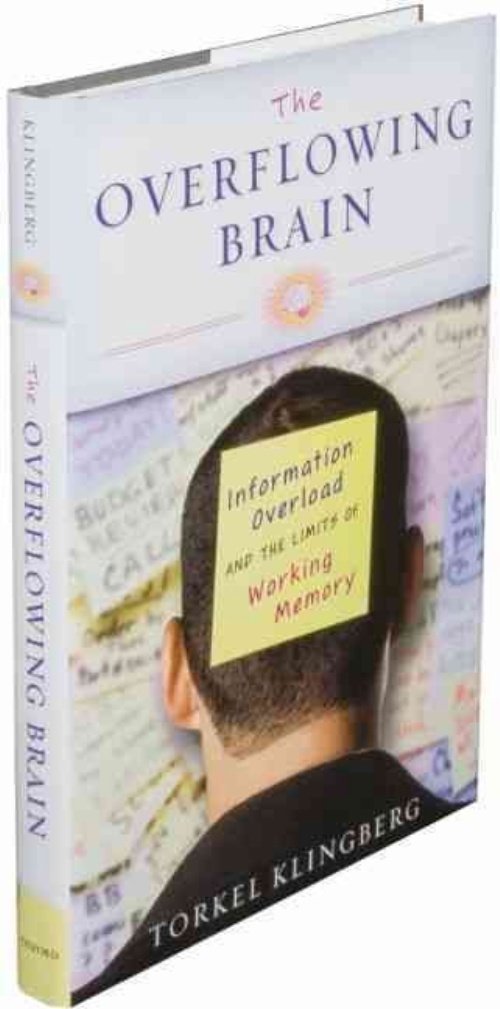
Title
The Overflowing Brain: Information Overload and the Limits of Working Memory,New
Sold by Ergodebooks, an authorized reseller.
Returns accepted within 30 days | support@ergodebooks.com
Shipping Information
- Free Standard Shipping — United States only
- Processing Time: 3–5 business days
- Estimated Delivery: 6–10 business days after dispatch
- Double-boxed, fully insured & discreetly packaged
- Tracking number sent via email once dispatched
Returns & Refund
Returns accepted within 30 days of delivery.
Damaged or Defective Item
Free return shipping + replacement or full refund
Wrong Item Received
Free return shipping + replacement or full refund
Change of Mind
Return shipping at customer's expense · 25% restocking fee applies
Payment Option

As the pace of technological change accelerates, we are increasingly experiencing a state of information overload. Statistics show that we are interrupted every three minutes during the course of the work day. Multitasking between email, cellphone, text messages, and four or five websites while listening to an iPod forces the brain to process more and more informaton at greater and greater speeds. And yet the human brain has hardly changed in the last 40,000 years.Are all these hightech advances overtaxing our Stone Age brains or is the constant flood of information good for us, giving our brains the daily exercise they seem to crave? In The Overflowing Brain, cognitive scientist Torkel Klingberg takes us on a journey into the limits and possibilities of the brain. He suggests that we should acknowledge and embrace our desire for information and mental challenges, but try to find a balance between demand and capacity. Klingberg explores the cognitive demands, or 'complexity,' of everyday life and how the brain tries to meet them. He identifies different types of attention, such as stimulusdriven and controlled attention, but focuses chiefly on 'working memory,' our capacity to keep information in mind for short periods of time. Dr Klingberg asserts that working memory capacity, long thought to be static and hardwired in the brain, can be improved by training, and that the increasing demands on working memory may actually have a constructive effect: as demands on the human brain increase, so does its capacity.The book ends with a discussion of the future of brain development and how we can best handle information overload in our everyday lives. Klingberg suggests how we might find a balance between demand and capacity and move from feeling overwhelmed to deeply engaged.
⚠️ WARNING (California Proposition 65):
This product may contain chemicals known to the State of California to cause cancer, birth defects, or other reproductive harm.
For more information, please visit www.P65Warnings.ca.gov.
- Q: What is the binding type of 'The Overflowing Brain'? A: The binding type is hardcover. This ensures durability and a premium feel for readers who appreciate a well-constructed book.
- Q: How many pages does 'The Overflowing Brain' have? A: The book contains two hundred twenty-four pages. This length provides a comprehensive exploration of information overload and working memory.
- Q: What are the dimensions of 'The Overflowing Brain'? A: The dimensions are one point one inches in thickness, six point four two inches in width, and nine point three inches in height. These dimensions make it a convenient size for reading and storage.
- Q: Who is the author of 'The Overflowing Brain'? A: The author is Torkel Klingberg. He is a cognitive scientist known for his research on working memory and cognitive development.
- Q: What is the genre of 'The Overflowing Brain'? A: The genre is non-fiction. It delves into cognitive science and psychology, focusing on information processing and memory.
- Q: What is the main theme of 'The Overflowing Brain'? A: The main theme revolves around information overload and the limits of working memory. It discusses how modern life challenges our cognitive capacities.
- Q: How can I benefit from reading 'The Overflowing Brain'? A: You can gain insights into managing information overload. The book offers strategies for balancing cognitive demands with mental capacity.
- Q: Is 'The Overflowing Brain' suitable for all ages? A: Yes, it is suitable for adults and older teens. The content is educational and focuses on cognitive development, making it appropriate for a mature audience.
- Q: What kind of reader is 'The Overflowing Brain' intended for? A: It is intended for readers interested in psychology, neuroscience, and cognitive science. Those looking to understand the impact of technology on the brain will find it particularly relevant.
- Q: How should I care for 'The Overflowing Brain' to maintain its condition? A: Keep it stored upright in a dry place. Avoid exposing it to direct sunlight and moisture to preserve its binding and pages.
- Q: Does 'The Overflowing Brain' include any practical exercises? A: Yes, it discusses working memory training techniques. These exercises aim to enhance cognitive capacity and manage information overload.
- Q: What if I receive 'The Overflowing Brain' damaged? A: You can return it for a refund or replacement. Check the return policy of the retailer for specific instructions on damaged items.
- Q: Is there a warranty on 'The Overflowing Brain'? A: No, books typically do not come with a warranty. However, retailers may offer return options for unsatisfactory conditions.
- Q: Can 'The Overflowing Brain' help with multitasking issues? A: Yes, it provides insights into cognitive demands of multitasking. Understanding these concepts can help improve your approach to managing tasks.
- Q: Is this book a good resource for understanding memory improvement? A: Yes, it discusses methods to enhance working memory. Readers can learn about techniques that may increase their cognitive abilities.