
Title
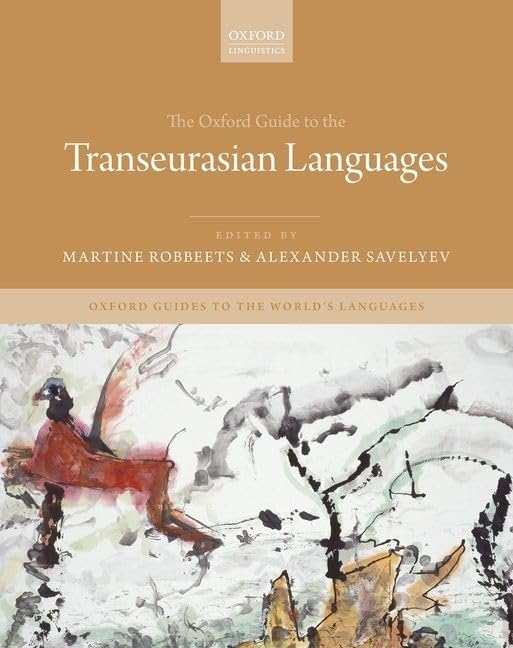
The Oxford Guide to the Transeurasian Languages (Oxford Guides to the World's Languages),Used
Sold by Ergodebooks, an authorized reseller.
Returns accepted within 30 days | support@ergodebooks.com
Shipping Information
- Free Standard Shipping — United States only
- Processing Time: 3–5 business days
- Estimated Delivery: 6–10 business days after dispatch
- Double-boxed, fully insured & discreetly packaged
- Tracking number sent via email once dispatched
Returns & Refund
Returns accepted within 30 days of delivery.
Damaged or Defective Item
Free return shipping + replacement or full refund
Wrong Item Received
Free return shipping + replacement or full refund
Change of Mind
Return shipping at customer's expense · 25% restocking fee applies
Payment Option

The Oxford Guide to the Transeurasian Languages provides a comprehensive account of the Transeurasian languages, and is the first major reference work in the field since 1965. The term 'Transeurasian' refers to a large group of geographically adjacent languages that includes five uncontroversial linguistic families: Japonic, Koreanic, Tungusic, Mongolic, and Turkic. The historical connection between these languages, however, constitutes one of the most debated issues in historical comparative linguistics. In the present book, a team of leading international scholars in the field take a balanced approach to this controversy, integrating different theoretical frameworks, combining both functional and formal linguistics, and showing that genealogical and areal approaches are in fact compatible with one another.The volume is divided into five parts. Part I deals with the historical sources and periodization of the Transeurasian languages and their classification and typology. In Part II, chapters provide individual structural overviews of the Transeurasian languages and the linguistic subgroups that they belong to, while Part III explores Transeurasian phonology, morphology, syntax, lexis, and semantics from a comparative perspective. Part IV offers a range of areal and genealogical explanations for the correlations observed in the preceding parts. Finally, Part V combines archaeological, genetic, and anthropological perspectives on the identity of speakers of Transeurasian languages. The Oxford Guide to the Transeurasian Languages will be an indispensable resource for specialists in Japonic, Koreanic, Tungusic, Mongolic, and Turkic languages and for anyone with an interest in Transeurasian and comparative linguistics more broadly.
⚠️ WARNING (California Proposition 65):
This product may contain chemicals known to the State of California to cause cancer, birth defects, or other reproductive harm.
For more information, please visit www.P65Warnings.ca.gov.