
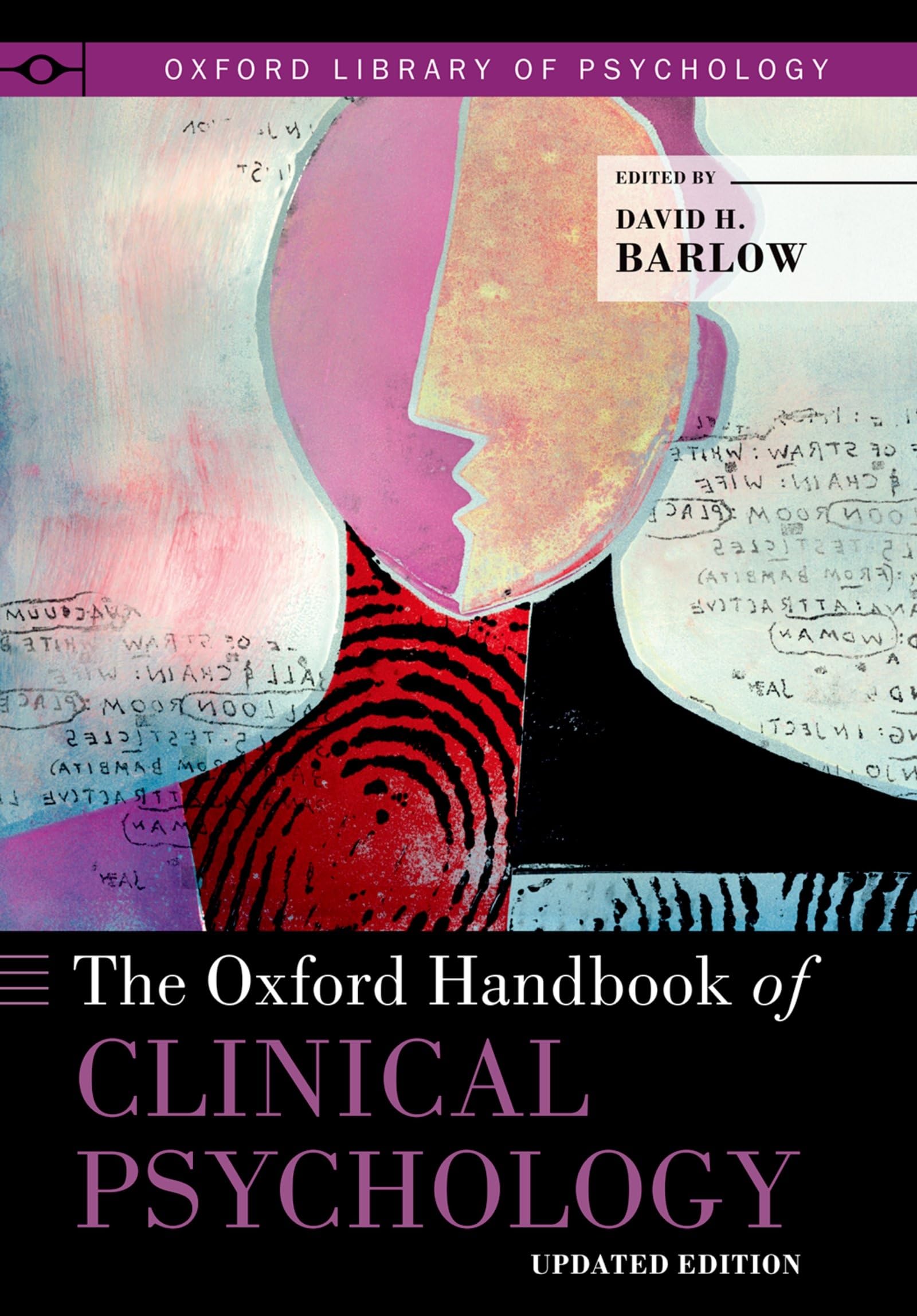
Title
The Oxford Handbook of Clinical Psychology: Updated Edition (Oxford Library of Psychology),Used
Sold by Ergodebooks, an authorized reseller.
Returns accepted within 30 days | support@ergodebooks.com
Shipping Information
- Free Standard Shipping — United States only
- Processing Time: 3–5 business days
- Estimated Delivery: 6–10 business days after dispatch
- Double-boxed, fully insured & discreetly packaged
- Tracking number sent via email once dispatched
Returns & Refund
Returns accepted within 30 days of delivery.
Damaged or Defective Item
Free return shipping + replacement or full refund
Wrong Item Received
Free return shipping + replacement or full refund
Change of Mind
Return shipping at customer's expense · 25% restocking fee applies
Payment Option

The exponential growth of clinical psychology since the late 1960s can be measured in part by the extensiveperhaps exhaustiveliterature on the subject. This proliferation of writing has continued into the new century, and the field has come to be defined as much by its many topics as its many voices.The Oxford Handbook of Clinical Psychology synthesizes these decades of literature in one extraordinary volume. Comprising chapters from the foremost scholars in clinical psychology, the handbook provides even and authoritative coverage of the research, practice, and policy factors that combine to form today's clinical psychology landscape.In addition to core sections on topics such as training, assessment, diagnosis, and intervention, the handbook includes valuable chapters devoted to new and emerging issues in the clinical field, including heath care reforms, cultural factors, and technological innovations and challenges. Each chapter offers a review of the most pertinent literature, outlining current issues and identifying possibilities for future research.Featuring two chapters by Editor David H. Barlow one on changes during his own 40year odyssey in the field, the other projecting ten themes for the future of clinical psychology The Oxford Handbook of Clinical Psychology is a landmark publication that is sure to serve as the field's benchmark reference publication for years to come. It is an essential resource for students, clinicians, and researchers across the evergrowing clinical psychology community.
⚠️ WARNING (California Proposition 65):
This product may contain chemicals known to the State of California to cause cancer, birth defects, or other reproductive harm.
For more information, please visit www.P65Warnings.ca.gov.
- Q: What is the main focus of The Oxford Handbook of Clinical Psychology? A: The Oxford Handbook of Clinical Psychology synthesizes decades of literature in clinical psychology, covering research, practice, and policy factors that define the field today.
- Q: Who is the author of this handbook? A: The handbook is edited by David H. Barlow, a prominent figure in clinical psychology.
- Q: Is this edition updated? A: Yes, this is the updated edition, published on April 28, 2014.
- Q: How many pages does this book have? A: The Oxford Handbook of Clinical Psychology contains 976 pages.
- Q: What topics are covered in the handbook? A: The handbook covers core topics such as training, assessment, diagnosis, intervention, as well as emerging issues like healthcare reforms and technological challenges.
- Q: What type of binding does this book have? A: This edition is available in paperback binding.
- Q: Who would benefit from reading this handbook? A: This resource is essential for students, clinicians, and researchers in the field of clinical psychology.
- Q: Are there any notable chapters in the book? A: Yes, there are two significant chapters by David H. Barlow, discussing his experiences in the field and future themes in clinical psychology.
- Q: What is the condition of the book? A: The book is listed as new.
- Q: Does the handbook address contemporary issues in clinical psychology? A: Yes, it includes valuable discussions on contemporary issues and identifies possibilities for future research.