
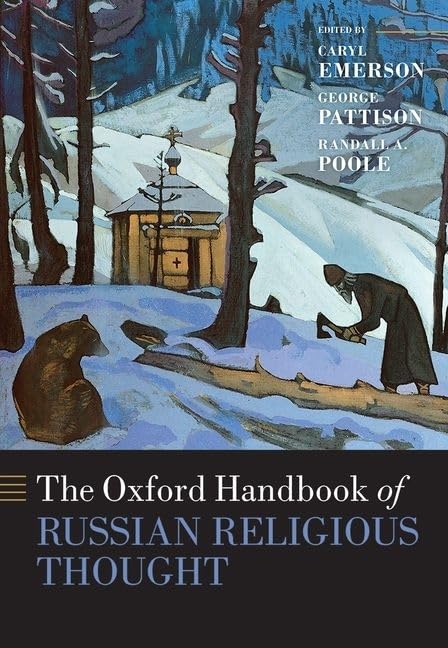
Title
The Oxford Handbook of Russian Religious Thought (Oxford Handbooks),Used
Sold by Ergodebooks, an authorized reseller.
Returns accepted within 30 days | support@ergodebooks.com
Shipping Information
- Free Standard Shipping — United States only
- Processing Time: 3–5 business days
- Estimated Delivery: 6–10 business days after dispatch
- Double-boxed, fully insured & discreetly packaged
- Tracking number sent via email once dispatched
Returns & Refund
Returns accepted within 30 days of delivery.
Damaged or Defective Item
Free return shipping + replacement or full refund
Wrong Item Received
Free return shipping + replacement or full refund
Change of Mind
Return shipping at customer's expense · 25% restocking fee applies
Payment Option

The Oxford Handbook of Russian Religious Thought is an authoritative new reference and interpretive volume detailing the origins, development, and influence of one of the richest aspects of Russian cultural and intellectual life its religious ideas. After setting the historical background and context, the Handbook follows the leading figures and movements in modern Russian religious thought through a period of immense historical upheavals, including seventy years of officially atheist communist rule and the growth of an exiled diaspora with, e.g., its journal The Way. Therefore the shape of Russian religious thought cannot be separated from longrunning debates with nihilism and atheism. Important thinkers such as Losev and Bakhtin had to guard their words in an environment of religious persecution, whilst some views were shaped by prison experiences. Before the Soviet period, Russian national identity was closely linked with religion linkages which again are being forged in the new Russia. Relevant in this connection are complex relationships with Judaism. In addition to religious thinkers such as Philaret, Chaadaev, Khomiakov, Kireevsky, Soloviev, Florensky, Bulgakov, Berdyaev, Shestov, Frank, Karsavin, and Alexander Men, the Handbook also looks at the role of religion in aesthetics, music, poetry, art, film, and the novelists Dostoevsky and Tolstoy. Ideas, institutions, and movements discussed include the Church academies, Slavophilism and Westernism, theosis, the nameglorifying (imiaslavie) controversy, the Godseekers and Godbuilders, Russian religious idealism and liberalism, and the Neopatristic school. Occultism is considered, as is the role of tradition and the influence of Russian religious thought in the West.
⚠️ WARNING (California Proposition 65):
This product may contain chemicals known to the State of California to cause cancer, birth defects, or other reproductive harm.
For more information, please visit www.P65Warnings.ca.gov.