
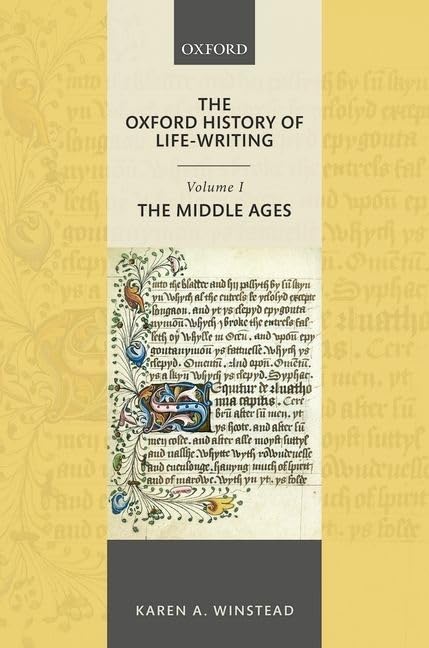
Title
The Oxford History of LifeWriting: Volume 1. The Middle Ages,Used
Sold by Ergodebooks, an authorized reseller.
Returns accepted within 30 days | support@ergodebooks.com
Shipping Information
- Free Standard Shipping — United States only
- Processing Time: 3–5 business days
- Estimated Delivery: 6–10 business days after dispatch
- Double-boxed, fully insured & discreetly packaged
- Tracking number sent via email once dispatched
Returns & Refund
Returns accepted within 30 days of delivery.
Damaged or Defective Item
Free return shipping + replacement or full refund
Wrong Item Received
Free return shipping + replacement or full refund
Change of Mind
Return shipping at customer's expense · 25% restocking fee applies
Payment Option

The Oxford History of LifeWriting: Volume 1: The Middle Ages explores the richness and variety of lifewriting from late Antiquity to the threshold of the Renaissance. During the Middle Ages, writers from Bede to Chaucer were thinking about life and experimenting with ways to translate lives, their own and others', into literature. Their subjects included career religious, saints, celebrities, visionaries, pilgrims, princes, philosophers, poets, and even a few 'ordinary people.' They relay life stories not only in chronological narratives, but also in debates, dialogues, visions, and letters. Many medieval biographers relied on the reader's trust in their authority, but some espoused standards of evidence that seem distinctly modern, drawing on reliable written sources, interviewing eyewitnesses, and crosschecking their facts wherever possible. Others still professed allegiance to evidence but nonetheless freely embellished and invented not only events and dialogue but the sources to support them.The first book devoted to lifewriting in medieval England, The Oxford History of LifeWriting: Volume 1: The Middle Ages covers major life stories in Old and Middle English, Latin, and French, along with such Continental classics as the letters of Abelard and Heloise and the autobiographical Vision of Christine de Pizan. In addition to the life stories of historical figures, it treats accounts of fictional heroes, from Beowulf to King Arthur to Queen Katherine of Alexandria, which show medieval authors experimenting with, adapting, and expanding the conventions of life writing. Though Medieval life writings can be challenging to read, we encounter in them the antecedents of many of our own diverse biographical formstabloid lives, literary lives, brief lives, revisionist lives; lives of political figures, memoirs, fictional lives, and psychologicallyoriented accounts that register the inner lives of their subjects.
⚠️ WARNING (California Proposition 65):
This product may contain chemicals known to the State of California to cause cancer, birth defects, or other reproductive harm.
For more information, please visit www.P65Warnings.ca.gov.