
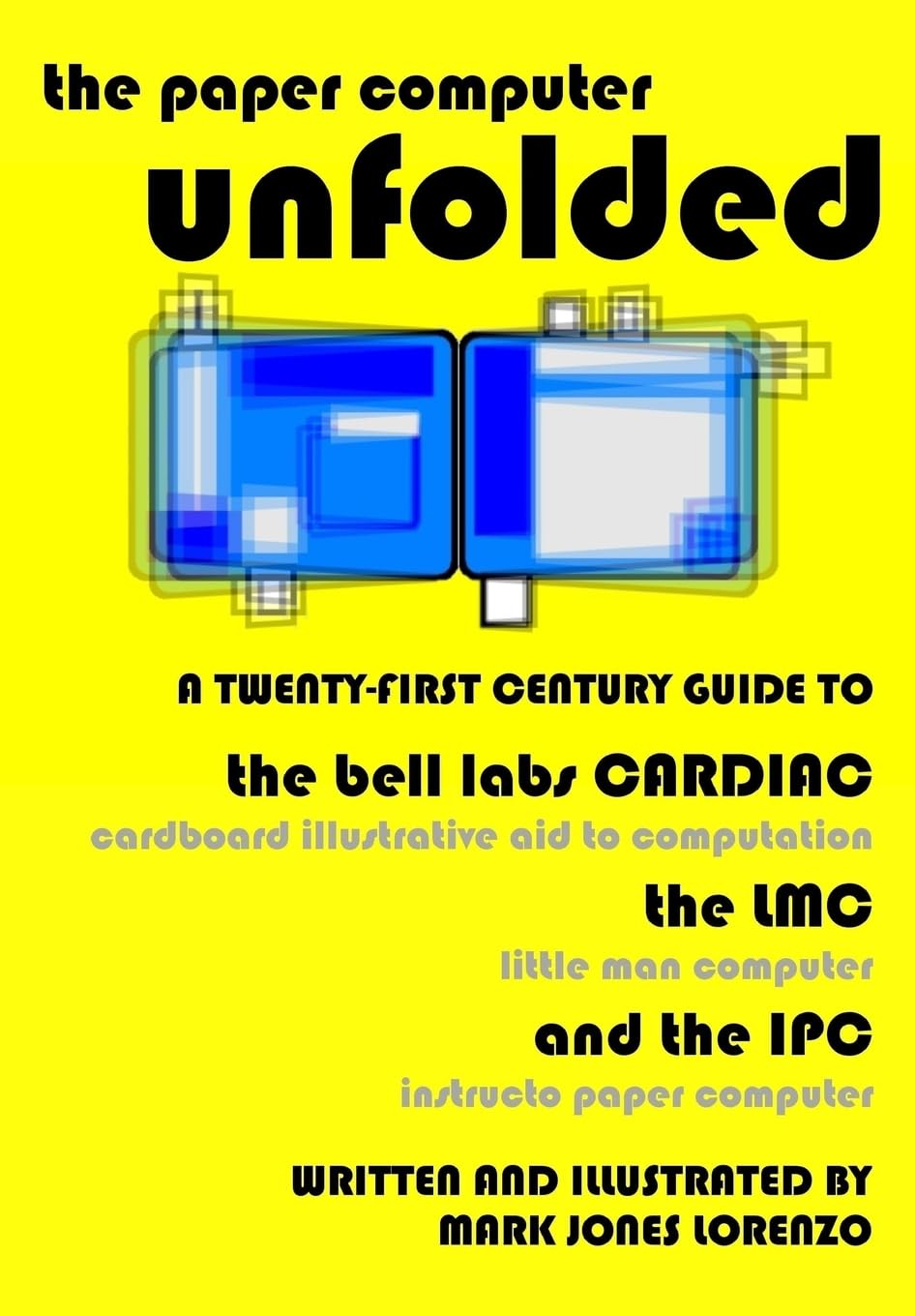
Title
The Paper Computer Unfolded: A Twentyfirst Century Guide To The Bell Labs Cardiac (Cardboard Illustrative Aid To Computation),
Sold by Ergodebooks, an authorized reseller.
Returns accepted within 30 days | support@ergodebooks.com
Shipping Information
- Free Standard Shipping — United States only
- Processing Time: 3–5 business days
- Estimated Delivery: 6–10 business days after dispatch
- Double-boxed, fully insured & discreetly packaged
- Tracking number sent via email once dispatched
Returns & Refund
Returns accepted within 30 days of delivery.
Damaged or Defective Item
Free return shipping + replacement or full refund
Wrong Item Received
Free return shipping + replacement or full refund
Change of Mind
Return shipping at customer's expense · 25% restocking fee applies
Payment Option

The Paper Computer Unfolded Reveals The Untold True Story Of Three Fully Programmable Computers That Were Made Of Nothing More Than Paper, Cardboard, A Bit Of Glue, And A Lot Of Imagination.From Transistors To Lasers, From Radio Astronomy To The Solar Battery Cell, And From The C Programming Language To Information Theory, Through Much Of The Twentieth Century Bell Telephone Laboratories Was The Birthplace Of The Future. But Just As Important As What The Scientists And Mathematicians At Bell Labs Invented Were Their Clever Promotional Efforts Describing The Nature Of Their Work. For Instance, In The 1960S Bell Distributed Selfpromotional Advertisements In The Form Of Free Scientific And Technology Kits To Teachers And Students In Middle And High Schools Nationwide. One Kit Focused On Transistors; Another, On Solar Energy; And Yet Another, On Crystals And Light.By The End Of The Sixties, Many High School Students Received Their First Exposure To Computers Courtesy Of The Understanding Computers Bell Labs Kit. Inside Was A Strangelooking Device Constructed Out Of Paper And Diecut Cardboard: The Cardboard Illustrative Aid To Computation (Cardiac), A Fully Programmable Computer Created By A Visionary Bell Mathematician. The Singleaddress, Singleaccumulatorbased Cardiac Needed (Rather Fittingly) Just A Single Power Source To Run Programs On Its Hardware: You. Handoperated, No Electricity Required. With The Relative Scarcity Of Electronic Computers And The Expense Of Computer Time, There Was Perhaps No Better Teaching Tool Than The Cardiac.The Story Of The Paper Computer, However, Doesnt End With The Cardiac; In Fact, It Probably Doesnt Even Begin With It. Several Years Before Bell Labs Released Their Understanding Computers Kit, A Young Massachusetts Institute Of Technology Doctoral Student Developed His Own Instructional Model: The Little Man Computer (Lmc). With A Design And Instruction Set Quite Similar To The Cardiac, The Lmcrequiring Nothing More Than Paper And Pencil To Run Programsquickly Caught On At Mit, Where It Was Taught To All Undergraduates Studying Computers. Decades Later, The Lmc Paradigm, In Various Incarnations, Still Persists In Computer Science Curricula Around The Country.And Improbably, Despite The Ascension And Growing Availability Of Cheap Microcomputers By The Late 1970S, A Third Paper Computer, Called The Instructo, Was Patented And Released. If The Cardiac Was A Product Of The Research Lab And The Lmc A Product Of The Ivory Tower, The Instructo Was A True Product Of The Classroom: It Was Developed By A Prolific Mathematics Teacher Who Knew A Thing Or Two About Teaching Computers To Middle And High School Students. Vastly Different From The Other Two Machines, The Instructo Paper Computer (Ipc) Has A Large Instruction Set And Multiple Registers And Switches Powering Its Cardboard Components. But Like The Cardiac And The Lmc, The Ipc Models A Von Neumann Architecture, Albeit Also Without The Need For An Electric Power Source.Tracing Their Origins To The Early Calculating Machines Of Pascal And Babbage, Through The Groundbreaking Computational Theories Of Turing And Von Neumann, To The First Electromechanical And Electronic Computers, And Finally To The Influence Of Other Instructional Models Like The Tutorial Automatic Computer (Tutac) And The Infamous Paperclip Computer, The Paper Computer Unfolded Is The Most Thoroughly Researched Book Available On The Design And Development Of The Cardiac, The Lmc, And The Ipc.Mark Jones Lorenzo'S Eminently Readable Book, Which Fuses The Technical Jargon Of A Computer Manual With The Prose Of A True Pageturner, Also Contains Many Example Paper Computer Programs Written In Both Machine And Assembly Language, Code Listings Of Emulators For All Three Machines, As Well As Cartoon Illustrations Paying Homage To The Innovative Cardiac Manual.
⚠️ WARNING (California Proposition 65):
This product may contain chemicals known to the State of California to cause cancer, birth defects, or other reproductive harm.
For more information, please visit www.P65Warnings.ca.gov.
- Q: How many pages does the book have? A: This book contains two hundred fifty-six pages. It provides a comprehensive look at paper computers and their development.
- Q: What is the binding type of the book? A: The book is available in paperback binding. This makes it lightweight and easy to handle.
- Q: What are the dimensions of the book? A: The dimensions of the book are six point six nine inches in length, zero point five nine inches in thickness, and nine point six one inches in height.
- Q: Who is the author of this book? A: The author is Mark Jones Lorenzo. He combines technical knowledge with engaging storytelling in this book.
- Q: What topics does the book cover? A: The book covers the history of three paper computers and the evolution of computational theory. It discusses the CARDIAC, LMC, and IPC.
- Q: What is the age suitability for this book? A: The book is suitable for high school students and above. It provides detailed insights into computer science history.
- Q: How can I use this book for educational purposes? A: You can use this book as a supplemental resource for teaching computer science concepts. It includes examples of paper computer programs.
- Q: Is this book suitable for beginners in computer science? A: Yes, this book is suitable for beginners. It explains fundamental concepts in an accessible manner.
- Q: Are there any hands-on activities in the book? A: Yes, the book includes examples of paper computer programs. These can be used for practical demonstrations.
- Q: How should I store this book to keep it in good condition? A: Store the book in a cool, dry place away from direct sunlight. This will help preserve its quality.
- Q: Can I clean the book if it gets dirty? A: Yes, you can clean the book gently with a dry cloth. Avoid using water or cleaning solutions.
- Q: What if the book arrives damaged? A: If the book arrives damaged, you should contact customer support for a return or exchange. Keep the original packaging if possible.
- Q: Is there a warranty for the book? A: Books typically do not come with a warranty. However, you can check the seller's return policy.
- Q: How can I find out more about the author? A: You can search for Mark Jones Lorenzo online for more information about his works and background.
- Q: Is this book part of a series? A: No, this book is a standalone title. It focuses exclusively on the history of paper computers.