
Title

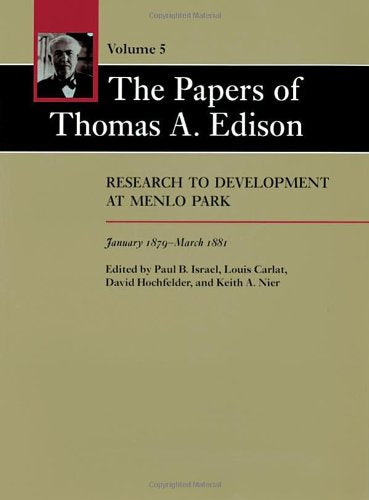
The Papers of Thomas A. Edison: Research to Development at Menlo Park, January 1879March 1881 (Volume 5),Used
Sold by Ergodebooks, an authorized reseller.
Returns accepted within 30 days | support@ergodebooks.com
Shipping Information
- Free Standard Shipping — United States only
- Processing Time: 3–5 business days
- Estimated Delivery: 6–10 business days after dispatch
- Double-boxed, fully insured & discreetly packaged
- Tracking number sent via email once dispatched
Returns & Refund
Returns accepted within 30 days of delivery.
Damaged or Defective Item
Free return shipping + replacement or full refund
Wrong Item Received
Free return shipping + replacement or full refund
Change of Mind
Return shipping at customer's expense · 25% restocking fee applies
Payment Option

The fifth volume of The Papers of Thomas A. Edison covers Edison's invention and development of the first commercial incandescent electric light and power system. In the process he turned his famed Menlo Park laboratory into the first true research and development facility. This also enabled him to develop a new telephone for the British market in the midst of his herculean efforts on electric lighting.In the face of daunting technical challenges and skepticism from leading scientists and engineers, Edison and his team of experimenters and machinists found the solution to the decadesold problem of creating a practical incandescent lamp. By focusing on the characteristics of the entire system Edison reconceptualized the requirements of a successful lamp design. While rivals worked primarily on lamps, Edison developed other parts of a complete system as well. This approach was most notable in his revolutionary work on generator technology, one of the highlights of this volume. Successful exhibitions of the system in December 1879 drew crowds to Menlo Park to witness the softly glowing lamps. These spectacles gratified his financial backers but Edison realized the importance of following experimental demonstrations with the hard work of commercial development. He needed to make each component work effectively in daily use and to improve the designs so that they were easy to use and inexpensive to manufacture. To create a daytime market for electricity he also developed electric motors for a variety of uses, including electric railways, for which he built a small demonstration line at Menlo Park. To accomplish all this Edison greatly enlarged his staff to as many as sixty experimenters, machinists, carpenters, and office workers. He began manufacturing lamps at a factory in Menlo Park. At the end of 1880, Edison was ready to move his system into commercial production and made plans to produce other components in New York. He also invited New York officials to a demonstration in order to win their approval for running underground lines in lower Manhattan where he planned to put his first commercial central station. In March 1881, he moved to the Edison Electric Light Company's headquarters on Fifth Avenue and began the hard work of introducing the new electric light and power technology.
⚠️ WARNING (California Proposition 65):
This product may contain chemicals known to the State of California to cause cancer, birth defects, or other reproductive harm.
For more information, please visit www.P65Warnings.ca.gov.