If you have any questions, you are always welcome to contact us. We'll get back to you as soon as possible, withing 24 hours on weekdays.
Customer service
All questions about your order, return and delivery must be sent to our customer service team by e-mail at yourstore@yourdomain.com
Sale & Press
If you are interested in selling our products, need more information about our brand or wish to make a collaboration, please contact us at press@yourdomain.com
Help
If you have any questions, you are always welcome to contact us. We'll get back to you as soon as possible, withing 24 hours on weekdays.
Customer service
All questions about your order, return and delivery must be sent to our customer service team by e-mail at yourstore@yourdomain.com
Sale & Press
If you are interested in selling our products, need more information about our brand or wish to make a collaboration, please contact us at press@yourdomain.com
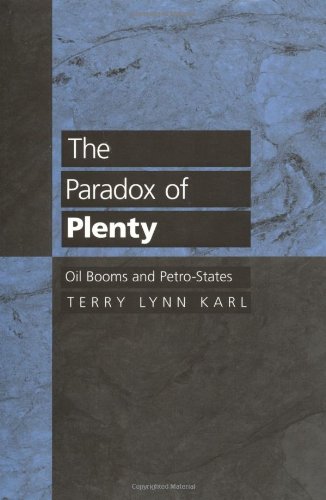
The Paradox of Plenty explains why, in the midst of two massive oil booms in the 1970s, oilexporting governments as different as Venezuela, Iran, Nigeria, Algeria, and Indonesia chose common development paths and suffered similarly disappointing outcomes. Meticulously documented and theoretically innovative, this book illuminates the manifold factorseconomic, political, and socialthat determine the nature of the oil state, from the coherence of public bureaucracies, to the degree of centralization, to patterns of policymaking.Karl contends that oil countries, while seemingly disparate, are characterized by similar social classes and patterns of collective action. In these countries, dependence on petroleum leads to disproportionate fiscal reliance on petrodollars and public spending, at the expense of statecraft. Oil booms, which create the illusion of prosperity and development, actually destabilize regimes by reinforcing oilbased interests and further weakening state capacity.Karl's incisive investigation unites structural and choicebased approaches by illuminating how decisions of policymakers are embedded in institutions interacting with domestic and international markets. This approachwhich Karl dubs 'structured contingency'uses a state's leading sector as the starting point for identifying a range of decisionmaking choices, and ends by examining the dynamics of the state itself.
⚠️ WARNING (California Proposition 65):
This product may contain chemicals known to the State of California to cause cancer,
birth defects, or other reproductive harm.
For MAP (Minimum Advertised Price) violations and Intellectual Property (IP) or Trademark concerns, please contact:
support@ergodebooks.com
⚠️ California Proposition 65 Warning: Some products sold on this website may expose you to chemicals known to the State of California to cause cancer, birth defects, or other reproductive harm. For more information, visit www.P65Warnings.ca.gov.