
Title
The People's Property?,New
Sold by Ergodebooks, an authorized reseller.
Returns accepted within 30 days | support@ergodebooks.com
Shipping Information
- Free Standard Shipping — United States only
- Processing Time: 3–5 business days
- Estimated Delivery: 6–10 business days after dispatch
- Double-boxed, fully insured & discreetly packaged
- Tracking number sent via email once dispatched
Returns & Refund
Returns accepted within 30 days of delivery.
Damaged or Defective Item
Free return shipping + replacement or full refund
Wrong Item Received
Free return shipping + replacement or full refund
Change of Mind
Return shipping at customer's expense · 25% restocking fee applies
Payment Option

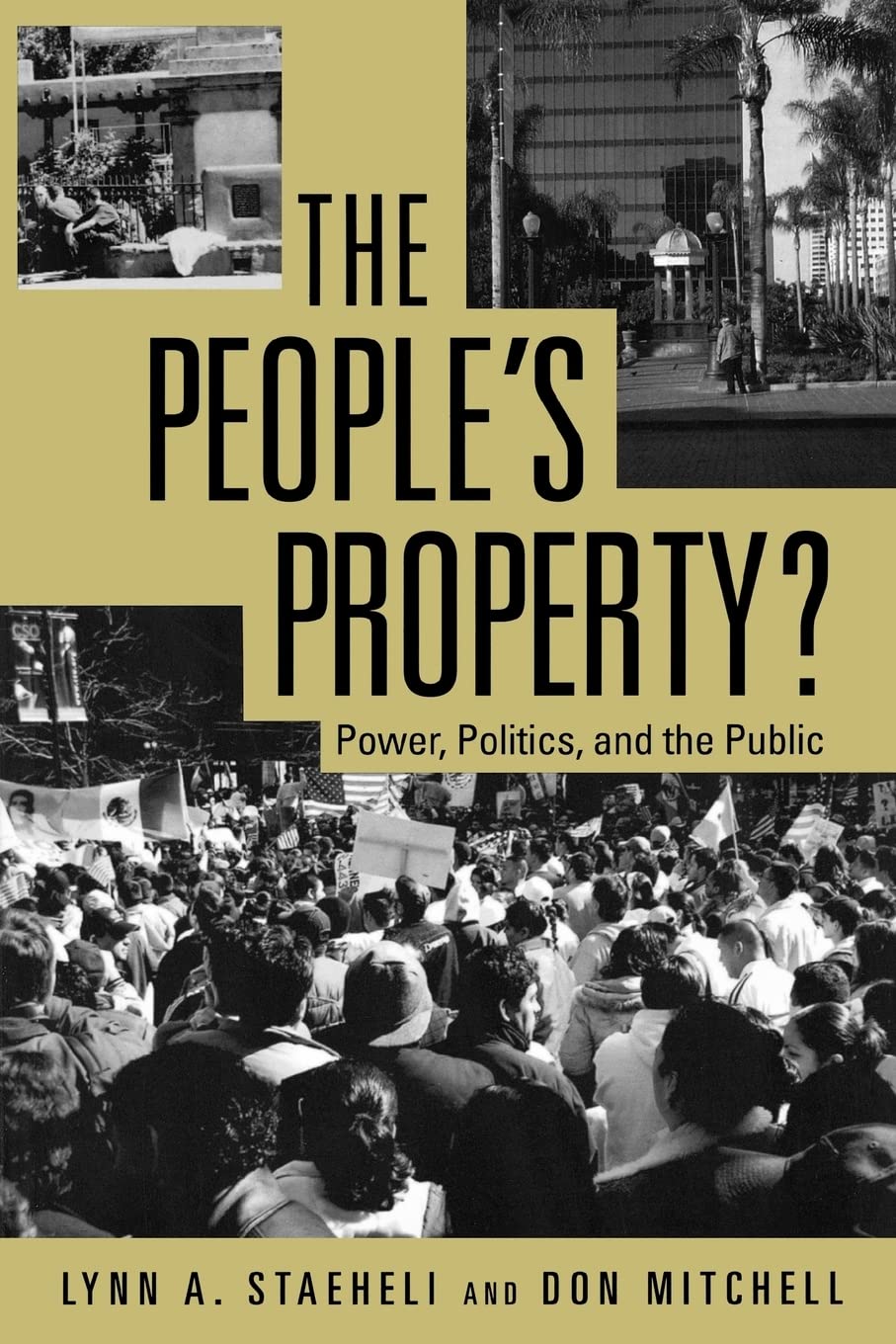
The Peoples Property? is the first booklength scholarly examination of how negotiations over the ownership, control, and peopling of public space are central to the development of publicity, citizenship, and democracy in urban areas. The book asks the questions: Why does it matter who owns public property? Who controls it? Who is in it? Donald Mitchell and Lynn A. Staeheli answer the questions by focusing on the interplay between property (in its geographical sense, as a parcel of owned space) and people. Property rights are often defined as the 'right to exclude.' It is important, therefore, to understand who (what individual and corporate entities, governed by what kinds of regulations and restrictions) owns publicly accessible property. It is likewise important to understand the changing bases for excluding some people and classes of people from otherwise publicly accessible property. That is to say, it is important to understand how modes of access and possibilities for association in publicly accessible space vary for different individuals and different classes of people, if we are to understand the role public spaces play in shaping democratic possibilities. In what ways are urban public spaces 'the peoples property' and in what ways are they not? What does this mean for citizenship and the constitution of an inclusive, democratic polity? The book develops its argument through five case studies: protest in Washington DC; struggles over the Plaza of Santa Fe, NM; homelessness and property redevelopment in San Diego, CA; the enclosure of public space in a mall in Syracuse, NY; and community gardens in New York City. Though empirically focused on the US, the book is of broader interests as publics in all liberal democracies are undergoing rapid reconsideration and transformation.
⚠️ WARNING (California Proposition 65):
This product may contain chemicals known to the State of California to cause cancer, birth defects, or other reproductive harm.
For more information, please visit www.P65Warnings.ca.gov.