
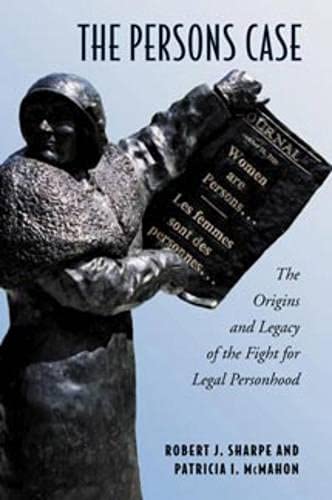
Title
The Persons Case: The Origins and Legacy of the Fight for Legal Personhood (Osgoode Society for Canadian Legal History),Used
Sold by Ergodebooks, an authorized reseller.
Returns accepted within 30 days | support@ergodebooks.com
Shipping Information
- Free Standard Shipping — United States only
- Processing Time: 3–5 business days
- Estimated Delivery: 6–10 business days after dispatch
- Double-boxed, fully insured & discreetly packaged
- Tracking number sent via email once dispatched
Returns & Refund
Returns accepted within 30 days of delivery.
Damaged or Defective Item
Free return shipping + replacement or full refund
Wrong Item Received
Free return shipping + replacement or full refund
Change of Mind
Return shipping at customer's expense · 25% restocking fee applies
Payment Option

On 18 October 1929, John Sankey, England's reformminded Lord Chancellor, ruled in the Persons case that women were eligible for appointment to Canada's Senate. Initiated by Edmonton judge Emily Murphy and four other activist women, the Persons case challenged the exclusion of women from Canada's upper house and the idea that the meaning of the constitution could not change with time. The Persons Case considers the case in its political and social context and examines the lives of the key Emily Murphy, Nellie McClung, and the other members of the 'famous five,' the politicians who opposed the appointment of women, the lawyers who argued the case, and the judges who decided it. Robert J. Sharpe and Patricia I. McMahon examine the Persons case as a pivotal moment in the struggle for women's rights and as one of the most important constitutional decisions in Canadian history. Lord Sankey's decision overruled the Supreme Court of Canada's judgment that the courts could not depart from the original intent of the framers of Canada's constitution in 1867. Describing the constitution as a 'living tree,' the decision led to a reassessment of the nature of the constitution itself. After the Persons case, it could no longer be viewed as fixed and unalterable, but had to be treated as a document that, in the words of Sankey, was in 'a continuous process of evolution.' The Persons Case is a comprehensive study of this important event, examining the case itself, the ruling of the Privy Council, and the profound affect that it had on women's rights and the constitutional history of Canada.
⚠️ WARNING (California Proposition 65):
This product may contain chemicals known to the State of California to cause cancer, birth defects, or other reproductive harm.
For more information, please visit www.P65Warnings.ca.gov.
- Q: What is the main focus of 'The Persons Case'? A: 'The Persons Case' explores the legal and social implications of the 1929 ruling that recognized women as eligible for appointment to Canada's Senate, highlighting the contributions of key figures like Emily Murphy and Nellie McClung.
- Q: Who are the authors of this book? A: The book is authored by Robert J. Sharpe and Patricia I. McMahon, both esteemed scholars in Canadian legal history.
- Q: What is the publication date of 'The Persons Case'? A: 'The Persons Case' was published on October 13, 2007, as a first edition.
- Q: How many pages does this book have? A: The book contains 272 pages, providing an in-depth exploration of its subject.
- Q: What type of binding does this book have? A: 'The Persons Case' is available in hardcover binding, which offers durability and a professional appearance.
- Q: What condition is the book in? A: The book is listed as 'New', ensuring that it is in pristine condition for readers.
- Q: Is there a specific edition of the book? A: Yes, this book is a first edition, which may include unique features or insights not present in later editions.
- Q: What are some key themes discussed in the book? A: Key themes include women's rights, constitutional evolution, and the historical impact of the Persons case on Canadian society.
- Q: Who were the 'famous five' mentioned in the book? A: The 'famous five' refers to Emily Murphy, Nellie McClung, Irene Parlby, Louise McKinney, and Henrietta Muir Edwards, who were pivotal in advocating for women's legal personhood.
- Q: What is the significance of the decision discussed in the book? A: The decision in the Persons case is significant as it reshaped the understanding of the Canadian constitution, establishing that it is a 'living tree' subject to interpretation and change over time.