
Title
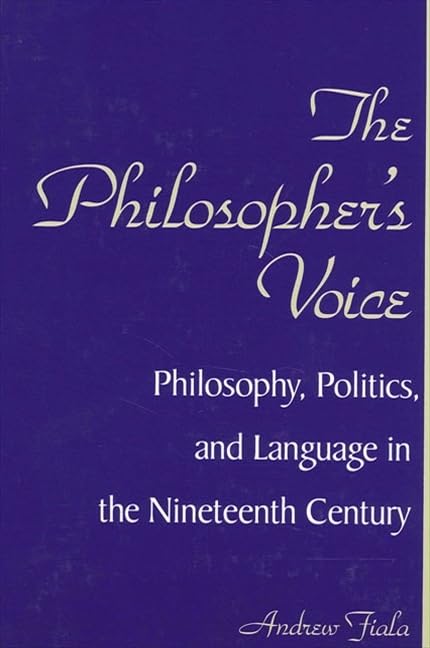
The Philosopher's Voice: Philosophy, Politics, and Language in the Nineteenth Century (Suny Series in Philosophy),Used
Sold by Ergodebooks, an authorized reseller.
Returns accepted within 30 days | support@ergodebooks.com
Shipping Information
- Free Standard Shipping — United States only
- Processing Time: 3–5 business days
- Estimated Delivery: 6–10 business days after dispatch
- Double-boxed, fully insured & discreetly packaged
- Tracking number sent via email once dispatched
Returns & Refund
Returns accepted within 30 days of delivery.
Damaged or Defective Item
Free return shipping + replacement or full refund
Wrong Item Received
Free return shipping + replacement or full refund
Change of Mind
Return shipping at customer's expense · 25% restocking fee applies
Payment Option

Product Description Explores the relationship between philosophy and politics in the work of Kant, Fichte, Hegel, and Marx. Review Fialas engaging style is itself a useful aid to the reader as he revisits and restates the positions of these philosophers to bring out both differences and similarities among them. Journal of Speculative PhilosophyFiala has an imaginative and creative thesis: that a philosopher writes out of a concrete political perspective, and that the philosophers he studies are therefore aware of the role they play in the political arena, even if they may also claim to be speaking sub speci aeternitatis. John W. Burbidge, author of Hegel on Logic and Religion: The Reasonableness of ChristianityThis topic is significant and important, since the relation of philosophy and politics has been raised anew recently in a number of waysthrough the adventures of Martin Heidegger with Nazism, through Habermass social theory, and through the emergence of a number of important political thinkers in the continental side of the discussion here and abroad. Tom Rockmore, editor of New Essays on the Precritical Kant From the Back Cover This analysis of the relationship between philosophy and politics recognizes that political philosophers must continually struggle to distinguish their voices from others that clamor within political life. Author Andrew Fiala asks whether it is possible to maintain a distinction between philosophical speech and other political and poetic language. His answer is that philosophy distinguishes itself from politics by its methodological selfconsciousness of the nature of its voice. By focusing on the different ways in which this methodological norm was enacted in the lives and work of Kant, Fichte, Hegel, and Marx, the author puts the problem in a larger context and considers the roles that these thinkers played in the political history of the nineteenth century. About the Author Andrew Fiala is Assistant Professor of Philosophy and Humanistic Studies at the University of Wisconsin, Green Bay.
⚠️ WARNING (California Proposition 65):
This product may contain chemicals known to the State of California to cause cancer, birth defects, or other reproductive harm.
For more information, please visit www.P65Warnings.ca.gov.