If you have any questions, you are always welcome to contact us. We'll get back to you as soon as possible, withing 24 hours on weekdays.
Customer service
All questions about your order, return and delivery must be sent to our customer service team by e-mail at yourstore@yourdomain.com
Sale & Press
If you are interested in selling our products, need more information about our brand or wish to make a collaboration, please contact us at press@yourdomain.com
Help
If you have any questions, you are always welcome to contact us. We'll get back to you as soon as possible, withing 24 hours on weekdays.
Customer service
All questions about your order, return and delivery must be sent to our customer service team by e-mail at yourstore@yourdomain.com
Sale & Press
If you are interested in selling our products, need more information about our brand or wish to make a collaboration, please contact us at press@yourdomain.com
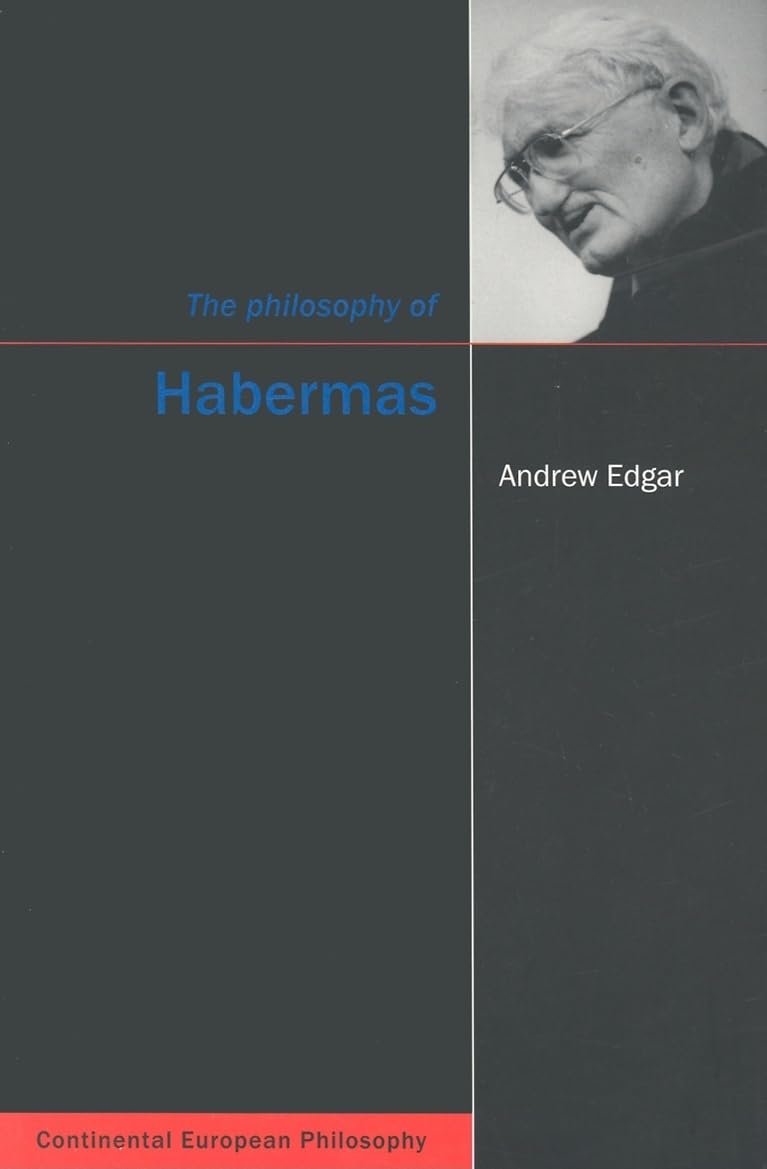
This comprehensive introduction to the thought of Jurgen Habermas covers the full range of his ideas from his early work on student politics to his recent work on communicative action, ethics and law. Andrew Edgar examines Habermas' key texts in chronological order, revealing the developments, shifts and turns in Habermas' thinking as he refines his basic insights and incorporates new sources and ideas. Some of the themes discussed include Habermas' early reshaping of Marxist theory and practice, his characterization of critical theory, his conception of universal pragmatics, his theories of communicative action and discourse ethics, and his defence of the project of modernity. Edgar offers much more than a schematic run through of Habermas' big ideas. He deals in detail with Habermas' arguments in order to demonstrate how he weaves together multiple strands of thought, and he usefully situates Habermas' ideas within the contexts of the history of German philosophy, the history of sociology, and within contemporary debates in both continental and analytic philosophy. By engaging with some of Habermas' key critics and contrasting his views with the ideas of contemporaries, Edgar is able to give a clear sense of Habermas' place and importance in contemporary philosophy and social theory.
⚠️ WARNING (California Proposition 65):
This product may contain chemicals known to the State of California to cause cancer,
birth defects, or other reproductive harm.
For MAP (Minimum Advertised Price) violations and Intellectual Property (IP) or Trademark concerns, please contact:
support@ergodebooks.com
⚠️ California Proposition 65 Warning: Some products sold on this website may expose you to chemicals known to the State of California to cause cancer, birth defects, or other reproductive harm. For more information, visit www.P65Warnings.ca.gov.