
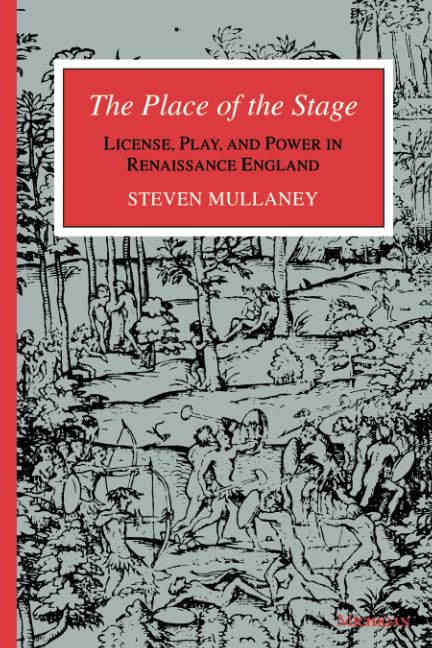
Title

The Place of the Stage: License, Play, and Power in Renaissance England,New
Sold by Ergodebooks, an authorized reseller.
Returns accepted within 30 days | support@ergodebooks.com
Shipping Information
- Free Standard Shipping — United States only
- Processing Time: 3–5 business days
- Estimated Delivery: 6–10 business days after dispatch
- Double-boxed, fully insured & discreetly packaged
- Tracking number sent via email once dispatched
Returns & Refund
Returns accepted within 30 days of delivery.
Damaged or Defective Item
Free return shipping + replacement or full refund
Wrong Item Received
Free return shipping + replacement or full refund
Change of Mind
Return shipping at customer's expense · 25% restocking fee applies
Payment Option

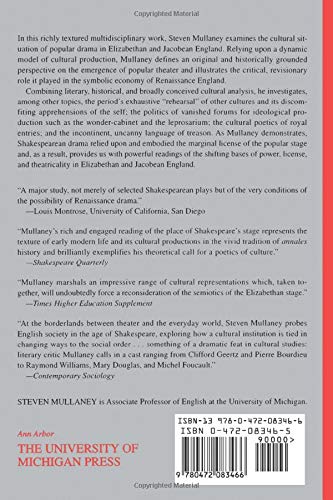
In this richly textured multidisciplinary work, Steven Mullaney examines the cultural situation of popular drama in Elizabethan and Jacobean England. Relying upon a dynamic model of cultural production, Mullaney defines an original and historically grounded perspective on the emergence of popular theater and illustrates the critical, revisionary role it played in the symbolic economy of Renaissance England.Combining literary, historical, and broadly conceived cultural analysis, he investigates, among other topics, the period's exhaustive 'rehearsal' of other cultures and its discomfiting apprehensions of the self; the politics of vanished forums for ideological production such as the wondercabinet and the leprosarium; the cultural poetics of royal entries; and the incontinent, uncanny language of treason. As Mullaney demonstrates, Shakespearean drama relied upon and embodied the marginal license of the popular stage and, as a result, provides us with powerful readings of the shifting bases of power, license, and theatricality in Elizabethan and Jacobean England.'A major study, not merely of selected Shakespearean plays but of the very conditions of the possibility of Renaissance drama.' Louis Montrose, University of California, San Diego'Mullaney's rich and engaged reading of the place of Shakespeare's stage represents the texture of early modern life and its cultural productions in the vivid tradition of annales history and brilliantly exemplifies his theoretical call for a poetics of culture.' Shakespeare Quarterly'Mullaney marshals an impressive range of cultural representations which, taken together, will undoubtedly force a reconsideration of the semiotics of the Elizabethan stage.' Times Higher Education Supplement'. . . something of a dramatic feat in cultural studies: literary critic Mullaney calls in a cast ranging from Clifford Geertz and Pierre Bourdieu to Raymond Williams, Mary Douglas, and Michel Foucault.' Contemporary SociologySteven Mullaney is Associate Professor of English at the University of Michigan.
⚠️ WARNING (California Proposition 65):
This product may contain chemicals known to the State of California to cause cancer, birth defects, or other reproductive harm.
For more information, please visit www.P65Warnings.ca.gov.