
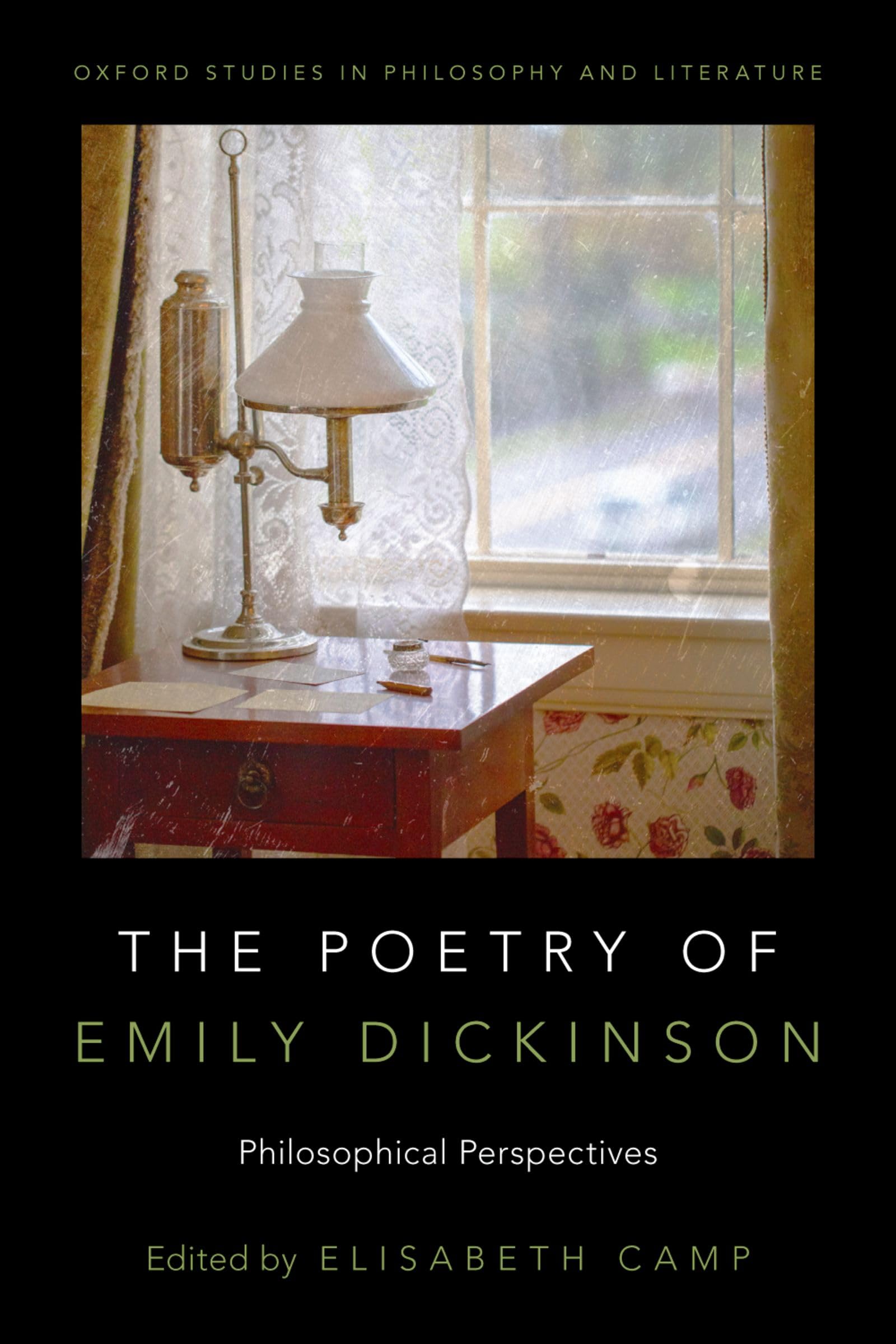
Title
The Poetry of Emily Dickinson: Philosophical Perspectives (Oxford Studies in Philosophy and Literature),Used
Sold by Ergodebooks, an authorized reseller.
Returns accepted within 30 days | support@ergodebooks.com
Shipping Information
- Free Standard Shipping — United States only
- Processing Time: 3–5 business days
- Estimated Delivery: 6–10 business days after dispatch
- Double-boxed, fully insured & discreetly packaged
- Tracking number sent via email once dispatched
Returns & Refund
Returns accepted within 30 days of delivery.
Damaged or Defective Item
Free return shipping + replacement or full refund
Wrong Item Received
Free return shipping + replacement or full refund
Change of Mind
Return shipping at customer's expense · 25% restocking fee applies
Payment Option

One of America's most celebrated poets, Emily Dickinson was virtually unpublished in her lifetime. When a slim volume of her poems emerged on the American scene in 1890, her work created shockwaves that have not subsided yet. Famously precise and sparse, Emily Dickinson's poetry is often described as philosophical, both because her poetry grapples with philosophical topics like death, spirituality, and the darkening operations of the mind, and because she approaches those topics in a characteristically philosophical manner: analyzing and extrapolating from close observation, exploring alternatives, and connecting thoughts into cumulative demonstrations. But unlike Lucretius or Pope, she cannot be accused of producing versified treatises. Many of her poems are unsettling in their lack of conclusion; their disparate insights often stand in conflict; and her logic turns crucially on imagery, juxtaposition, assonance, slant rhyme, and punctuation.The six chapters of this volume collectively argue that Dickinson is an epistemically ambitious poet, who explores fundamental questions by advancing arguments that are designed to convince. Dickinson exemplifies abstract ideas in tangible form and habituates readers into productive trains of thoughtshe doesn't just make philosophical claims, but demonstrates how poetry can make a distinct contribution to philosophy.All essays in this volume, drawn from both philosophers and literary theorists, serve as a counterpoint to recent critical work, which has emphasized Dickinson's anguished uncertainty, her nonconventional style, and the unsettled status of her manuscripts. On the view that emerges here, knowing is like cleaning, mending, and lacemakingL a form of hard, ongoing work, but one for which poetry is a powerful, perhaps indispensable, tool.
⚠️ WARNING (California Proposition 65):
This product may contain chemicals known to the State of California to cause cancer, birth defects, or other reproductive harm.
For more information, please visit www.P65Warnings.ca.gov.