
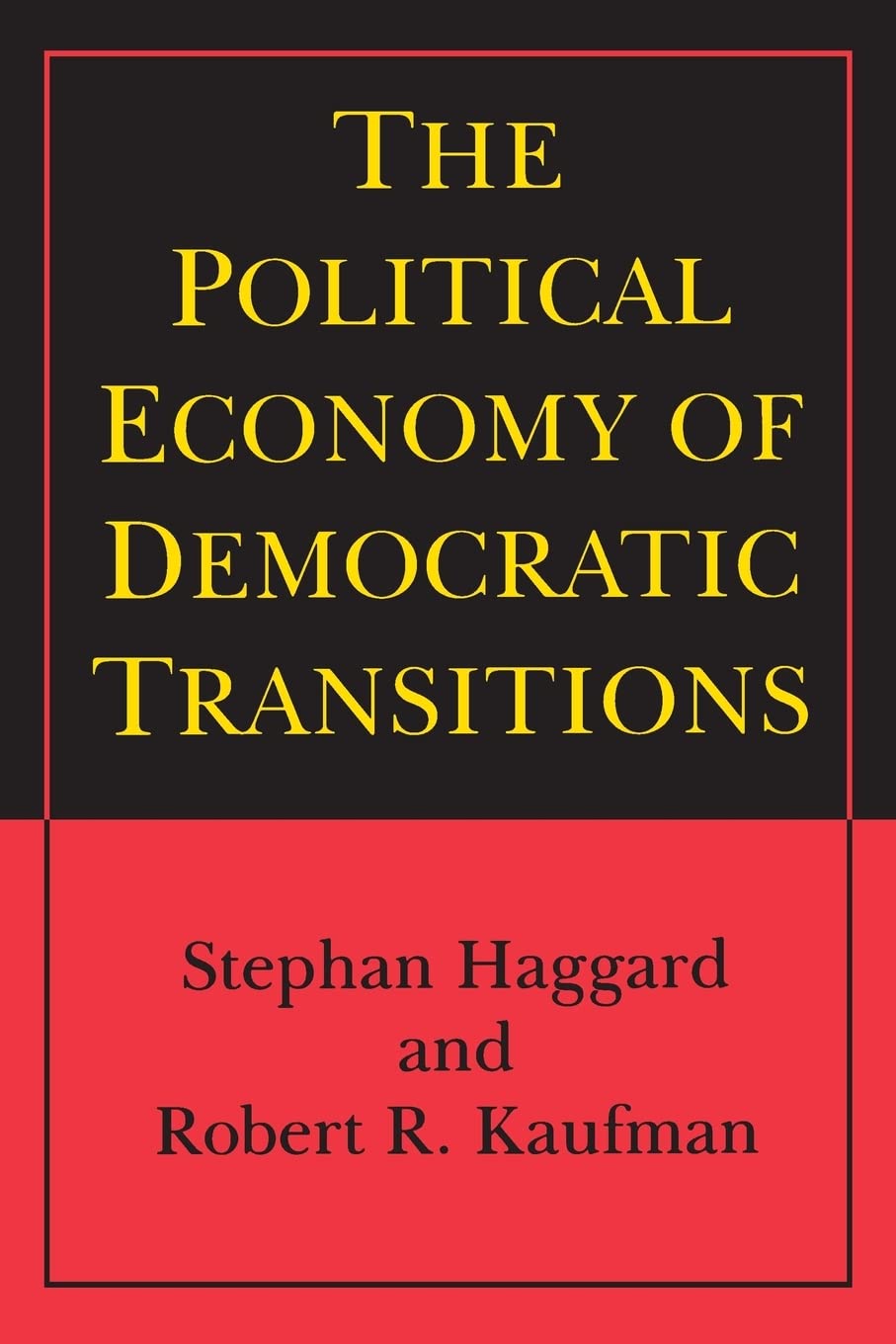
Title
The Political Economy of Democratic Transitions (Princeton Paperbacks),Used
Sold by Ergodebooks, an authorized reseller.
Returns accepted within 30 days | support@ergodebooks.com
Shipping Information
- Free Standard Shipping — United States only
- Processing Time: 3–5 business days
- Estimated Delivery: 6–10 business days after dispatch
- Double-boxed, fully insured & discreetly packaged
- Tracking number sent via email once dispatched
Returns & Refund
Returns accepted within 30 days of delivery.
Damaged or Defective Item
Free return shipping + replacement or full refund
Wrong Item Received
Free return shipping + replacement or full refund
Change of Mind
Return shipping at customer's expense · 25% restocking fee applies
Payment Option

In the last two decades, there has been a widespread movement from authoritarian to democratic rule among developing countries, often occurring against a backdrop of severe economic crises and the adoption of marketoriented reforms. The coincidence of these events raises longstanding questions about the relationship between economic and political change. In this book, Stephan Haggard and Robert Kaufman explore this relationship, addressing a variety of questions: What role have economic crises played in the current wave of political liberalization and democratization? Can new democracies manage the daunting political challenges posed by economic reform? Under what economic and institutional conditions is democracy most likely to be consolidated? Drawing on contemporary political economy and the experiences of twelve Latin American and Asian countries, they develop a new approach to understanding democratic transitions.Haggard and Kaufman first analyze the relationship between economic crisis and authoritarian withdrawal and then examine how the economic and institutional legacies of authoritarian rule affect the capacity of new democratic governments to initiate and sustain economic policy reform. Finally, the authors analyze the consolidation of political and economic reform over the long run. Throughout, they emphasize the relationship between economic conditions, the interests and power of contending social groups, and the mediating role of representative institutions, particularly political parties.
⚠️ WARNING (California Proposition 65):
This product may contain chemicals known to the State of California to cause cancer, birth defects, or other reproductive harm.
For more information, please visit www.P65Warnings.ca.gov.
- Q: How many pages does the book have? A: This book has three hundred seventy-six pages. It provides an in-depth exploration of political economy and democratic transitions.
- Q: What is the binding type of this book? A: The book is available in paperback binding. This makes it lightweight and flexible for easy reading.
- Q: What is the size of this book? A: The book measures six point four two inches in length, one point zero two inches in width, and nine point one inches in height. These dimensions make it a comfortable size for handling.
- Q: Who is the author of this book? A: The book is authored by Stephan Haggard. He is known for his research in political economy and democratic transitions.
- Q: What is the main topic of this book? A: The main topic of this book is the political economy of democratic transitions. It examines the relationship between economic crises and democratization.
- Q: Is this book suitable for beginners in political science? A: Yes, this book is suitable for beginners. It provides a comprehensive overview of democratic transitions in accessible language.
- Q: Can this book help me understand economic reforms in new democracies? A: Yes, it addresses how new democracies can manage economic reforms. It highlights the challenges and institutional conditions for successful reform.
- Q: What kind of insights does this book offer? A: The book offers insights into the relationship between economic conditions and political change. It draws on experiences from multiple countries.
- Q: How should I store this book to keep it in good condition? A: Store the book in a cool, dry place away from direct sunlight. This helps preserve the binding and pages.
- Q: Is this book in good condition if used? A: Yes, it is classified as a used book in good condition. It should have minimal wear and be readable.
- Q: What if the book arrives damaged? A: If the book arrives damaged, you can return it for a full refund. Ensure to follow the return policy guidelines provided.
- Q: Are there any safety concerns with this book? A: No, there are no safety concerns associated with this book. It is a standard paperback publication.
- Q: Is this book relevant for understanding Latin American politics? A: Yes, it includes case studies from Latin American countries. This makes it relevant for understanding their political economies.
- Q: Will this book be useful for my research on democratization? A: Yes, this book is an excellent resource for research on democratization. It provides theoretical frameworks and empirical data.
- Q: What makes this book stand out among others on the same topic? A: This book stands out for its comprehensive analysis and inclusion of diverse country experiences. It offers a detailed exploration of political and economic reform.
- Q: Is the content of this book based on recent data? A: Yes, the content is based on contemporary political economy research. It reflects the latest understanding of democratic transitions.