
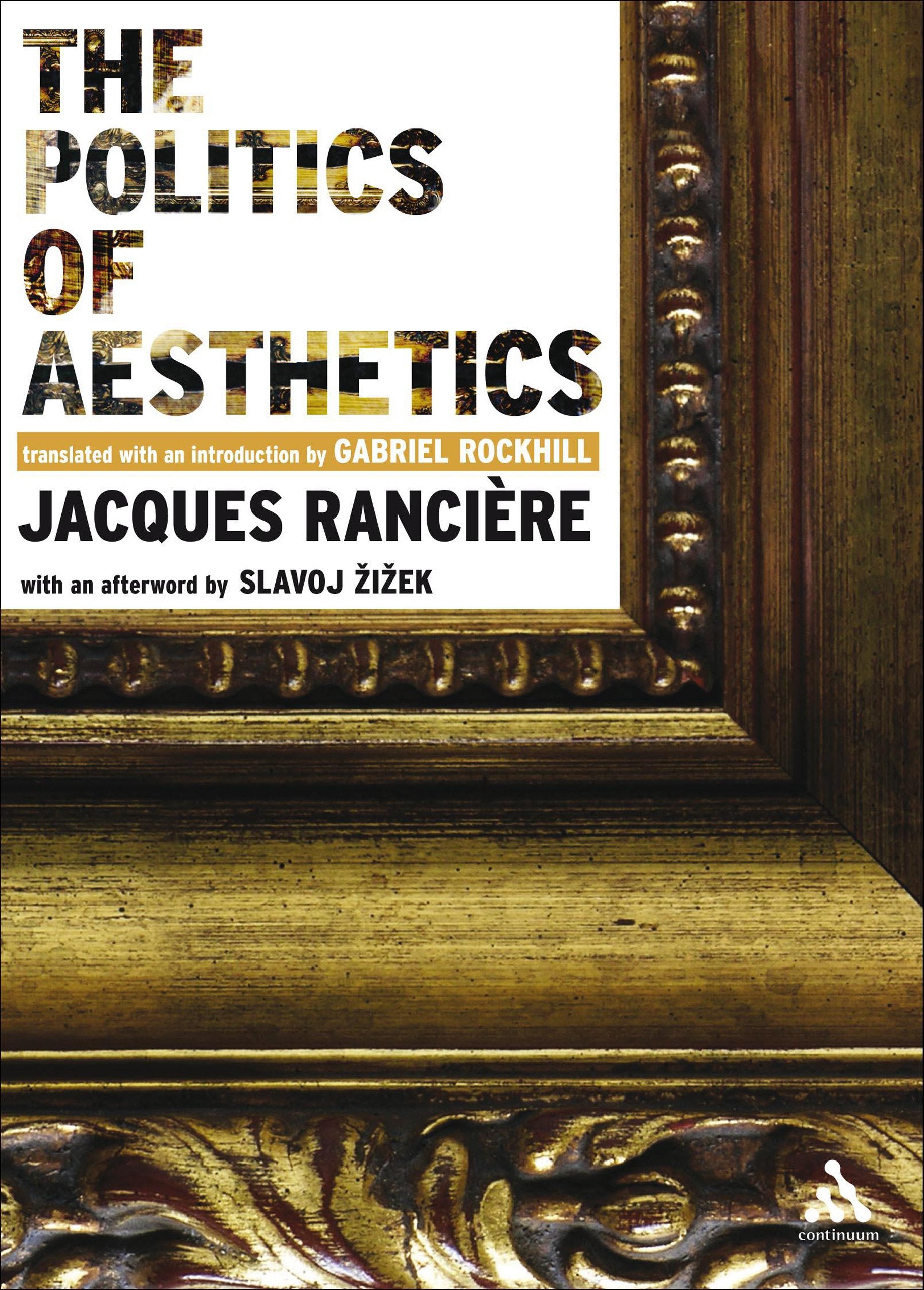
Title
The Politics of Aesthetics,New
Sold by Ergodebooks, an authorized reseller.
Returns accepted within 30 days | support@ergodebooks.com
Shipping Information
- Free Standard Shipping — United States only
- Processing Time: 3–5 business days
- Estimated Delivery: 6–10 business days after dispatch
- Double-boxed, fully insured & discreetly packaged
- Tracking number sent via email once dispatched
Returns & Refund
Returns accepted within 30 days of delivery.
Damaged or Defective Item
Free return shipping + replacement or full refund
Wrong Item Received
Free return shipping + replacement or full refund
Change of Mind
Return shipping at customer's expense · 25% restocking fee applies
Payment Option

The Politics of Aesthetics rethinks the relationship between art and politics, reclaiming 'aesthetics' from the narrow confines it is often reduced to. Jacques Rancire reveals its intrinsic link to politics by analysing what they both have in common: the delimitation of the visible and the invisible, the audible and the inaudible, the thinkable and the unthinkable, the possible and the impossible.Presented as a set of interlinked interviews, The Politics of Aesthetics provides the most comprehensive introduction to Rancire's work to date, ranging across the history of art and politics from the Greek polis to the aesthetic revolution of the modern age.Already translated into five languages, this English edition of The Politics of Aesthetics includes a new afterword by Slavoj Zizek, an interview for the English edition, a glossary of technical terms and an extensive bibliography.
⚠️ WARNING (California Proposition 65):
This product may contain chemicals known to the State of California to cause cancer, birth defects, or other reproductive harm.
For more information, please visit www.P65Warnings.ca.gov.
- Q: How many pages does The Politics of Aesthetics have? A: This book has one hundred twelve pages. It provides an in-depth exploration of the connection between art and politics.
- Q: What is the binding type of The Politics of Aesthetics? A: The binding type is paperback. This makes it lightweight and easy to handle for reading.
- Q: What are the dimensions of The Politics of Aesthetics? A: The dimensions are four point nine inches in length, zero point six inches in width, and seven point seven two inches in height. These compact dimensions make it portable.
- Q: Who is the author of The Politics of Aesthetics? A: The author is Jacques Rancière. He examines the interplay between aesthetics and politics throughout the book.
- Q: What category does The Politics of Aesthetics fall under? A: It falls under the Aesthetics category. The book discusses the philosophical aspects of art and political thought.
- Q: Is The Politics of Aesthetics suitable for beginners? A: Yes, it is suitable for beginners. The book provides a comprehensive introduction to Rancière's work, making it accessible.
- Q: How do I read The Politics of Aesthetics? A: You can read it as a series of inter-linked interviews. This format helps in understanding complex ideas in a conversational manner.
- Q: What age group is The Politics of Aesthetics appropriate for? A: It is appropriate for adults and mature teens. The themes discussed are intended for a more advanced audience.
- Q: How should I store The Politics of Aesthetics? A: Store it in a cool, dry place. Keeping it away from direct sunlight will help preserve the quality of the paperback.
- Q: Can I clean the pages of The Politics of Aesthetics? A: No, do not clean the pages. Instead, handle the book with clean hands to avoid smudging or damaging the pages.
- Q: What if The Politics of Aesthetics arrives damaged? A: You can return it for a replacement or refund. Ensure to check the return policy for specific instructions.
- Q: Is there a glossary included in The Politics of Aesthetics? A: Yes, there is a glossary of technical terms. This feature aids readers in understanding complex concepts.
- Q: Does The Politics of Aesthetics have an interview for the English edition? A: Yes, it includes an interview specifically for the English edition. This provides additional insights into Rancière's ideas.
- Q: What is the primary focus of The Politics of Aesthetics? A: The primary focus is on the relationship between art and politics. Rancière discusses how aesthetics is intertwined with political thought.
- Q: Is The Politics of Aesthetics available in multiple languages? A: Yes, it has been translated into five languages. This makes Rancière's work accessible to a broader audience.