
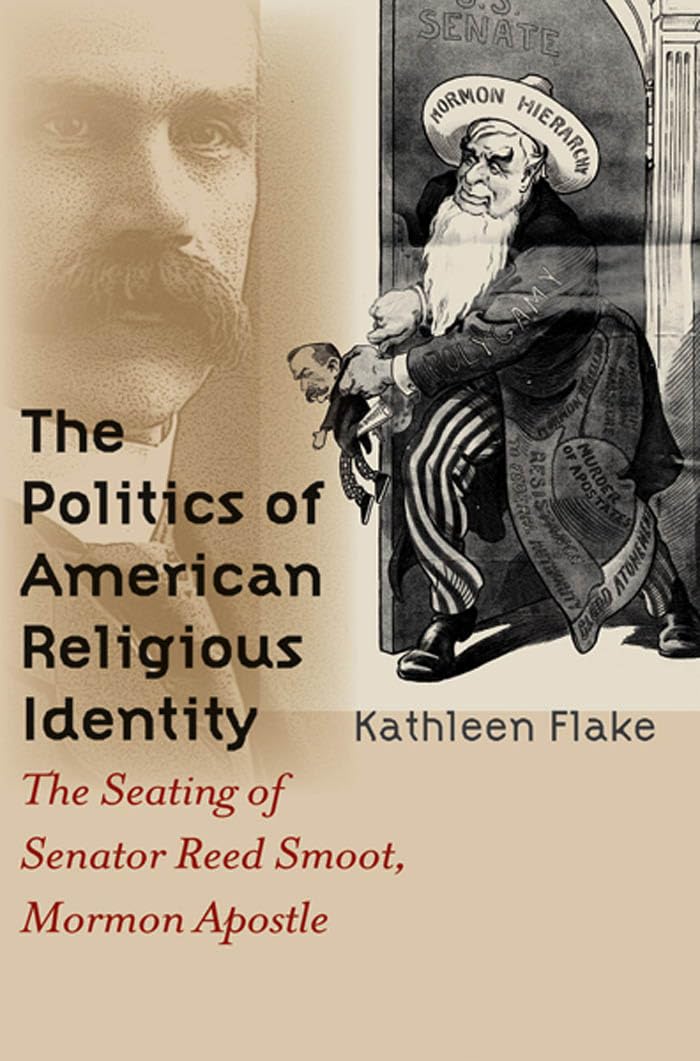
Title
The Politics of American Religious Identity: The Seating of Senator Reed Smoot, Mormon Apostle,Used
Sold by Ergodebooks, an authorized reseller.
Returns accepted within 30 days | support@ergodebooks.com
Shipping Information
- Free Standard Shipping — United States only
- Processing Time: 3–5 business days
- Estimated Delivery: 6–10 business days after dispatch
- Double-boxed, fully insured & discreetly packaged
- Tracking number sent via email once dispatched
Returns & Refund
Returns accepted within 30 days of delivery.
Damaged or Defective Item
Free return shipping + replacement or full refund
Wrong Item Received
Free return shipping + replacement or full refund
Change of Mind
Return shipping at customer's expense · 25% restocking fee applies
Payment Option

Between 1901 and 1907, a broad coalition of Protestant churches sought to expel newly elected Reed Smoot from the Senate, arguing that as an apostle in the Church of Jesus Christ of Latterday Saints, Smoot was a lawbreaker and therefore unfit to be a lawmaker. The resulting Senate investigative hearing featured testimony on every peculiarity of Mormonism, especially its polygamous family structure. The Smoot hearing ultimately mediated a compromise between Progressive Era Protestantism and Mormonism and resolved the nation's longstanding 'Mormon Problem.' On a broader scale, Kathleen Flake shows how this landmark hearing provided the occasion for the countrythrough its elected representatives, the daily press, citizen petitions, and social reform activismto reconsider the scope of religious free exercise in the new century.Flake contends that the Smoot hearing was the forge in which the Latterday Saints, the Protestants, and the Senate hammered out a model for churchstate relations, shaping for a new generation of nonProtestant and nonChristian Americans what it meant to be free and religious. In addition, she discusses the Latterday Saints' use of narrative and collective memory to retain their religious identity even as they changed to meet the nation's demands.
⚠️ WARNING (California Proposition 65):
This product may contain chemicals known to the State of California to cause cancer, birth defects, or other reproductive harm.
For more information, please visit www.P65Warnings.ca.gov.
- Q: What is the main topic of 'The Politics of American Religious Identity'? A: The book examines the Senate hearing regarding Reed Smoot, a Mormon apostle, and how it influenced the discussion of religious identity and church-state relations in America.
- Q: Who is the author of this book? A: The author is Kathleen Flake, who provides insight into the intersection of religion and politics during the early 20th century.
- Q: What can I expect from the book's content? A: Readers can expect a detailed analysis of the Smoot hearing and its implications for Mormonism and Protestantism, as well as the broader context of religious free exercise in America.
- Q: Is this book suitable for academic research? A: Yes, the book is suitable for academic research, providing historical context and analysis relevant to religious studies, political science, and American history.
- Q: What is the publication date of the book? A: The book was published on March 22, 2004.
- Q: How many pages does the book have? A: The book has 256 pages.
- Q: What type of binding does the book have? A: The book is available in hardcover binding.
- Q: What condition is the book in? A: The book is in new condition.
- Q: Does the book include any illustrations or images? A: The book primarily focuses on text and does not emphasize illustrations or images, concentrating on the narrative and analysis.
- Q: What edition of the book is available? A: This is the first edition of 'The Politics of American Religious Identity'.