
Title
The Politics of Genocide,Used
Sold by Ergodebooks, an authorized reseller.
Returns accepted within 30 days | support@ergodebooks.com
Shipping Information
- Free Standard Shipping — United States only
- Processing Time: 3–5 business days
- Estimated Delivery: 6–10 business days after dispatch
- Double-boxed, fully insured & discreetly packaged
- Tracking number sent via email once dispatched
Returns & Refund
Returns accepted within 30 days of delivery.
Damaged or Defective Item
Free return shipping + replacement or full refund
Wrong Item Received
Free return shipping + replacement or full refund
Change of Mind
Return shipping at customer's expense · 25% restocking fee applies
Payment Option

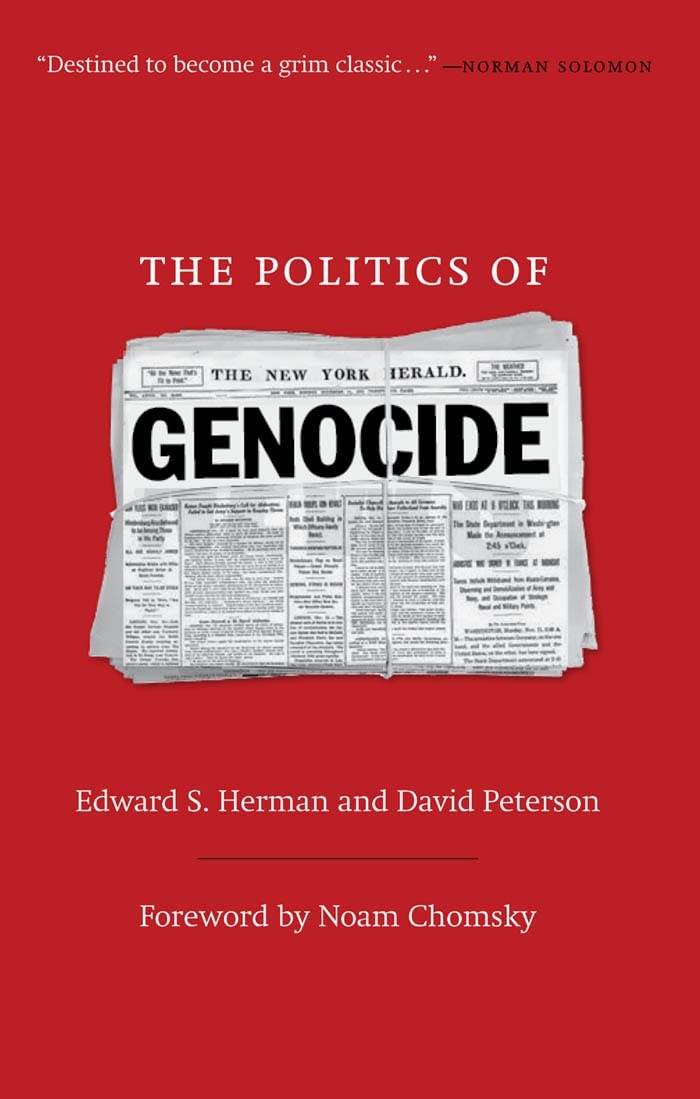
In this impressive book, Edward S. Herman and David Peterson examine the uses and abuses of the word genocide. They argue persuasively that the label is highly politicized and that in the United States it is used by the government, journalists, and academics to brand as evil those nations and political movements that in one way or another interfere with the imperial interests of U.S. capitalism. Thus the word genocide is seldom applied when the perpetrators are U.S. allies (or even the United States itself), while it is used almost indiscriminately when murders are committed or are alleged to have been committed by enemies of the United States and U.S. business interests. One set of rules applies to cases such as U.S. aggression in Vietnam, Israeli oppression of Palestinians, Indonesian slaughter of socalled communists and the people of East Timor, U.S. bombings in Serbia and Kosovo, the U.S. war of liberation in Iraq, and mass murders committed by U.S. allies in Rwanda and the Republic of Congo. Another set applies to cases such as Serbian aggression in Kosovo and Bosnia, killings carried out by U.S. enemies in Rwanda and Darfur, Saddam Hussein, any and all actions by Iran, and a host of others.With its careful and voluminous documentation, close reading of the U.S. media and political and scholarly writing on the subject, and clear and incisive charts, The Politics of Genocide is both a damning condemnation and stunning expos of a deeply rooted and effective system of propaganda aimed at deceiving the population while promoting the expansion of a cruel and heartless imperial system.
⚠️ WARNING (California Proposition 65):
This product may contain chemicals known to the State of California to cause cancer, birth defects, or other reproductive harm.
For more information, please visit www.P65Warnings.ca.gov.
- Q: What is the main theme of 'The Politics of Genocide'? A: The main theme of 'The Politics of Genocide' is the politicization of the term 'genocide' and how it is used selectively by the U.S. government, media, and academia to label certain nations and political movements as evil, while often overlooking similar actions by U.S. allies.
- Q: Who are the authors of this book? A: The authors of 'The Politics of Genocide' are Edward S. Herman and David Peterson.
- Q: When was 'The Politics of Genocide' published? A: The book was published on April 1, 2010.
- Q: What is the format of this book? A: The book is available in paperback format.
- Q: How many pages does 'The Politics of Genocide' have? A: The book contains 128 pages.
- Q: What is the condition of the book being sold? A: The book is listed as 'New'.
- Q: What category does this book fall under? A: 'The Politics of Genocide' falls under the category of 'Violence in Society'.
- Q: What are the key arguments presented in the book? A: The authors argue that the term 'genocide' is applied inconsistently, often to vilify U.S. adversaries while absolving allies, and they provide extensive documentation and analysis to support this claim.
- Q: Is there any specific historical context discussed in the book? A: Yes, the book discusses various historical contexts, including U.S. aggression in Vietnam, Israeli actions against Palestinians, and the atrocities committed by U.S. allies, contrasting these with actions taken by U.S. enemies.
- Q: What can readers expect from the writing style of the authors? A: Readers can expect a careful and voluminous documentation style, with clear charts and incisive analysis, making the complex topic accessible.