If you have any questions, you are always welcome to contact us. We'll get back to you as soon as possible, withing 24 hours on weekdays.
Customer service
All questions about your order, return and delivery must be sent to our customer service team by e-mail at yourstore@yourdomain.com
Sale & Press
If you are interested in selling our products, need more information about our brand or wish to make a collaboration, please contact us at press@yourdomain.com
Help
If you have any questions, you are always welcome to contact us. We'll get back to you as soon as possible, withing 24 hours on weekdays.
Customer service
All questions about your order, return and delivery must be sent to our customer service team by e-mail at yourstore@yourdomain.com
Sale & Press
If you are interested in selling our products, need more information about our brand or wish to make a collaboration, please contact us at press@yourdomain.com
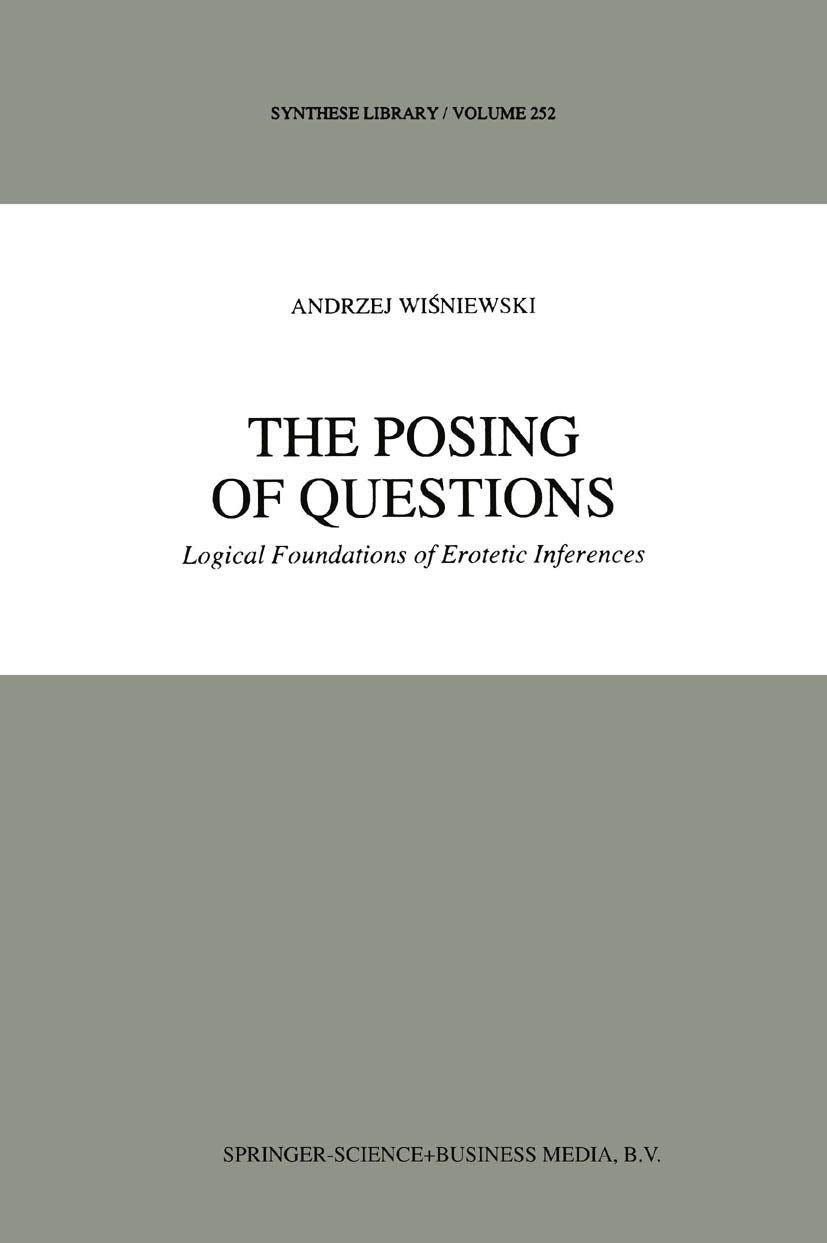
This book is a study in the logic of questions (sometimes called erotetic logic). The central topics in erotetic logic have been the structure of questions and the questionanswer relationship. This book doesn't neglect these problems, but much of it is focussed on other issues. The main subject is the logical analysis of certain relations between questions and the contexts of their appearance. And our aim is to elaborate the conceptual apparatus of the inferential approach to the logic of questions. Questions are asked for many reasons and for different purposes. Yet, before a question is asked or posed, a questioner must arrive at it. In many cases arriving at a question resembles coming to a conclusion: there are some premises involved and some inferential thought processes take place. If we agree that a conclusion need not be "conclusive", we may say that sometimes questions can play the role of conclusions. But questions can also perform the role of premises: we often pass from some "initial" question to another question. In other words, there are inferential thought processes we shall call them erotetic inferences in which questions play the roles of conclusions or conclusions and premises. The inferential approach to the logic of questions focusses its attention on the analysis of erotetic inferences. This book consists of eight chapters.
⚠️ WARNING (California Proposition 65):
This product may contain chemicals known to the State of California to cause cancer,
birth defects, or other reproductive harm.
For MAP (Minimum Advertised Price) violations and Intellectual Property (IP) or Trademark concerns, please contact:
support@ergodebooks.com
⚠️ California Proposition 65 Warning: Some products sold on this website may expose you to chemicals known to the State of California to cause cancer, birth defects, or other reproductive harm. For more information, visit www.P65Warnings.ca.gov.