
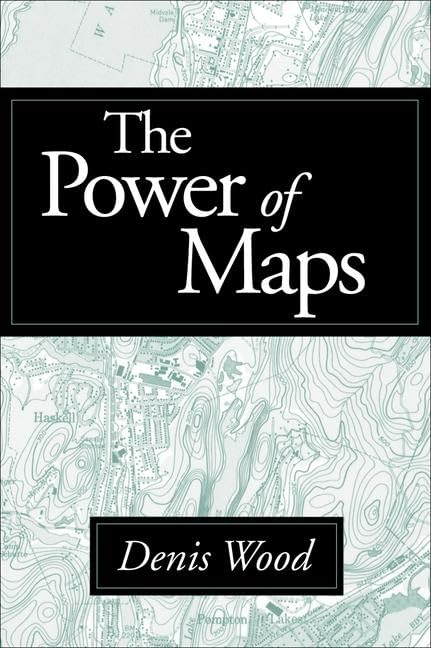
Title
The Power Of Maps
Sold by Ergodebooks, an authorized reseller.
Returns accepted within 30 days | support@ergodebooks.com
Shipping Information
- Free Standard Shipping — United States only
- Processing Time: 3–5 business days
- Estimated Delivery: 6–10 business days after dispatch
- Double-boxed, fully insured & discreetly packaged
- Tracking number sent via email once dispatched
Returns & Refund
Returns accepted within 30 days of delivery.
Damaged or Defective Item
Free return shipping + replacement or full refund
Wrong Item Received
Free return shipping + replacement or full refund
Change of Mind
Return shipping at customer's expense · 25% restocking fee applies
Payment Option

This Volume Ventures Into Terrain Where Even The Most Sophisticated Map Fails To Leadthrough The Mapmaker'S Bias. Denis Wood Shows How Maps Are Not Impartial Reference Objects, But Rather Instruments Of Communication, Persuasion, And Power. Like Paintings, They Express A Point Of View. By Connecting Us To A Reality That Could Not Exist In The Absence Of Mapsa World Of Property Lines And Voting Rights, Taxation Districts And Enterprise Zonesthey Embody And Project The Interests Of Their Creators. Sampling The Scope Of Maps Available Today, Illustrations Include Peter Gould'S Aids Map, Tom Van Sant'S Map Of The Earth, U.S. Geological Survey Maps, And A Child'S Drawing Of The World. The Power Of Maps Was Published In Conjunction With An Exhibition At The Cooper Hewitt Museum, The Smithsonian Institution'S National Museum Of Design.
⚠️ WARNING (California Proposition 65):
This product may contain chemicals known to the State of California to cause cancer, birth defects, or other reproductive harm.
For more information, please visit www.P65Warnings.ca.gov.
- Q: What is the size of 'The Power of Maps'? A: The book measures six inches in length, nine point zero two inches in height, and zero point seventy five inches in width.
- Q: How many pages does 'The Power of Maps' have? A: This book contains two hundred forty eight pages.
- Q: What type of binding does 'The Power of Maps' have? A: It has a paperback binding.
- Q: Who is the author of 'The Power of Maps'? A: The author is Denis Wood.
- Q: What is the main theme of 'The Power of Maps'? A: The book explores how maps reflect the mapmaker's bias and serve as tools of communication and power.
- Q: Is 'The Power of Maps' suitable for all ages? A: Yes, it is appropriate for a general audience, though it is best suited for readers interested in engineering and design.
- Q: How can I best utilize 'The Power of Maps'? A: You can read it for insights on cartography, bias in mapping, and the societal implications of maps.
- Q: Does 'The Power of Maps' include illustrations? A: Yes, it includes various illustrations showcasing different types of maps.
- Q: Can I find specific maps in 'The Power of Maps'? A: Yes, the book features examples such as Peter Gould's AIDS map and Tom Van Sant's map of the earth.
- Q: What are the key features of 'The Power of Maps'? A: It is a used book in good condition, published by The Guilford Press.
- Q: How should I store 'The Power of Maps' to keep it in good condition? A: Store it in a dry place, away from direct sunlight to prevent damage to the binding and pages.
- Q: Is there a warranty for 'The Power of Maps'? A: Typically, used books like this do not come with a warranty, but you should check with the seller.
- Q: What if 'The Power of Maps' arrives damaged? A: You should contact the seller for return or exchange options regarding damaged items.
- Q: Are there any cleaning instructions for 'The Power of Maps'? A: It is recommended to keep the book dry and handle it with clean hands to avoid marking the pages.
- Q: How does 'The Power of Maps' compare to other engineering books? A: It uniquely addresses the intersection of cartography and societal implications, making it distinct from technical engineering texts.
- Q: Is 'The Power of Maps' a good choice for someone new to cartography? A: Yes, it is accessible and provides a foundational understanding of the biases inherent in mapping.