
Title
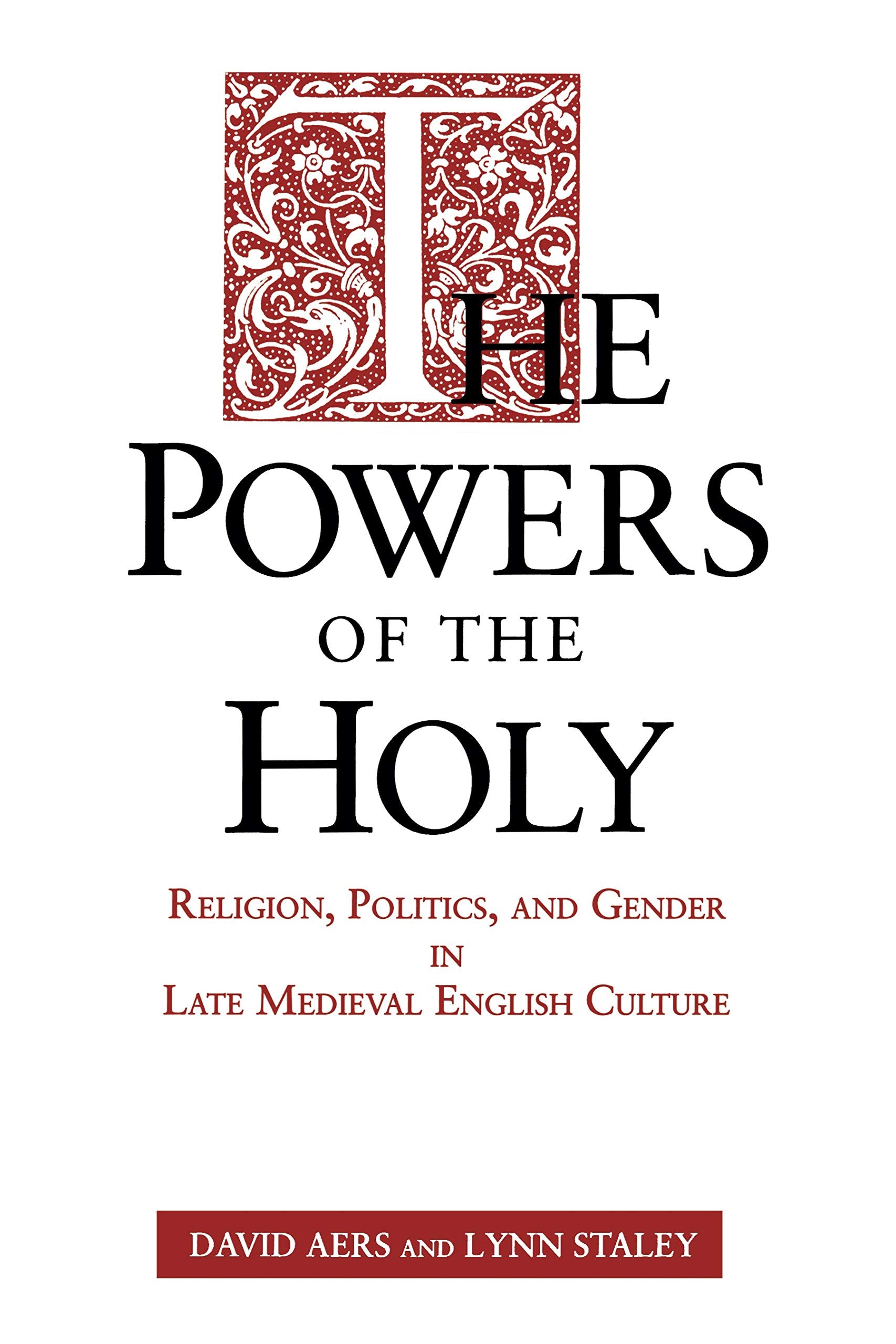
The Powers of the Holy: Religion, Politics, and Gender in Late Medieval English Culture,Used
Sold by Ergodebooks, an authorized reseller.
Returns accepted within 30 days | support@ergodebooks.com
Shipping Information
- Free Standard Shipping — United States only
- Processing Time: 3–5 business days
- Estimated Delivery: 6–10 business days after dispatch
- Double-boxed, fully insured & discreetly packaged
- Tracking number sent via email once dispatched
Returns & Refund
Returns accepted within 30 days of delivery.
Damaged or Defective Item
Free return shipping + replacement or full refund
Wrong Item Received
Free return shipping + replacement or full refund
Change of Mind
Return shipping at customer's expense · 25% restocking fee applies
Payment Option

About the AuthorDavid Aers is Professor of English and Religion at Duke University. He is the coeditor of The Journal of Medieval and Early Modern Studies and author of, most recently, Culture and History, 13501600 (1992) and Community, Gender, and Individual Identity: English Writing, 13601430 (1988).Lynn Staley is Harrington and Shirley Drake Professor of the Humanities at Colgate University. Her most recent books include Margery Kempe's Dissenting Fictions (Penn State, 1994), The Shepheardes Calendar: An Introduction (Penn State, 1990), and an edition of The Book of Margery Kempe (1996)Product DescriptionThe Powers of the Holy explores ways in which the language and images of Christian devotion in late fourteenthcentury England were inextricably bound up with a variety of social and political relations. Addressing a wide range of texts, David Aers and Lynn Staley analyze the complex, shifting, and often extremely subtle forms in which writers responded to this situation.Aers concentrates on representations of the humanity of Christ. He unfolds the spiritual and political implications of different versions of the humanity of Christ composed in this period, addressing major issues of gender and power introduced into the field by Caroline Walker Bynum and others. He considers conventional devotional texts, Wycliffite writings, Langland's Piers Plowman, and Julian of Norwich's Revelation. Staley focuses on Julian of Norwich and Geoffrey Chaucer, two very different minds working both within and against dominant conventions of representations and power. Though not usually paired, both writers signal their knowing participation in the contemporary debate about power and authority, a debate that was conducted using the language of sanctity.The Powers of the Holy shows how and why medieval attempts to deal with an emerging crisis in the legitimization of authority (in most domains) interacted with conflicting versions of Christian sanctity. Simultaneously it shows just how, and why, matters that were distinctively spiritual could be politicized. Future readings of the period will undoubtedly follow this books cultivation of methodologies that avoid any splitting apart of the study of devotion and devotional texts, the study of the politics of ecclesiastical and secular institutions, and the study of gender.ReviewThe Powers of the Holy is one of those books you keep feeling youve decided about, only to find you havent. Passionately argued and replete with historical analysis, literary interpretations, theoretical observations, and generally wellconsidered polemics, it is unusual to the degree in which it treats students of Middle English as though we all approach our subject as intellectuals, personally and politically engaged in the fourteenth century as part of our wider engagement in life in the present. . . . I have learned a great deal from this book, agree with much that is in it, disagree with much else, and expect to be telling students of medieval and early modern culture and thought I encounter over the next few years that it is one of the books that they must read.Nicholas Watson, Studies in the Age of ChaucerA very fine book, the fruit of an unusually seamless and effective collaboration by two prominent readers of English writing of the late fourteenth and early fifteenth centuries. . . . Aers and Staley . . . deliver that relatively rare thing, a book rich in scholarship and insistently, urgently challenging.South Atlantic ReviewThe authors delineate the variable ways that late medieval representations of the holy are profoundly engaged in the politics of state, church, class, and gender. They offer innovative analyses of major authors and texts that will prove to be essential reading for medievalists in general and that will, I believe, have a salutary impact on the current rewriting of English literary history. The significance of Aerss and Staleys major claim about the powers of
⚠️ WARNING (California Proposition 65):
This product may contain chemicals known to the State of California to cause cancer, birth defects, or other reproductive harm.
For more information, please visit www.P65Warnings.ca.gov.
- Q: What is the page count of the book? A: The book has three hundred twenty pages. This length allows for an in-depth exploration of the themes of religion, politics, and gender.
- Q: What are the dimensions of the book? A: The book measures five point ninety-eight inches in length, zero point eighty-seven inches in width, and nine point zero two inches in height. These dimensions make it a standard paperback size.
- Q: What type of binding does this book have? A: The book is published in paperback binding. This makes it flexible and lightweight, suitable for easy reading.
- Q: Who are the authors of this book? A: The book is authored by David Aers and Lynn Staley. Both authors are noted scholars in medieval studies.
- Q: What genre does this book belong to? A: The book falls under the genre of medieval studies. It explores religious and cultural themes in late medieval England.
- Q: What is the main focus of the book? A: The book examines the intersection of religion, politics, and gender in late medieval English culture. It delves into how these themes influenced social and political relations.
- Q: How is the book structured? A: The book is structured around various texts and themes, analyzing representations of Christ's humanity and discussions on authority. It features insights from multiple medieval writers.
- Q: Is this book suitable for academic study? A: Yes, this book is suitable for academic study. It provides scholarly analysis and methodologies relevant to medieval literature and culture.
- Q: What should I expect from the writing style? A: The writing style is academic yet accessible, making complex themes understandable. Readers can expect a thorough examination of nuanced topics.
- Q: How do I care for this book? A: To care for this book, keep it away from damp environments and store it upright on a shelf. Avoid exposing it to direct sunlight to prevent fading.
- Q: Can I return the book if I'm not satisfied? A: Yes, you can typically return the book if you are not satisfied. Check the return policy of the retailer from which you purchased it.
- Q: What if the book arrives damaged? A: If the book arrives damaged, contact the retailer for a replacement or refund. Most retailers have policies in place for such situations.
- Q: Is this book appropriate for all ages? A: The book is primarily intended for adult readers and students of medieval studies. Some themes may not be suitable for younger audiences.
- Q: Will this book help me understand medieval gender roles? A: Yes, the book provides insights into medieval gender roles. It discusses how these roles interacted with religious and political authority.
- Q: Does the book include references to specific texts? A: Yes, the book analyzes specific texts including Wycliffite writings and Julian of Norwich's Revelation. These texts are central to the discussion.