
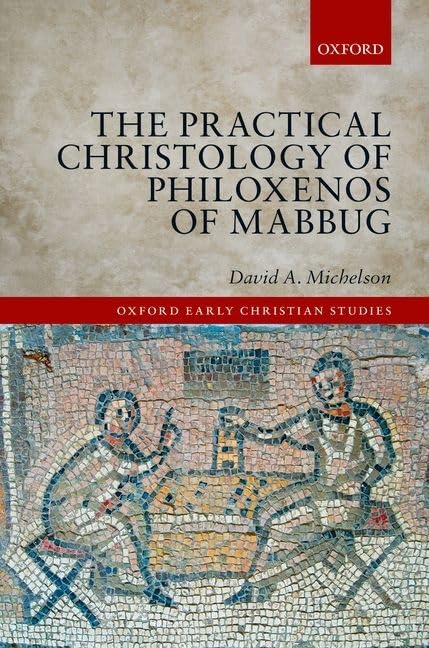
Title
The Practical Christology of Philoxenos of Mabbug (Oxford Early Christian Studies),Used
Sold by Ergodebooks, an authorized reseller.
Returns accepted within 30 days | support@ergodebooks.com
Shipping Information
- Free Standard Shipping — United States only
- Processing Time: 3–5 business days
- Estimated Delivery: 6–10 business days after dispatch
- Double-boxed, fully insured & discreetly packaged
- Tracking number sent via email once dispatched
Returns & Refund
Returns accepted within 30 days of delivery.
Damaged or Defective Item
Free return shipping + replacement or full refund
Wrong Item Received
Free return shipping + replacement or full refund
Change of Mind
Return shipping at customer's expense · 25% restocking fee applies
Payment Option

Philoxenos of Mabbug (c. 440523) was a prolific lateantique theologian and polemicist who produced the largest literary corpus to have survived in Syriac. He earned a reputation as the leading Syriac opponent of the Council of Chalcedon (451) and its twonature Christology. In The Practical Christology of Philoxenos of Mabbug, David A. Michelson offers a new interpretation of Philoxenos' onenature Christology by interpreting the postChalcedonian doctrinal disputes through a holistic analysis of Philoxenos' life and works. Michelson's exploration of the entire Philoxenian corpus reveals a miaphysite perspective on the Christological controversies in which the intellectual clash was not primarily over defining doctrine. As a metropolitan bishop, sponsor of a revised New Testament, and monastic theologian, Philoxenos was principally concerned with matters of Christian praxis and the ascetic pursuit of divine knowledge. This book shows how he opposed Chalcedonian Christology because he was convinced its 'intellectual' theological method was inimical to the mystical pursuit of divine knowledge through liturgical and ascetic practice. Philoxenos' polemical engagement drew upon a theological epistemology that he had adapted from lateNicene theologians including Ephrem, the Cappadocians, and Evagrius. Philoxenos argued that divine knowledge was not to be achieved through human understanding or doctrinal inquiry. Instead, true divine knowledge was attained through practice, specifically contemplation, reading of scripture, participation in the liturgical mysteries, and ascetic discipline. Michelson considers each of these practices in turn to show how Philoxenos contextualized opposition to Chalcedon as part of a larger vision of ascetic and spiritual struggle. In short, for Philoxenos the doctrinally recondite conflict over Christology was foremost a practical matter.
⚠️ WARNING (California Proposition 65):
This product may contain chemicals known to the State of California to cause cancer, birth defects, or other reproductive harm.
For more information, please visit www.P65Warnings.ca.gov.