
Title
The Presidency Of Warren G. Harding (American Presidency Series),Used
Sold by Ergodebooks, an authorized reseller.
Returns accepted within 30 days | support@ergodebooks.com
Shipping Information
- Free Standard Shipping — United States only
- Processing Time: 3–5 business days
- Estimated Delivery: 6–10 business days after dispatch
- Double-boxed, fully insured & discreetly packaged
- Tracking number sent via email once dispatched
Returns & Refund
Returns accepted within 30 days of delivery.
Damaged or Defective Item
Free return shipping + replacement or full refund
Wrong Item Received
Free return shipping + replacement or full refund
Change of Mind
Return shipping at customer's expense · 25% restocking fee applies
Payment Option

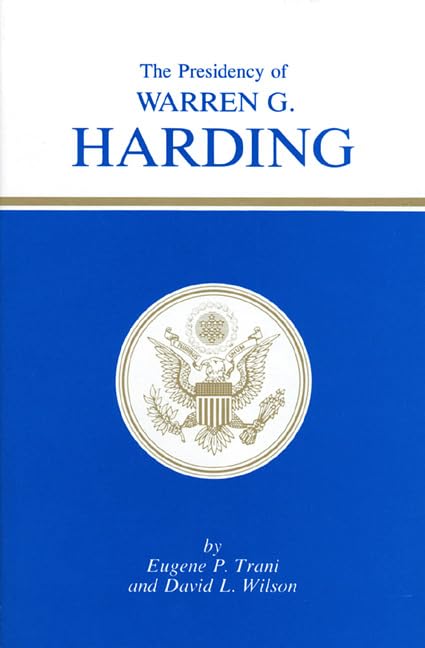
In this volume, Eugene P. Trani and David L. Wilson evaluate the presidency of Warren G. Harding by surveying scholarship on the Harding years. Hardinggenerally considered one of the weakest American presidentswas elected chief executive in 1920, during a time of uncertainty and frustration for many of the American people. The authors assess the critics and defenders of Harding in light of the administration's accomplishments and failures.Both the strengths and weaknesses of the Harding administration came from the people President Harding selected for high office. Charles G. Dawes accomplished much by implementing sound budgetary practices in the federal government for the first time in history. Herbert Hoover became the dominant figure in the Harding administration, using his influence to advance both domestic and foreign policies. And Charles Evans Hughes proved to be an able, if conservative, secretary of state. Yet the accomplishments of these and other capable men tended to be shortterm in nature.Trani and Wilson describe the widespread corruption and malfeasance in the Harding administration, pointing out the Harding's erratic judgment of character caused many of his problems as president. His personal habitsphilandering, playing poker, and drinking liquor during national prohibitiontainted his reputation and appeared to connect him to the activities of his associates. Tragically, Harding sought to avoid controversy, even if it meant ignoring real problems or evading justice, and thus failed to provide moral leadership for the nation.Harding and his advisers demonstrated little understanding of the social and economic forces at work in the country and abroad. In the early 1920s, the United States continued the transition from a rural society to an urbanized and industrialized society. Rather than adjusting the government to meet the needs of all segments of an industrialized society, Harding instituted 'normalcy,' an attempt to maintain the values of a rural society rapidly disintegrating under the impact of social and economic change. The few real accomplishments of the Harding administration were buried under scandal. and in the end, Harding must be rated as an ineffective leader at a time when the nation would have been better served by a different, more imaginative approach to government.
⚠️ WARNING (California Proposition 65):
This product may contain chemicals known to the State of California to cause cancer, birth defects, or other reproductive harm.
For more information, please visit www.P65Warnings.ca.gov.