
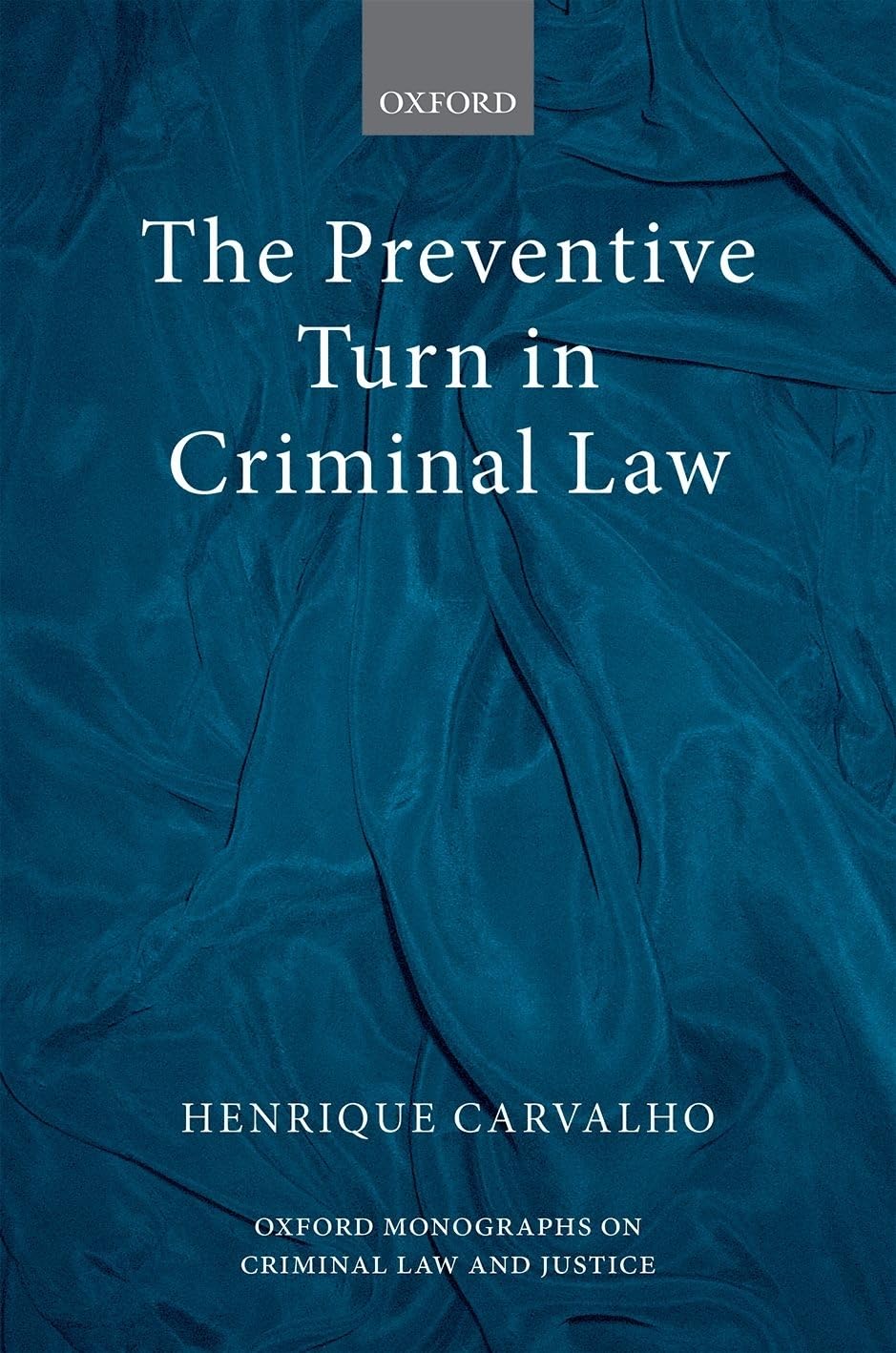
Title
The Preventive Turn in Criminal Law (Oxford Monographs on Criminal Law and Justice),Used
Sold by Ergodebooks, an authorized reseller.
Returns accepted within 30 days | support@ergodebooks.com
Shipping Information
- Free Standard Shipping — United States only
- Processing Time: 3–5 business days
- Estimated Delivery: 6–10 business days after dispatch
- Double-boxed, fully insured & discreetly packaged
- Tracking number sent via email once dispatched
Returns & Refund
Returns accepted within 30 days of delivery.
Damaged or Defective Item
Free return shipping + replacement or full refund
Wrong Item Received
Free return shipping + replacement or full refund
Change of Mind
Return shipping at customer's expense · 25% restocking fee applies
Payment Option

This book presents a theoretical examination of the rise and expansion of preventive criminal offences that has gained momentum in AngloAmerican criminal justice since the latetwentieth century. It shows how recent transformations in criminal law and justice are intrinsically related to and embedded in the way liberal society and liberal law have been imagined, developed and conditioned by their social, political and historical contexts. The book starts by identifying a tension, within contemporary criminal law, between the importance given to the expression of individual autonomy and responsibility, and the perceived need for prevention as a condition for the security of autonomy and the promotion of welfare. The book then traces this tension back to an intrinsic ambivalence within the modern conception of individual liberty, which is both repressed and preserved by liberal conceptions of responsibility and punishment. It finds that it is this tension that ultimately grounds the rise of preventive criminal offences in recent times.The Preventive Turn in Criminal Law engages with the main contemporary literature on criminal law, prevention, risk, security and criminalisation, by deploying a theoretical perspective from both classical and contemporary works of social and political theory, including the works of Hobbes, Locke, Hegel, and Bentham. It does so in order to reveal that the pervasiveness of prevention in twentyfirst century criminal law not only represents the consequence of new and unprecedented features of contemporary politics and society, but also embeds longestablished features of the liberal legal and political tradition.
⚠️ WARNING (California Proposition 65):
This product may contain chemicals known to the State of California to cause cancer, birth defects, or other reproductive harm.
For more information, please visit www.P65Warnings.ca.gov.