
Title
The Principles of Life,Used
Sold by Ergodebooks, an authorized reseller.
Returns accepted within 30 days | support@ergodebooks.com
Shipping Information
- Free Standard Shipping — United States only
- Processing Time: 3–5 business days
- Estimated Delivery: 6–10 business days after dispatch
- Double-boxed, fully insured & discreetly packaged
- Tracking number sent via email once dispatched
Returns & Refund
Returns accepted within 30 days of delivery.
Damaged or Defective Item
Free return shipping + replacement or full refund
Wrong Item Received
Free return shipping + replacement or full refund
Change of Mind
Return shipping at customer's expense · 25% restocking fee applies
Payment Option

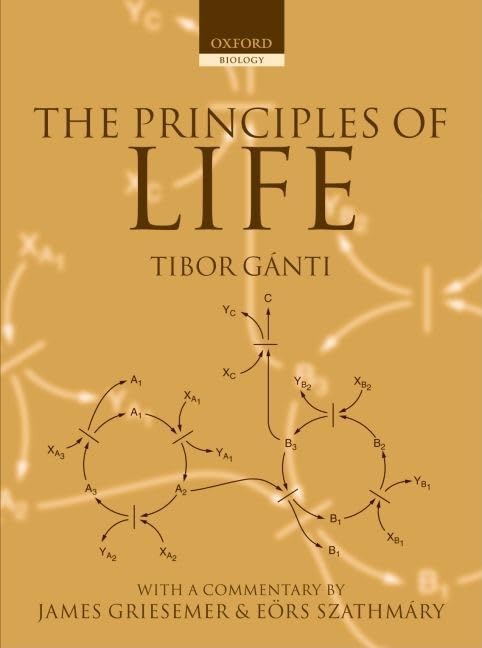
Beginning with a new essay, "Levels of Life and Death," Tibor Gnti develops three general arguments about the nature of life. In "The Nature of the Living State," Professor Gnti answers Francis Crick's puzzles about "life itself," offering a set of reflections on the parameters of the problems to be solved in origins of life research and, more broadly, in the search for principles governing the living state in general. "The Principle of Life" describes in accessible language Gnti's chief insight about the organization of living systemshis theory of the "chemoton," or chemical automaton. The simplest chemoton model of the living state consists of three chemically coupled subsystems: an autocatalytic metabolism, a genetic molecule and a membrane. Gnti offers a fresh approach to the ancient problem of "life criteria," articulating a basic philosophy of the units of life applicable to the deepest theoretical considerations of genetics, chemical synthesis, evolutionary biology and the requirements of an "exact theoretical biology." New essays by Ers Szathmry and James Griesemer on the biological and philosophical significance of Gnti's work of thirty years indicate not only the enduring theoretical significance, but also the continuing relevance and heuristic power of Gnti's insights. New endnotes by Szathmry and Griesemer bring this legacy into dialogue with current thought in biology and philosophy. Gnti's chemoton model reveals the fundamental importance of chemistry for biology and philosophy. Gnti's technical innovation cycle stoichiometry at once captures the fundamental fact that biological systems are organized in cycles and at the same time offers a way to understand what it is to think chemically. Perhaps most fundamentally, Gnti's chemoton model avoids dualistic thinking enforced by the dichotomies of modern biology: germ and soma, gene and character, genotype and phenotype.
⚠️ WARNING (California Proposition 65):
This product may contain chemicals known to the State of California to cause cancer, birth defects, or other reproductive harm.
For more information, please visit www.P65Warnings.ca.gov.