
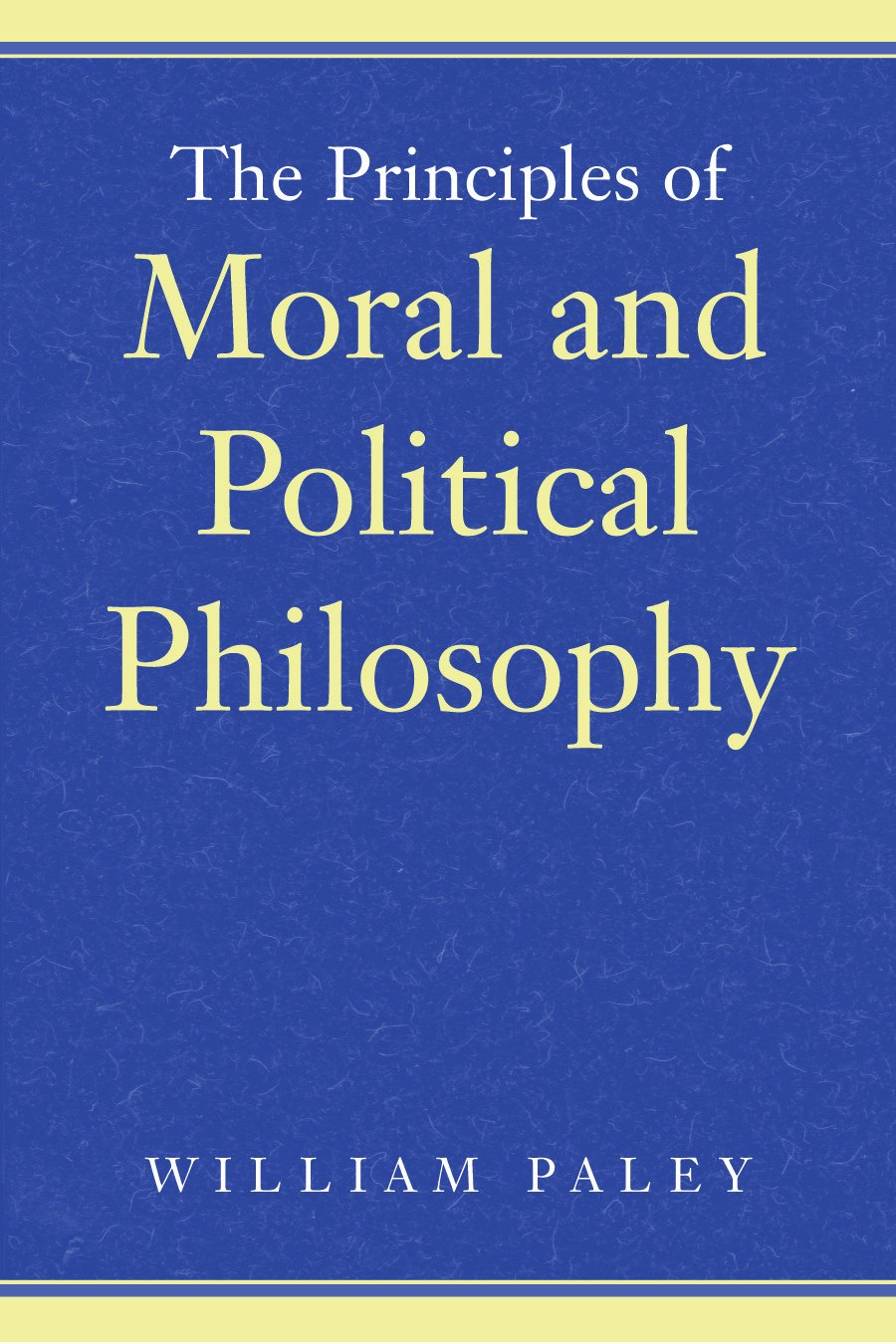
Title
The Principles Of Moral And Political Philosophy,Used
Sold by Ergodebooks, an authorized reseller.
Returns accepted within 30 days | support@ergodebooks.com
Shipping Information
- Free Standard Shipping — United States only
- Processing Time: 3–5 business days
- Estimated Delivery: 6–10 business days after dispatch
- Double-boxed, fully insured & discreetly packaged
- Tracking number sent via email once dispatched
Returns & Refund
Returns accepted within 30 days of delivery.
Damaged or Defective Item
Free return shipping + replacement or full refund
Wrong Item Received
Free return shipping + replacement or full refund
Change of Mind
Return shipping at customer's expense · 25% restocking fee applies
Payment Option

This classic work by William Paley was one of the most popular books in England and America in the early nineteenth century. Its significance lies in the fact that it marks an important point at which eighteenthcentury whiggism began to be transformed into nineteenthcentury liberalism.First published in 1785, Paleys Principles of Moral and Political Philosophy was originally based on his Cambridge lectures of 17661776. It was designed for instructional purposes and was almost immediately adopted as a required text for all undergraduates at Cambridge.The great popularity of Paleys Principlesis perhaps due in part to the authors remarkable gift for clear exposition. Even today, this work is very readable and easily comprehended. But the popularity of the book also reflected the fact that Paley expressed some of the leading scientific, theological, and ethical ideas of his time and place. In this respect, Paleys great classic provides valuable insight into the AngloAmerican mind of the early nineteenth century and helps us better understand the thinking processes and evolving concepts of liberty and virtue that were displacing the old whiggism of the preceding century.As editor D. L. Le Mahieu states, To Paley, the undeniable demands of self interest coincided rather than conflicted with the needs of society. Paley believed that it was the utility of any moral rule alone which determined obligation. In his political theory, Paley rejected social contract theory and substituted instead a natural history of civil society. His opposition to electoral reform, and, later, the French Revolution, became part of a larger ideological discourse that helped the British elites withstand the revolutionary currents of the 1790s.D. L. Le Mahieu is Hotchkiss Presidential Professor at Lake Forest College in Illinois. He is also the author of The Mind of William Paley: A Philosopher and His Age (1976) and A Culture for Democracy (1988).
⚠️ WARNING (California Proposition 65):
This product may contain chemicals known to the State of California to cause cancer, birth defects, or other reproductive harm.
For more information, please visit www.P65Warnings.ca.gov.