
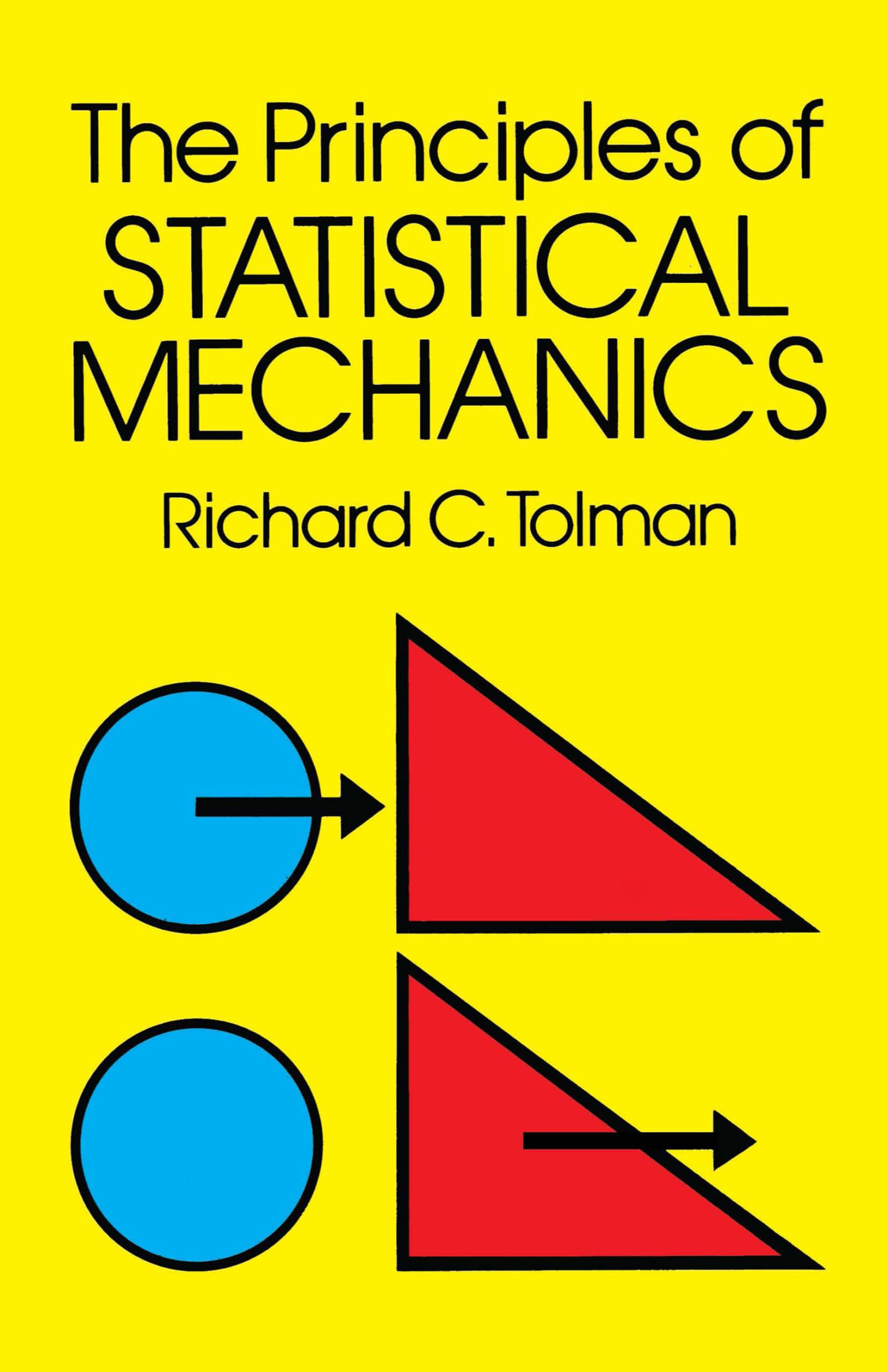
Title
The Principles of Statistical Mechanics (Dover Books on Physics),Used
Sold by Ergodebooks, an authorized reseller.
Returns accepted within 30 days | support@ergodebooks.com
Shipping Information
- Free Standard Shipping — United States only
- Processing Time: 3–5 business days
- Estimated Delivery: 6–10 business days after dispatch
- Double-boxed, fully insured & discreetly packaged
- Tracking number sent via email once dispatched
Returns & Refund
Returns accepted within 30 days of delivery.
Damaged or Defective Item
Free return shipping + replacement or full refund
Wrong Item Received
Free return shipping + replacement or full refund
Change of Mind
Return shipping at customer's expense · 25% restocking fee applies
Payment Option

Referred to by every later author, used by thousands of students in the over forty years since publication, and recommended with great enthusiasm by those same students who are now professors, The Principles of Statistical Mechanics is widely recognized as the classic treatment of a subject essential to contemporary physics. It is the definitive treatise on the fundamentals of statistical mechanics, and because it deals with the fundamentals, the material is as useful today as forty years ago.After a brief introduction, the text begins with a concise exposition of classical statistical mechanics, including such topics as Hamilton's principle, the Lagrangian function, canonical equations of motion, the fundamental theorem of Liouville, conditions for statistical equilibrium, the MaxwellBoltzmann distribution law, collisions as a mechanism of change with time, and Boltzmann's Htheorem. There follows a thorough elucidation of quantum statistical mechanics: historical remarks, the postulates, theorems illustrating the nature of quantum mechanics, transformation theory, applications, statistical ensembles, the MaxwellBoltzmann, EinsteinBose, and FermiDirac distributions, the change in quantum mechanical systems with time, and the quantum mechanical Htheorem. (The selfcontained treatment of quantum mechanics is almost a book within a book!) The final two chapters, illuminating one of the greatest achievements of physics, discuss the application of statistical mechanics to the problem of obtaining a mechanical explanation for the phenomena of thermodynamic behavior.Professor Richard C. Tolman was a distinguished physicist who taught at the California Institute of Technology. In the course of preparing this book he consulted with many eminent colleagues including Pauling, Fowler, and Pauli, and he discussed all parts of the book with J. Robert Oppenheimer. Scholars interested in the history of science can readily appreciate the importance of this book; but since it is so totally authoritative, and so elegantly written, every student and professor of statistical mechanics will find it equally valuable.
⚠️ WARNING (California Proposition 65):
This product may contain chemicals known to the State of California to cause cancer, birth defects, or other reproductive harm.
For more information, please visit www.P65Warnings.ca.gov.
- Q: What is the main focus of 'The Principles of Statistical Mechanics'? A: The book focuses on the fundamentals of statistical mechanics, providing a comprehensive treatment of both classical and quantum statistical mechanics.
- Q: Who is the author of this book? A: The author is Richard C. Tolman, a distinguished physicist known for his work at the California Institute of Technology.
- Q: What is the publication date of this book? A: The book was published on September 16, 2010.
- Q: How many pages does the book contain? A: The book contains 704 pages.
- Q: What is the binding type of 'The Principles of Statistical Mechanics'? A: The book is available in paperback binding.
- Q: Is this book suitable for beginners in statistical mechanics? A: While the book provides foundational knowledge, it is recommended for readers who have some prior understanding of physics concepts.
- Q: What topics are covered in the book? A: Key topics include classical statistical mechanics, Hamilton's principle, canonical equations, quantum statistical mechanics, and the application of statistical mechanics to thermodynamic behavior.
- Q: Is this a revised edition of the book? A: Yes, this is the revised edition of 'The Principles of Statistical Mechanics'.
- Q: Who would benefit from reading this book? A: Students, professors, and scholars interested in statistical mechanics and the history of physics would find this book valuable.
- Q: Does the book include historical context in its treatment of statistical mechanics? A: Yes, it includes historical remarks and discussions with eminent colleagues, providing context to the development of statistical mechanics.