
Title
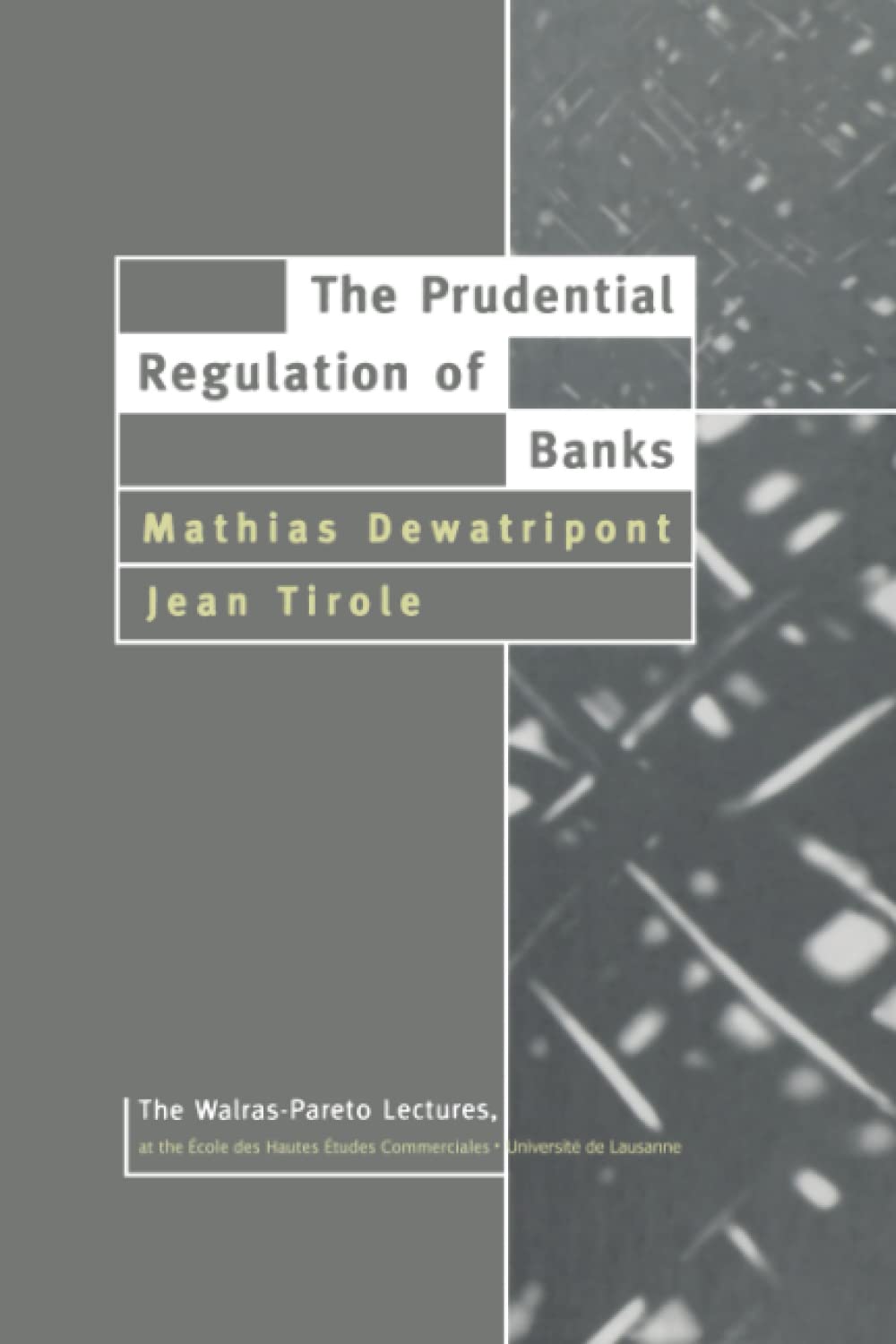
The Prudential Regulation Of Banks (Walraspareto Lectures),New
Sold by Ergodebooks, an authorized reseller.
Returns accepted within 30 days | support@ergodebooks.com
Shipping Information
- Free Standard Shipping — United States only
- Processing Time: 3–5 business days
- Estimated Delivery: 6–10 business days after dispatch
- Double-boxed, fully insured & discreetly packaged
- Tracking number sent via email once dispatched
Returns & Refund
Returns accepted within 30 days of delivery.
Damaged or Defective Item
Free return shipping + replacement or full refund
Wrong Item Received
Free return shipping + replacement or full refund
Change of Mind
Return shipping at customer's expense · 25% restocking fee applies
Payment Option

The Prudential Regulation of Banks applies modern economic theory to prudential regulation of financial intermediaries. Dewatripont and Tirole tackle the key problem of providing the right incentives to management in banks by looking at how external intervention by claimholders (holders of equity or debt) affects managerial incentives and how that intervention might ideally be implemented. Their primary focus is the regulation of commercial banks and S&Ls, but many of the implications of their theory are also valid for other intermediaries such as insurance companies, pension funds, and securities funds. Observing that the main concern of the regulation of intermediaries is solvency (the relation between equity, debt, and asset riskiness), the authors provide institutional background and develop a case for regulation as performing the monitoring functions (screening, auditing, convenant writing, and intervention) that dispersed depositors are unable or unwilling to perform. They also illustrate the dangers of regulatory failure in a summary of the S&L crisis of the 1980s. Following a survey of banking theory, Dewatripont and Tirole develop their model of the capital structure of banks and show how optimal regulation can be achieved using capital adequacy requirements and external intervention when banks are violated. They explain how regulation can be designed to minimize risks of accounting manipulations and to insulate bank managers from macroeconomic shocks, which are beyond their control. Finally, they provide a detailed evaluation of the existing regulation and of potential alternatives, such as rating agencies, private deposit insurance, and large private depositors. They show that these reforms are, at best, a complement, rather than a substitute, to the existing regulation which combines capital ratios with external intervention in case of insolvency. The Prudential Regulation of Banks is part of the Walras P
⚠️ WARNING (California Proposition 65):
This product may contain chemicals known to the State of California to cause cancer, birth defects, or other reproductive harm.
For more information, please visit www.P65Warnings.ca.gov.