
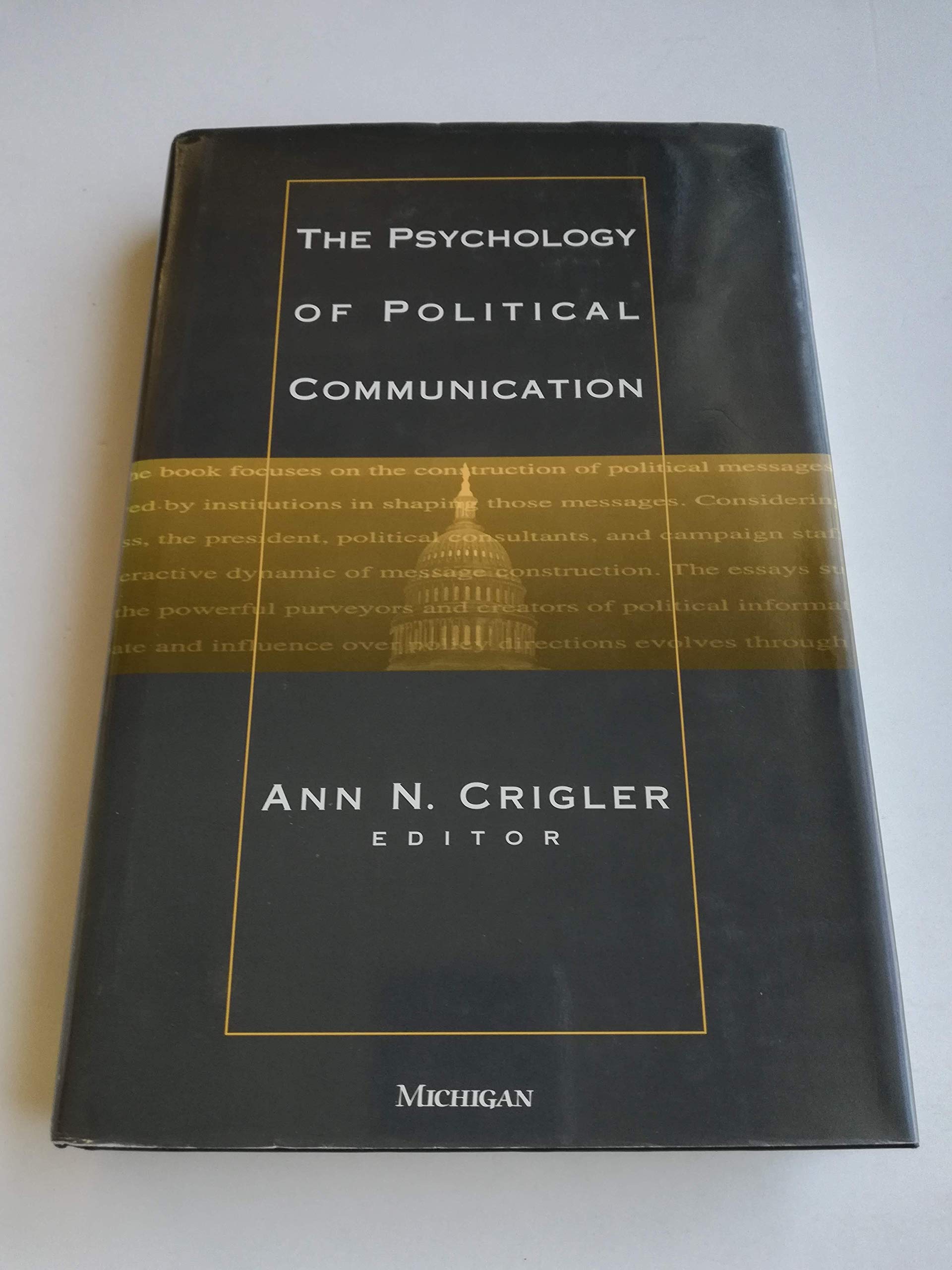
Title
The Psychology Of Political Communication
Sold by Ergodebooks, an authorized reseller.
Returns accepted within 30 days | support@ergodebooks.com
Shipping Information
- Free Standard Shipping — United States only
- Processing Time: 3–5 business days
- Estimated Delivery: 6–10 business days after dispatch
- Double-boxed, fully insured & discreetly packaged
- Tracking number sent via email once dispatched
Returns & Refund
Returns accepted within 30 days of delivery.
Damaged or Defective Item
Free return shipping + replacement or full refund
Wrong Item Received
Free return shipping + replacement or full refund
Change of Mind
Return shipping at customer's expense · 25% restocking fee applies
Payment Option

Rather than taking a traditional view of media influence flowing over a relatively passive audience, the contributors to this volume of essays treat political communication as an interactive process of making meaning. Meaning refers to what one intends to convey especially through language, as well as to what is actually conveyed and reflects the processes of message creation and interpretation. People communicate and interpret messages and meanings in the context of current and prior information according to the authors.The first part of the book focuses on the construction of political messages in the media and considers the roles played by the press, the president, political consultants, and campaign staffs. In the second part of the book, the authors look at individuals and how they construct political meanings from available messages.Contributors to the volume include Dean E. Alger, W. Lance Bennett, Timothy E. Cook, Ann Crigler, Michael X. Delli Carpini, Robert M. Entman, William A. Gamson, Doris A. Graber, August E. Grant, Roderick Hart, Marion Just, John Llewellyn, W. Russell Neuman, Richard M. Perloff, Deborah SmithHowell, and Bruce A. Williams.'. . . a laudable effort to examine political communication processes within a constructionist framework. . . . Here we have a picture of audiences who hold contradictory opinions, change their minds, get influenced by friends and colleages, draw images from the media but revise these constructions according to their own experiences and accumulated popular wisdom and select representatives as much because they've projected images of being 'nice guys' as because there are specific issues that motivate their choices. The book opens a number of doors to a better understanding of this process. . . .' International Journal of Public Opinion ResearchAnn Crigler is Associate Professor of Political Science, University of Southern California.
⚠️ WARNING (California Proposition 65):
This product may contain chemicals known to the State of California to cause cancer, birth defects, or other reproductive harm.
For more information, please visit www.P65Warnings.ca.gov.