

Title

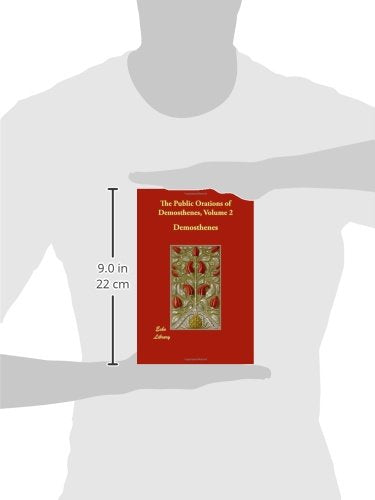
The Public Orations of Demosthenes,Used
Sold by Ergodebooks, an authorized reseller.
Returns accepted within 30 days | support@ergodebooks.com
Shipping Information
- Free Standard Shipping — United States only
- Processing Time: 3–5 business days
- Estimated Delivery: 6–10 business days after dispatch
- Double-boxed, fully insured & discreetly packaged
- Tracking number sent via email once dispatched
Returns & Refund
Returns accepted within 30 days of delivery.
Damaged or Defective Item
Free return shipping + replacement or full refund
Wrong Item Received
Free return shipping + replacement or full refund
Change of Mind
Return shipping at customer's expense · 25% restocking fee applies
Payment Option

Demosthenes, the son of Demosthenes of Paeania in Attica, a rich and highly respected factoryowner, was born in or about the year 384 B.C. He was early left an orphan; his guardians mismanaged his property for their own advantage; and although, soon after coming of age in 366, he took proceedings against them and was victorious in the lawcourts, he appears to have recovered comparatively little from them. In preparing for these proceedings he had the assistance of Isaeus, a teacher and writer of speeches who was remarkable for his knowledge of law, his complete mastery of all the aspects of any case with which he had to do, and his skill in dealing with questions of ownership and inheritance. Demosthenes' speeches against his guardians show plainly the influence of Isaeus, and the teacher may have developed in his pupil the thoroughness and the ingenuity in handling legal arguments which afterwards became characteristic of his work. Apart from this litigation with his guardians, we know little of Demosthenes' youth and early manhood. Various stories have come down to us (for the most part not on the best authority), of his having been inspired to aim at an orator's career by the eloquence and fame of Callistratus; of his having overcome serious physical defects by assiduous practice; of his having failed, nevertheless, owing to imperfections of delivery, in his early appearances before the people, and having been enabled to remedy these by the instruction of the celebrated actor Satyrus; and of his close study of the History of Thucydides. Upon the latter point the evidence of his early style leaves no room for doubt, and the same studies may have contributed to the skill and impressiveness with which, in nearly every oration, he appeals to the events of the past, and sums up the lessons of history. Whether he came personally under the influence either of Plato, the philosopher, or of Isocrates, the greatest rhetorical teacher of his time, and a political pamphleteer of high principles but little practical insight, is much more doubtful. The two men were almost as different in temperament and aims as it was possible to be, but Demosthenes' familiarity with the published speeches of Isocrates, and with the rhetorical principles which Isocrates taught and followed, can scarcely be questioned.
⚠️ WARNING (California Proposition 65):
This product may contain chemicals known to the State of California to cause cancer, birth defects, or other reproductive harm.
For more information, please visit www.P65Warnings.ca.gov.