
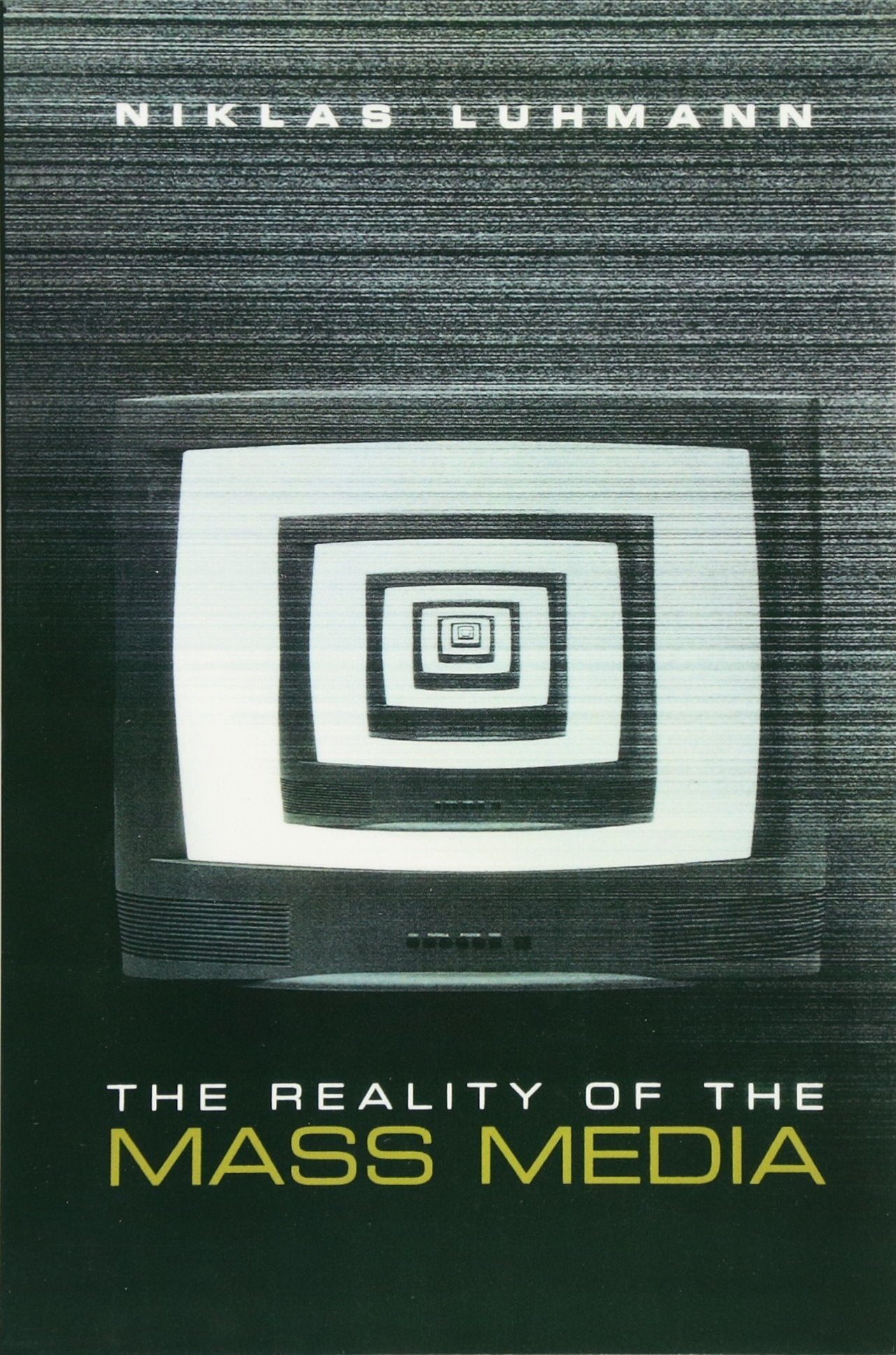
Title
The Reality of the Mass Media,Used
Sold by Ergodebooks, an authorized reseller.
Returns accepted within 30 days | support@ergodebooks.com
Shipping Information
- Free Standard Shipping — United States only
- Processing Time: 3–5 business days
- Estimated Delivery: 6–10 business days after dispatch
- Double-boxed, fully insured & discreetly packaged
- Tracking number sent via email once dispatched
Returns & Refund
Returns accepted within 30 days of delivery.
Damaged or Defective Item
Free return shipping + replacement or full refund
Wrong Item Received
Free return shipping + replacement or full refund
Change of Mind
Return shipping at customer's expense · 25% restocking fee applies
Payment Option

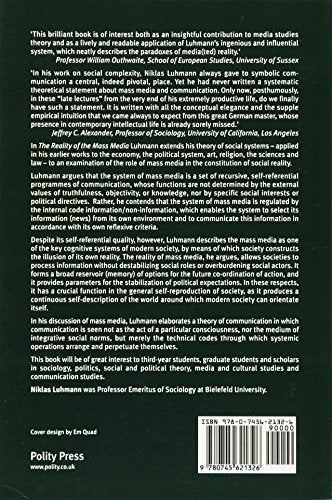
In The Reality of the Mass Media Luhmann extends his theory of social systems applied in his earlier works to the economy, the political system, art, religion, the sciences and law to an examination of the role of mass media in the constitution of social reality.Luhmann argues that the system of mass media is a set of recursive, selfreferential programmes of communication, whose functions are not determined by the external values of truthfulness, objectivity, or knowledge, nor by specific social interests or political directives. Rather, he contends that the system of mass media is regulated by the internal code information / noninformation, which enables the system to select its information (news) from its own environment and to communicate this information in accordance with its own reflexive criteria.Despite its selfreferential quality, however, Luhmann describes the mass media as one of the key cognitive systems of modern society, by means of which society constructs the illusion of its own reality. The reality of mass media, he argues, allows societies to process information without destabilizing social roles or overburdening social actors. It forms a broad reservoir (memory) of options for the future coordination of action, and it provides parameters for the stabilization of political expectations. In these respects, it has a crucial function in the general selfreproduction of society, as it produces a continuous selfdescription of the world around which modern society can orientate itself. In his discussion of mass media, Luhmann elaborates a theory of communication in which communication is seen not as the act of a particular consciousness, nor the medium of integrative social norms, but merely the technical codes through which systemic operations arrange and perpetuate themselves.This book will be of great interest to third year students, graduate students and scholars in sociology, politics, social and political theory, media and cultural studies and communication studies.
⚠️ WARNING (California Proposition 65):
This product may contain chemicals known to the State of California to cause cancer, birth defects, or other reproductive harm.
For more information, please visit www.P65Warnings.ca.gov.