
Title
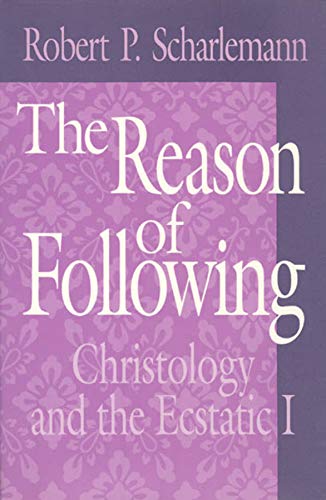
The Reason of Following: Christology and the Ecstatic I (Religion and Postmodernism),Used
Sold by Ergodebooks, an authorized reseller.
Returns accepted within 30 days | support@ergodebooks.com
Shipping Information
- Free Standard Shipping — United States only
- Processing Time: 3–5 business days
- Estimated Delivery: 6–10 business days after dispatch
- Double-boxed, fully insured & discreetly packaged
- Tracking number sent via email once dispatched
Returns & Refund
Returns accepted within 30 days of delivery.
Damaged or Defective Item
Free return shipping + replacement or full refund
Wrong Item Received
Free return shipping + replacement or full refund
Change of Mind
Return shipping at customer's expense · 25% restocking fee applies
Payment Option

In the Reason of Following noted scholar Robert P. Scharlemann takes Christology in a radically new direction, suggesting that Christology itself represents a form of reason and an understanding of selfhood. For the first time, Scharlemann establishes a logical place for Christology in philosophical theology.Scharlemann presents a christological phenomenology of the self, tracing the connections between the "I am" of the God who spoke to Moses, the "I am" of Christ, and the "I am" of autonomous selfidentification. How, he asks, can the self that spontaneously responds to Jesus' "Follow me!" be compared with the everyday, autonomous self? What is the nature of "following" on the part of those who answer the summons of one whose name is "I am"? Pursuing these questions, Scharlemann develops a christological phenomenology of the selfan account in which following means not the expression of the self in action or reflection but rather selfdiscovery in another person.With a deep sense of both culture and philosophy, Scharlemann distinguishes the forms of reason involved in "following" from those in ethics, aesthetics, and other modes of religious philosophic thought. His penetrating readings of nineteenth and twentiethcentury German theological and philosophical traditions provide an introduction to lesserknown thinkers such as Hermann and Picht as well as a profound critique of major figures such as Descartes, Heidegger, Fichte, and Kant.Finally Scharlemann outlines a program for a more systematic and rounded presentation of what Christian doctrine might mean in the contemporary world. His work will be of interest to students of theology and philosophy alike.
⚠️ WARNING (California Proposition 65):
This product may contain chemicals known to the State of California to cause cancer, birth defects, or other reproductive harm.
For more information, please visit www.P65Warnings.ca.gov.