If you have any questions, you are always welcome to contact us. We'll get back to you as soon as possible, withing 24 hours on weekdays.
Customer service
All questions about your order, return and delivery must be sent to our customer service team by e-mail at yourstore@yourdomain.com
Sale & Press
If you are interested in selling our products, need more information about our brand or wish to make a collaboration, please contact us at press@yourdomain.com
Help
If you have any questions, you are always welcome to contact us. We'll get back to you as soon as possible, withing 24 hours on weekdays.
Customer service
All questions about your order, return and delivery must be sent to our customer service team by e-mail at yourstore@yourdomain.com
Sale & Press
If you are interested in selling our products, need more information about our brand or wish to make a collaboration, please contact us at press@yourdomain.com
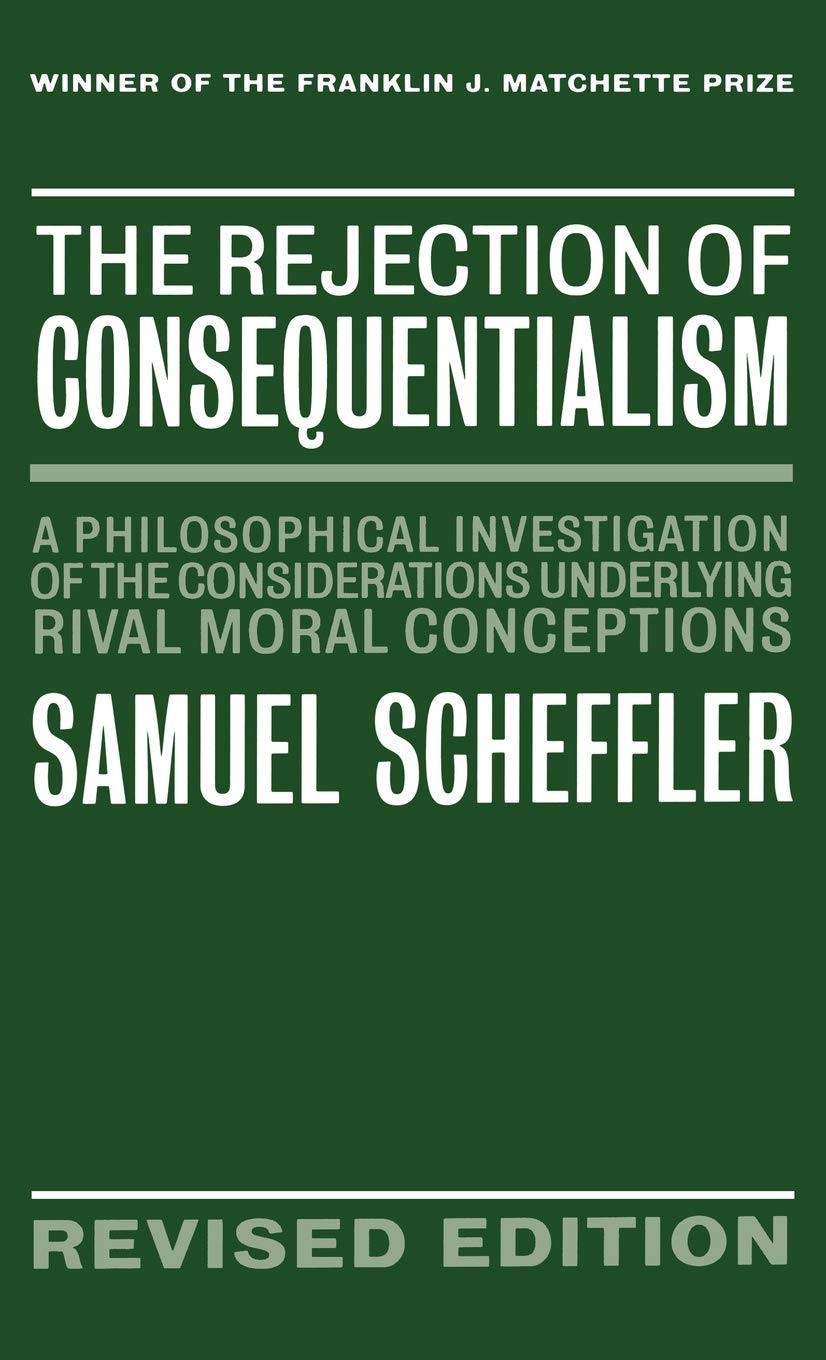
In contemporary philosophy, substantive moral theories are typically classified as either consequentialist or deontological. Standard consequentialist theories insist, roughly, that agents must always act so as to produce the best available outcomes overall. Standard deontological theories, by contrast, maintain that there are some circumstances where one is permitted but not required to produce the best overall results, and still other circumstances in which one is positively forbidden to do so. Classical utilitarianism is the most familiar consequentialist view, but it is widely regarded as an inadequate account of morality. Although Samuel Scheffler agrees with this assessment, he also believes that consequentialism seems initially plausible, and that there is a persistent air of paradox surrounding typical deontological views. In this book, therefore, he undertakes to reconsider the rejection of consequentialism. He argues that it is possible to provide a rationale for the view that agents need not always produce the best possible overall outcomes, and this motivates one departure from consequentialism; but he shows that it is surprisingly difficult to provide a satisfactory rationale for the view that there are times when agents must not produce the best possible overall outcomes. He goes on to argue for a hitherto neglected type of moral conception, according to which agents are always permitted, but not always required, to produce the best outcomes.
⚠️ WARNING (California Proposition 65):
This product may contain chemicals known to the State of California to cause cancer,
birth defects, or other reproductive harm.
For MAP (Minimum Advertised Price) violations and Intellectual Property (IP) or Trademark concerns, please contact:
support@ergodebooks.com
⚠️ California Proposition 65 Warning: Some products sold on this website may expose you to chemicals known to the State of California to cause cancer, birth defects, or other reproductive harm. For more information, visit www.P65Warnings.ca.gov.