
Title
The Reputational Premium: A Theory Of Party Identification And Policy Reasoning,Used
Sold by Ergodebooks, an authorized reseller.
Returns accepted within 30 days | support@ergodebooks.com
Shipping Information
- Free Standard Shipping — United States only
- Processing Time: 3–5 business days
- Estimated Delivery: 6–10 business days after dispatch
- Double-boxed, fully insured & discreetly packaged
- Tracking number sent via email once dispatched
Returns & Refund
Returns accepted within 30 days of delivery.
Damaged or Defective Item
Free return shipping + replacement or full refund
Wrong Item Received
Free return shipping + replacement or full refund
Change of Mind
Return shipping at customer's expense · 25% restocking fee applies
Payment Option

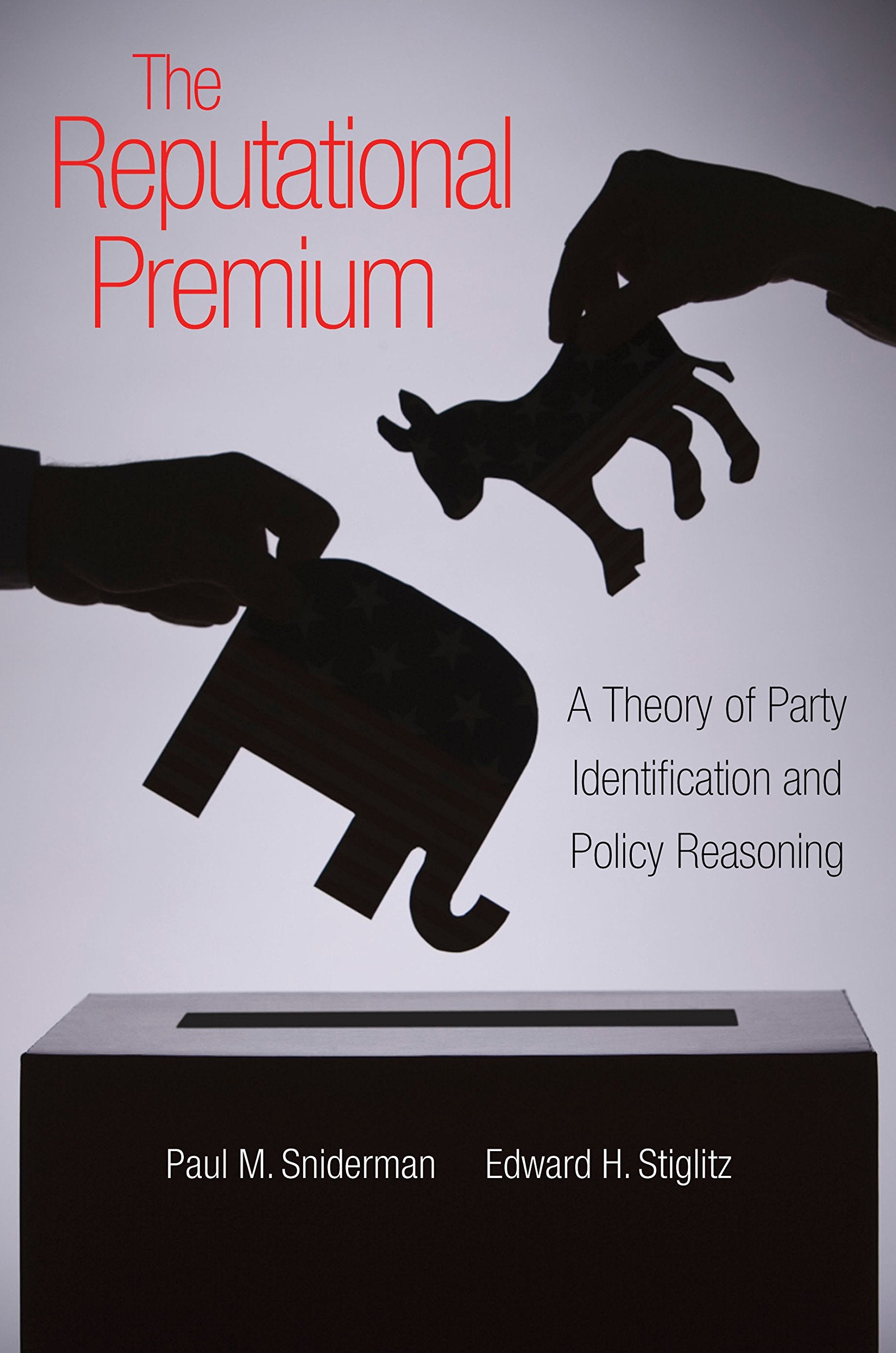
The Reputational Premium presents a new theory of party identification, the central concept in the study of voting. Challenging the traditional idea that voters identify with a political party out of blind emotional attachment, this pioneering book explains why party identification in contemporary American politics enables voters to make coherent policy choices.Standard approaches to the study of policybased voting hold that voters choose based on the policy positions of the two candidates competing for their support. This study demonstrates that candidates can get a premium in support from the policy reputations of their parties. In particular, Paul Sniderman and Edward Stiglitz present a theory of how partisans take account of the parties' policy reputations as a function of the competing candidates' policy positions.A central implication of this theory of reputationcentered choices is that party identification gives candidates tremendous latitude in their policy positioning. Paradoxically, it is the party supporters who understand and are in synch with the ideological logic of the American party system who open the door to a polarized politics precisely by making the bestinformed choices on offer.
⚠️ WARNING (California Proposition 65):
This product may contain chemicals known to the State of California to cause cancer, birth defects, or other reproductive harm.
For more information, please visit www.P65Warnings.ca.gov.