
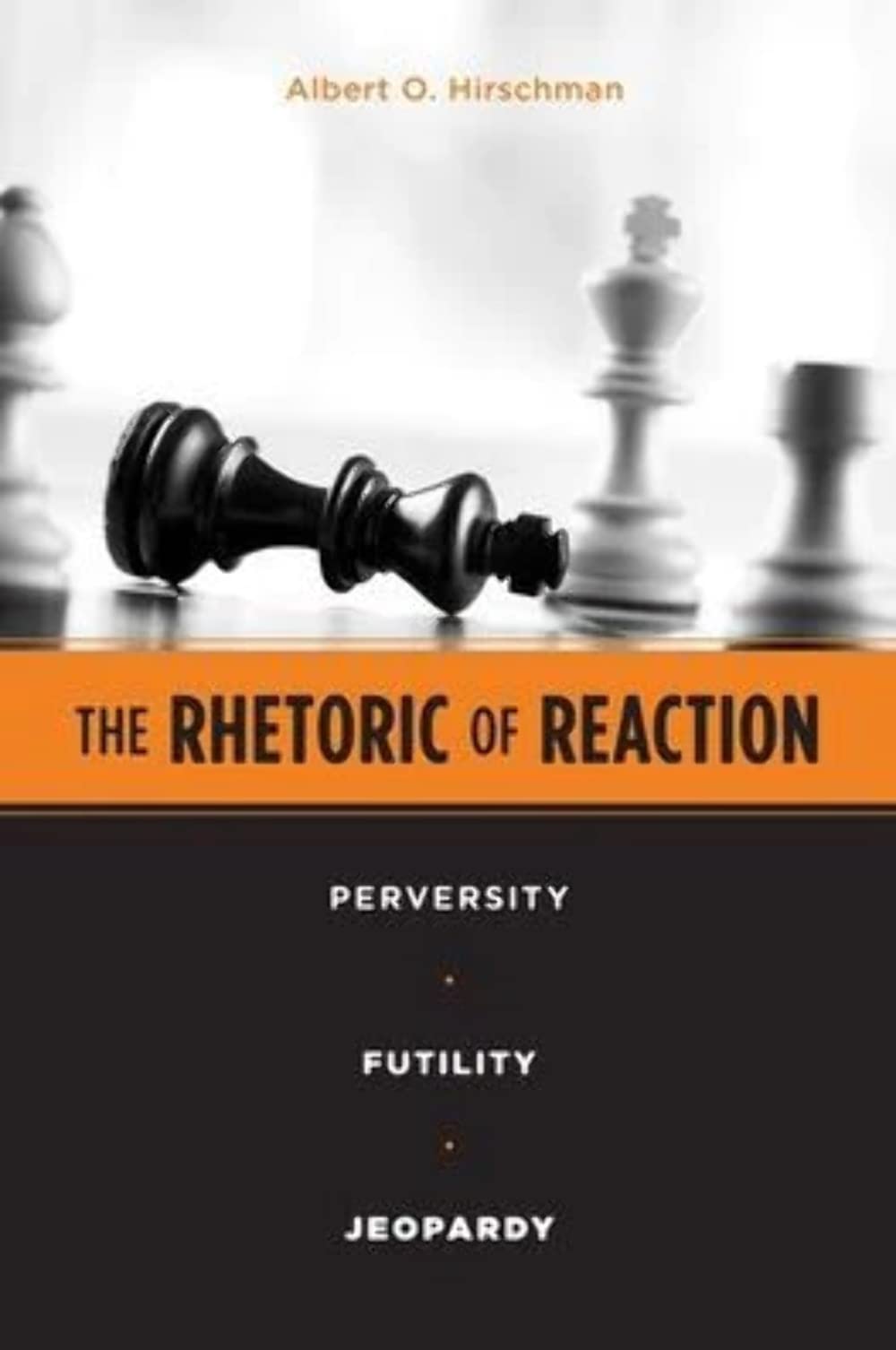
Title
The Rhetoric of Reaction: Perversity, Futility, Jeopardy,New
Sold by Ergodebooks, an authorized reseller.
Returns accepted within 30 days | support@ergodebooks.com
Shipping Information
- Free Standard Shipping — United States only
- Processing Time: 3–5 business days
- Estimated Delivery: 6–10 business days after dispatch
- Double-boxed, fully insured & discreetly packaged
- Tracking number sent via email once dispatched
Returns & Refund
Returns accepted within 30 days of delivery.
Damaged or Defective Item
Free return shipping + replacement or full refund
Wrong Item Received
Free return shipping + replacement or full refund
Change of Mind
Return shipping at customer's expense · 25% restocking fee applies
Payment Option

With engaging wit and subtle irony, Albert Hirschman maps the diffuse and treacherous world of reactionary rhetoric in which conservative public figures, thinkers, and polemicists have been arguing against progressive agendas and reforms for the past two hundred years.Hirschman draws his examples from three successive waves of reactive thought that arose in response to the liberal ideas of the French Revolution and the Declaration of the Rights of Man, to democratization and the drive toward universal suffrage in the nineteenth century, and to the welfare state in our own century. In each case he identifies three principal arguments invariably used: (1) the perversity thesis, whereby any action to improve some feature of the political, social, or economic order is alleged to result in the exact opposite of what was intended; (2) the futility thesis, which predicts that attempts at social transformation will produce no effects whateverwill simply be incapable of making a dent in the status quo; (3) the jeopardy thesis, holding that the cost of the proposed reform is unacceptable because it will endanger previous hardwon accomplishments. He illustrates these propositions by citing writers across the centuries from Alexis de Tocqueville to George Stigler, Herbert Spencer to Jay Forrester, Edmund Burke to Charles Murray. Finally, in a lightning turnabout, he shows that progressives are frequently apt to employ closely related rhetorical postures, which are as biased as their reactionary counterparts. For those who aspire to the genuine dialogue that characterizes a truly democratic society, Hirschman points out that both types of rhetoric function, in effect, as contraptions designed to make debate impossible. In the process, his book makes an original contribution to democratic thought.The Rhetoric of Reaction is a delightful handbook for all discussions of public affairs, the welfare state, and the history of social, economic, and political thought, whether conducted by ordinary citizens or academics.
⚠️ WARNING (California Proposition 65):
This product may contain chemicals known to the State of California to cause cancer, birth defects, or other reproductive harm.
For more information, please visit www.P65Warnings.ca.gov.
- Q: What is the main theme of 'The Rhetoric of Reaction'? A: The main theme of 'The Rhetoric of Reaction' is the exploration of reactionary rhetoric used against progressive reforms, detailing how conservative thinkers argue against social and political changes through three principal theses: perversity, futility, and jeopardy.
- Q: Who is the author of 'The Rhetoric of Reaction'? A: The author of 'The Rhetoric of Reaction' is Albert O. Hirschman, a noted economist and social scientist.
- Q: What are the key theses discussed in the book? A: The key theses discussed in the book are the perversity thesis, which claims that efforts to improve conditions often lead to the opposite result; the futility thesis, suggesting that social changes will have no effect; and the jeopardy thesis, which argues that reforms may endanger existing achievements.
- Q: What type of binding does 'The Rhetoric of Reaction' have? A: 'The Rhetoric of Reaction' is available in paperback binding.
- Q: How many pages does the book contain? A: 'The Rhetoric of Reaction' contains 224 pages.
- Q: When was 'The Rhetoric of Reaction' published? A: 'The Rhetoric of Reaction' was published on March 1, 1991.
- Q: Is the book in new or used condition? A: The book is listed as being in new condition.
- Q: What category does this book fall under? A: 'The Rhetoric of Reaction' falls under the category of Rhetoric.
- Q: What kind of readers would benefit from this book? A: Readers interested in discussions of public affairs, the welfare state, and the history of social, economic, and political thought, including both ordinary citizens and academics, would benefit from this book.
- Q: Does 'The Rhetoric of Reaction' include examples from historical figures? A: Yes, the book includes examples from various historical figures, such as Alexis de Tocqueville and Edmund Burke, illustrating the arguments made against progressive thoughts.