
Title
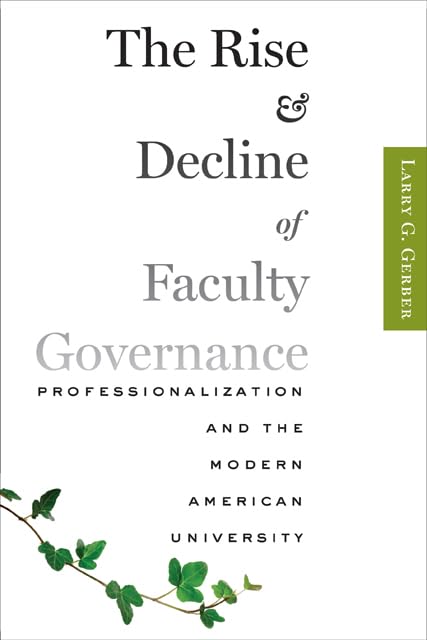
The Rise and Decline of Faculty Governance: Professionalization and the Modern American University,Used
Sold by Ergodebooks, an authorized reseller.
Returns accepted within 30 days | support@ergodebooks.com
Shipping Information
- Free Standard Shipping — United States only
- Processing Time: 3–5 business days
- Estimated Delivery: 6–10 business days after dispatch
- Double-boxed, fully insured & discreetly packaged
- Tracking number sent via email once dispatched
Returns & Refund
Returns accepted within 30 days of delivery.
Damaged or Defective Item
Free return shipping + replacement or full refund
Wrong Item Received
Free return shipping + replacement or full refund
Change of Mind
Return shipping at customer's expense · 25% restocking fee applies
Payment Option

There was a time when the faculty governed universities. Not anymore.The Rise and Decline of Faculty Governance is the first history of shared governance in American higher education. Drawing on archival materials and extensive published sources, Larry G. Gerber shows how the professionalization of college teachers coincided with the rise of the modern university in the late nineteenth century and was the principal justification for granting teachers power in making educational decisions. In the twentieth century, the efforts of these governing faculties were directly responsible for molding American higher education into the finest academic system in the world.In recent decades, however, the growing complexity of multiversities and the application of business strategies to manage these institutions threatened the concept of faculty governance. Faculty shifted from being autonomous professionals to being employees. The casualization of the academic labor market, Gerber argues, threatens to erode the quality of universities. As more faculty become contingent employees, rather than tenured career professionals enjoying both job security and intellectual autonomy, universities become factories in the knowledge economy.In addition to tracing the evolution of faculty decision making, this historical narrative provides readers with an important perspective on contemporary debates about the best way to manage Americas colleges and universities. Gerber also reflects on whether American colleges and universities will be able to retain their position of global preeminence in an increasingly marketdriven environment, given that the system of governance that helped make their success possible has been fundamentally altered.
⚠️ WARNING (California Proposition 65):
This product may contain chemicals known to the State of California to cause cancer, birth defects, or other reproductive harm.
For more information, please visit www.P65Warnings.ca.gov.