
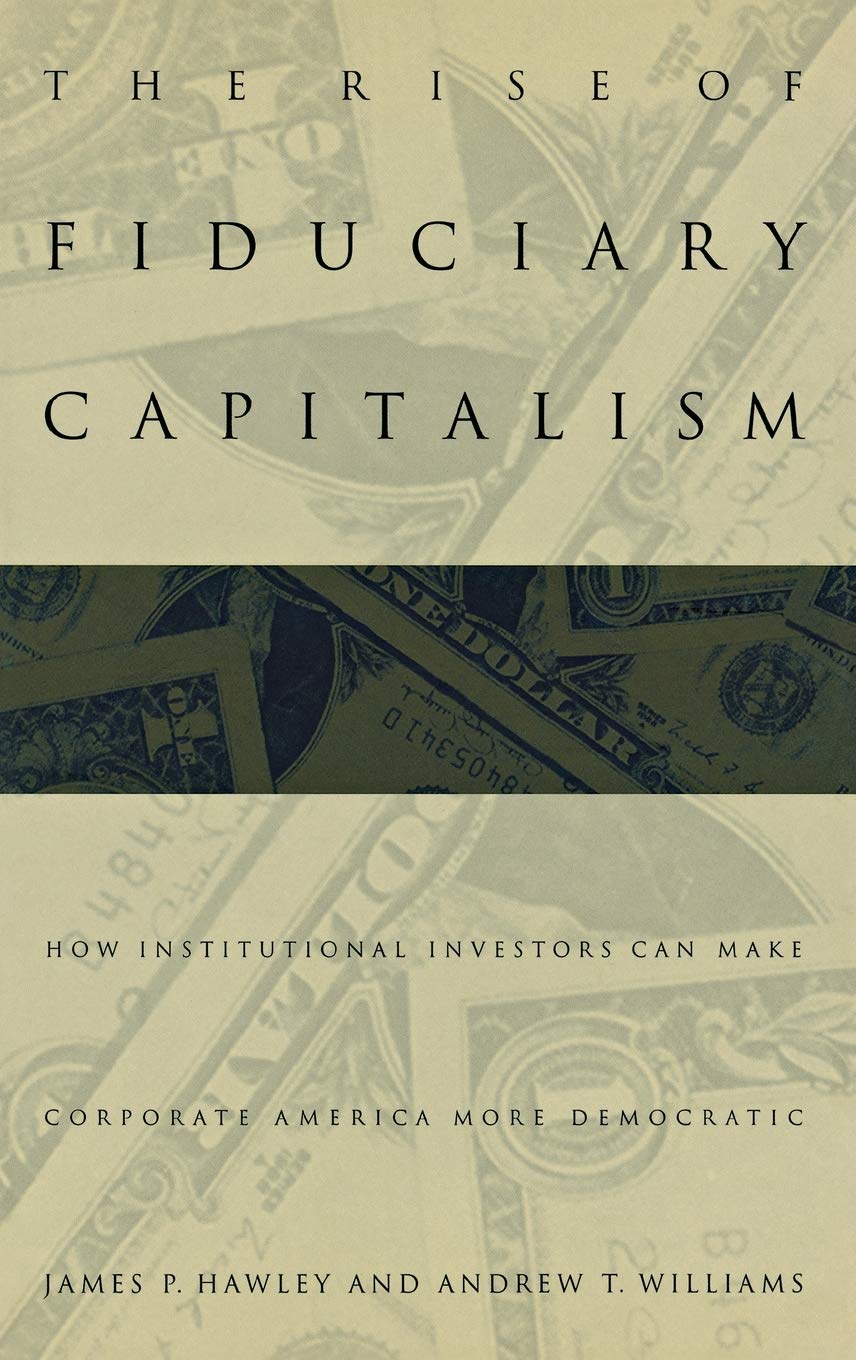
Title
The Rise Of Fiduciary Capitalism: How Institutional Investors Can Make Corporate America More Democratic
Sold by Ergodebooks, an authorized reseller.
Returns accepted within 30 days | support@ergodebooks.com
Shipping Information
- Free Standard Shipping — United States only
- Processing Time: 3–5 business days
- Estimated Delivery: 6–10 business days after dispatch
- Double-boxed, fully insured & discreetly packaged
- Tracking number sent via email once dispatched
Returns & Refund
Returns accepted within 30 days of delivery.
Damaged or Defective Item
Free return shipping + replacement or full refund
Wrong Item Received
Free return shipping + replacement or full refund
Change of Mind
Return shipping at customer's expense · 25% restocking fee applies
Payment Option

At The Beginning Of The Twentyfirst Century, The Structure Of Corporate Ownership Is Undergoing Major Change. The Rise Of Fiduciary Capitalism Chronicles The Rise Of Fiduciary Institutionsprimarily Public And Private Pension Fundswhich Now Own Almost 50 Percent Of The Equity Of American Corporations. In Turn, Approximately 50 Percent Of Americans Either Own Stock Individually Or, More Typically, Have An Ownership Or Retirement Interest In These Fiduciary Institutions.James P. Hawley And Andrew T. Williams Argue That, Because Of Their Extensive Diversification Of Ownership, Fiduciary Institutions Have Become Universal Owners With A Significant Stake In A Broad Crosssection Of The Largest Publicly Traded Firms In The Economy. Forced To Evaluate Portfoliowide Effects Of Individual Firm Actions, These Institutions Have A Quasipublic Policy Interest In The Longterm Health And Wellbeing Of The Whole Society. As Universal Owners, Fiduciary Institutions Are In A Unique Position To Develop And Pursue Policies Of Virtuous Efficiency, Minimizing Negative Externalities And Encouraging Positive Outcomes By The Firms In Their Portfolios. In This Way, They Have The Potential To Make The Firms In Which They Own Stock More Responsive To The Needs Of The Americans To Whom They Are Responsible And Thereby Make Those Firms More Democratic.The Rise Of Fiduciary Capitalism Investigates The Nature Of Property And Ownership In The Modern Corporate Setting, The Effects Of The Decline Of Traditional, Personally Held Property In Equity Form, And The Governance Implications Of The Developing New Form Of Corporate Ownership.
⚠️ WARNING (California Proposition 65):
This product may contain chemicals known to the State of California to cause cancer, birth defects, or other reproductive harm.
For more information, please visit www.P65Warnings.ca.gov.
- Q: How many pages does the book have? A: This book has two hundred fifty-six pages. It provides a comprehensive exploration of fiduciary capitalism and its implications.
- Q: What is the binding type of the book? A: The binding type is hardcover. This ensures durability and a professional appearance for your bookshelf.
- Q: What are the dimensions of the book? A: The book measures six and a half inches by nine and a half inches and three-quarters of an inch thick. These dimensions make it easy to handle and read.
- Q: Who is the author of this book? A: The author is James P. Hawley, along with co-author Andrew T. Williams. They are noted for their expertise in fiduciary capitalism.
- Q: What genre does this book belong to? A: The book belongs to the Theory genre. It addresses complex ideas related to corporate ownership and governance.
- Q: Is this book suitable for academic study? A: Yes, this book is suitable for academic study. It offers in-depth analysis and insights into fiduciary institutions.
- Q: How do I best read this book? A: You can read this book at your own pace, focusing on chapters relevant to your interests. It’s well-structured for easy navigation.
- Q: What reading level is this book appropriate for? A: This book is best suited for advanced readers. It tackles intricate theories and concepts related to corporate governance.
- Q: Can this book be used as a reference for research? A: Yes, this book can be used as a reference for research. It provides substantial information on fiduciary capitalism.
- Q: How should I care for this hardcover book? A: To care for the book, keep it in a dry place and avoid exposure to direct sunlight. This will help preserve its condition.
- Q: Is this book safe to handle for children? A: Yes, the book is safe to handle for children but may not be suitable for their understanding. It contains advanced concepts.
- Q: What if my book arrives damaged? A: If your book arrives damaged, contact customer service for a replacement or refund. Keep all packaging for reference.
- Q: Can I return the book if I don't like it? A: Yes, you can return the book if it does not meet your expectations. Check the return policy for specifics.
- Q: What should I do if I lose my book? A: If you lose the book, consider purchasing a new copy. Libraries may also have this title available for borrowing.
- Q: Is there a warranty for this book? A: No, there is typically no warranty for books. However, you can return it if it arrives damaged.
- Q: How does this book compare to others in its genre? A: This book offers a unique perspective on fiduciary capitalism, distinguishing it from many others that focus solely on corporate finance.