
Title
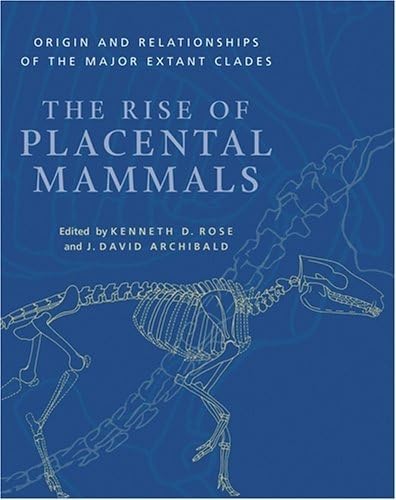
The Rise Of Placental Mammals: Origins And Relationships Of The Major Extant Clades
Sold by Ergodebooks, an authorized reseller.
Returns accepted within 30 days | support@ergodebooks.com
Shipping Information
- Free Standard Shipping — United States only
- Processing Time: 3–5 business days
- Estimated Delivery: 6–10 business days after dispatch
- Double-boxed, fully insured & discreetly packaged
- Tracking number sent via email once dispatched
Returns & Refund
Returns accepted within 30 days of delivery.
Damaged or Defective Item
Free return shipping + replacement or full refund
Wrong Item Received
Free return shipping + replacement or full refund
Change of Mind
Return shipping at customer's expense · 25% restocking fee applies
Payment Option

From Shrews To Blue Whales, Placental Mammals Are Among The Most Diverse And Successful Vertebrates On The Earth. Arising Sometime Near The Late Cretaceous, This Broad Clade Of Mammals Contains More Than 1,000 Genera And Approximately 4,400 Extant Species. Although Much Studied, The Origin And Diversification Of The Placentals Continue To Be A Source Of Debate.Paleontologists Kenneth D. Rose And J. David Archibald Have Assembled The World'S Leading Authorities To Provide A Comprehensive And Uptodate Evolutionary History Of Placental Mammals. Focusing On Anatomical Evidence, The Contributors Present An Unbiased Scientific Account Of The Initial Radiation And Ordinal Relationships Of Placental Mammals, Representing Both The Consensus And Significant Minority Viewpoints. This Book Will Be Invaluable To Paleontologists, Evolutionary Biologists, Mammalogists, And Students.Contributors: J. David Archibald, San Diego State University; Robert J. Asher, Institut Fr Systematische Zoologie; Jonathan I. Bloch, University Of Michigan; Douglas M. Boyer, University Of Michigan; Daryl P. Domning, Howard University; Eduardo Eizirik, National Cancer Institute; Robert J. Emry, Smithsonian Institution; Jrg Erfurt, Martinlutheruniversity; John J. Flynn, The Field Museum; Timothy J. Gaudin, University Of Tennessee; Emmanuel Gheerbrant, Musum National D'Histoire Naturelle; Philip D. Gingerich, The University Of Michigan; Patricia A. Holroyd, University Of California, Berkeley; J. J. Hooker, The Natural History Museum; Lo F. Laporte, University Of California, Santa Cruz; Jin Meng, American Museum Of Natural History;William J. Murphy, National Cancer Institute; Jason C. Mussell, The Johns Hopkins University School Of Medicine; Michael J. Novacek, American Museum Of Natural History; Stephen J. O'Brien, National Cancer Institute; Kenneth D. Rose, The Johns Hopkins University School Of Medicine; Guillermo W. Rougier, University Of Louisville; Eric J. Sargis, Yale University; Mary T. Silcox, University Of Winnipeg; Nancy B. Simmons, American Museum Of Natural History; Mark S. Springer, University Of California, Riverside; Gerhard Storch, Forschungsinstitut Senckenberg; Pascal Tassy, Musum National D'Histoire Naturelle; Jessica M. Theodor, Illinois State Museum; Gina D. Wesley, The University Of Chicago; John R. Wible, Carnegie Museum Of Natural History; Andr Wyss, University Of California, Santa Barbara.
⚠️ WARNING (California Proposition 65):
This product may contain chemicals known to the State of California to cause cancer, birth defects, or other reproductive harm.
For more information, please visit www.P65Warnings.ca.gov.
- Q: How many pages does the book have? A: This book contains two hundred eighty pages. It provides a comprehensive overview of placental mammals and their evolutionary history.
- Q: What is the binding type of this book? A: The binding of this book is hardcover. This ensures durability and longevity for readers and collectors.
- Q: What are the dimensions of this book? A: The book measures eight and a half inches in length, eleven inches in height, and is approximately nine hundred forty thousandths of an inch thick.
- Q: Who are the authors of this book? A: The authors include Kenneth D. Rose and J. David Archibald, along with contributions from various authoritative figures in paleontology.
- Q: Is this book suitable for beginners? A: Yes, this book is suitable for both beginners and advanced readers. It offers a detailed exploration of placental mammals, making it accessible to a wide audience.
- Q: What is the main focus of this book? A: The main focus of the book is the evolutionary history of placental mammals. It discusses anatomical evidence and various viewpoints on their relationships.
- Q: How should I care for this book? A: To care for this book, store it upright in a cool, dry place. Avoid exposure to direct sunlight to maintain its condition.
- Q: Can I clean the cover of the book? A: Yes, you can clean the cover with a soft, dry cloth. Avoid using any liquids or cleaners to prevent damage.
- Q: Is this book safe for young readers? A: Yes, this book is safe for young readers. However, it is more suited for students and adults interested in paleontology and biology.
- Q: How does this book compare to other paleontology texts? A: This book is unique due to its comprehensive contributions from leading experts, providing a well-rounded view compared to other texts.
- Q: What if the book arrives damaged? A: If the book arrives damaged, please contact the seller for return or replacement options. Most sellers offer customer support for such issues.
- Q: What is the publisher of this book? A: The publisher of this book is Johns Hopkins University Press. They are known for their academic and scholarly publications.
- Q: Are there illustrations or diagrams in the book? A: Yes, the book contains illustrations and diagrams that aid in understanding the evolutionary concepts discussed.
- Q: What topics are covered in this book? A: The book covers topics related to the origins, diversification, and anatomical relationships of placental mammals.
- Q: Is there a glossary or index in the book? A: Yes, the book includes an index, which helps readers locate specific topics and terms related to placental mammals.