
Title
The Role Of The Solvent In Chemical Reactions (Oxford Chemistry Masters)
Sold by Ergodebooks, an authorized reseller.
Returns accepted within 30 days | support@ergodebooks.com
Shipping Information
- Free Standard Shipping — United States only
- Processing Time: 3–5 business days
- Estimated Delivery: 6–10 business days after dispatch
- Double-boxed, fully insured & discreetly packaged
- Tracking number sent via email once dispatched
Returns & Refund
Returns accepted within 30 days of delivery.
Damaged or Defective Item
Free return shipping + replacement or full refund
Wrong Item Received
Free return shipping + replacement or full refund
Change of Mind
Return shipping at customer's expense · 25% restocking fee applies
Payment Option

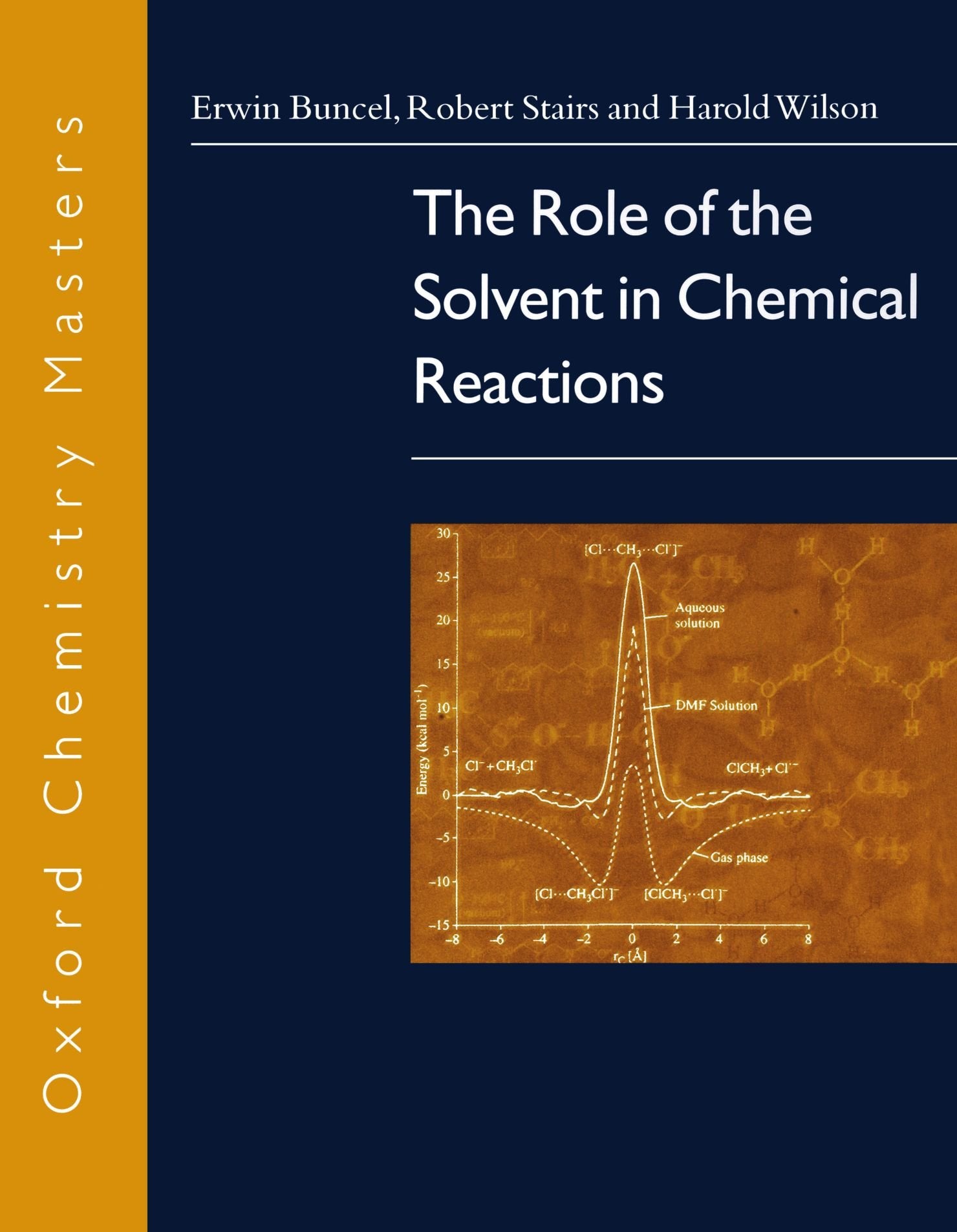
The role of the solvent in chemical reactions is one of immediate and daily concern to the practising chemist. Whether in the laboratory, or in industry, most reactions are carried out in the liquid phase. In the majority of these, one or two reacting components, or reagents, are dissolved in a suitable medium and the reaction is allowed to take place. Given the importance of solvent, the need for an indepth understanding of this topic is obvious. However, many inorganic and organic chemistry texts only make passing references to solvents, or worse still, fail to mention that a given reaction takes place in a particular solvent at all. This book successfully addresses the gap in our understanding of solvent chemistry, and brings the role of the solvent rightly to the fore.The book begins with a summary of essential thermodynamic and kinetic facts, emphasizing aspects of these fields, where relevant, to reactions in solution. Chapter 2 introduces the reader to the role of the solvent purely as a medium, touching on early theories based on electrostatic considerations (Born and KirkwoodOnsager) and the solubility parameter (Hildebrand). Chapter 3 discusses the role of solvent as an active participant, chiefly through hydrogen bonding, BrnstedLowry and Lewis acidbase interactions, including hard and soft acids and bases. The ability of solvents to serve as media for oxidation and reduction is also touched upon. There then follows a chapter on chemometrics; the application of statistical methods to chemical phenomena and spectra, chiefly linear free energy correlations and principal component analysis. A novel method for the presentation of data is also described. In chapter 5, methods of theoretical calculation are discussed. These include quantummechanical abinitio and semiempirical methods, integralequation theories, and methods based on statistical mechanics (Monte Carlo and molecular dynamics). Examples to illustrate these methods are detailed in the chapter. Chapters 6 and 7 look at a selection of particular classes of solvents including aproticdipolar, acidic, basic, roomtemperature ionic, and chiral. The suitability of examples from each class of solvent for particular purposes is also discussed. The final chapter presents some concluding observations.Throughout the book, the authors use a semiquantitative and thermodynamically based approach, deliberately avoiding unnecessary detail or rigour, so that the discussions are accessible to both senior undergraduates and postgraduates. The text is also interspersed with helpful examples taken from both inorganic and organic chemistry.
⚠️ WARNING (California Proposition 65):
This product may contain chemicals known to the State of California to cause cancer, birth defects, or other reproductive harm.
For more information, please visit www.P65Warnings.ca.gov.