
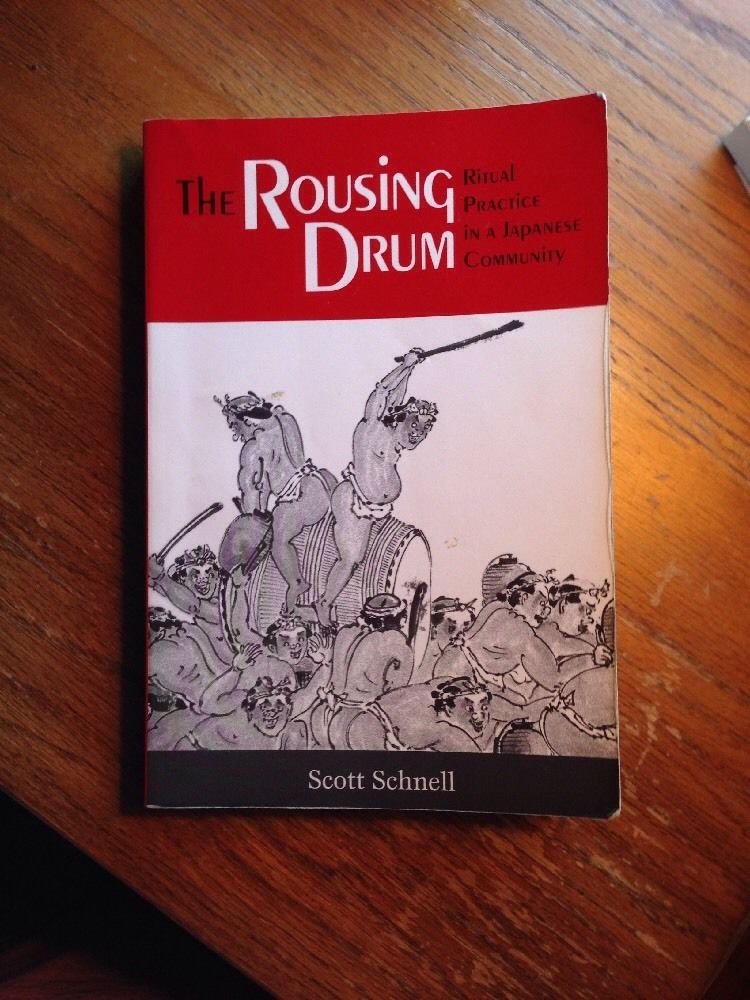
Title
The Rousing Drum: Ritual Practice in a Japanese Community,Used
Sold by Ergodebooks, an authorized reseller.
Returns accepted within 30 days | support@ergodebooks.com
Shipping Information
- Free Standard Shipping — United States only
- Processing Time: 3–5 business days
- Estimated Delivery: 6–10 business days after dispatch
- Double-boxed, fully insured & discreetly packaged
- Tracking number sent via email once dispatched
Returns & Refund
Returns accepted within 30 days of delivery.
Damaged or Defective Item
Free return shipping + replacement or full refund
Wrong Item Received
Free return shipping + replacement or full refund
Change of Mind
Return shipping at customer's expense · 25% restocking fee applies
Payment Option

Ritual is too often equated with unvarying or repetitive behavior. This impression is encouraged by the ethnographic tendency toward an overly narrow time frame, which highlights current relationships and conditions rather than longterm developments.The Rousing Drum takes a different view. It adopts a historical perspective encompassing several hundred years in exploring the role of ritual as an effective medium for negotiating sociopolitical and economic change.The setting is Furukawa, a town located in Japan's mountainous interior. Every spring the local Shinto shrine festival provides an opportunity for enacting social relationships and attitudes. By day, a portable shrine containing the spirit of the guardian deity is escorted through town in a stately procession. At night, however, a different scenario unfolds. A barrelshaped drum is borne through the nighttime streets on a massive gridlike platform. Prominent members of the community are obliged to ride upon the platform, while teams of young adults rush out and attack it as it passes through their respective neighborhoods. The action can become quite unruly, and random fights and injuries are accepted as inevitable correlates.In analyzing the festival over time, Schnell reveals a dramatic transformation. The drum ritual, which originated as a minor preliminary to the other events, emerged during the late 1800s as an occasion for airing hostilities and settling scores. As Japan's modernization progressed, the ritual performance came to embody a symbolic challenge to institutionalized authority, and occasionally escalated into politically motivated violence. While the religious ceremonies observed during the day were appropriated by local power holders, the nighttime drum ritual represented a folk response to the officially sanctioned liturgy. The festival as a whole thus represented the clash of competing ideologies within the context of a single public forum. Today's ritual, rather tame by comparison, is being transformed into a tourist attraction aligned with the town's economic development objectives.Schnell's careful examination of the ethnohistorical data offers a valuable new perspective on Japanese festivals as well as the events and conditions that influence their development. His innovative look at ritual behavior over time persuades us that we can grasp the underlying significance of such activities only if we consider them within the context of larger historical patterns.
⚠️ WARNING (California Proposition 65):
This product may contain chemicals known to the State of California to cause cancer, birth defects, or other reproductive harm.
For more information, please visit www.P65Warnings.ca.gov.
- Q: What is the main focus of 'The Rousing Drum'? A: 'The Rousing Drum' examines the historical role of ritual in a Japanese community, particularly how it serves as a medium for negotiating sociopolitical and economic change over several hundred years.
- Q: Who is the author of this book? A: The book is authored by Scott Schnell, who provides an in-depth analysis of the evolution of ritual practices in Japan.
- Q: What is the significance of the drum ritual discussed in the book? A: The drum ritual discussed in the book evolved from a minor event into a significant expression of community dynamics and a challenge to institutional authority, reflecting broader sociopolitical changes.
- Q: Is this book suitable for academic study? A: Yes, 'The Rousing Drum' offers valuable insights and ethnohistorical data, making it suitable for academic study on Japanese festivals and cultural practices.
- Q: How many pages does 'The Rousing Drum' have? A: 'The Rousing Drum' contains 376 pages, providing a comprehensive exploration of its subject matter.
- Q: What is the publication date of this book? A: 'The Rousing Drum' was published on June 1, 1999.
- Q: What type of binding is used for this edition? A: This book is available in paperback binding, making it accessible and easy to handle.
- Q: What themes are explored in 'The Rousing Drum'? A: The book explores themes of ritual behavior, community dynamics, and the impact of modernization in Japan, particularly through the lens of local festivals.
- Q: Can this book be helpful for understanding Japanese customs and traditions? A: Yes, 'The Rousing Drum' provides deep insights into Japanese customs and traditions, particularly in the context of ritual practices and community interactions.
- Q: What condition is the book in? A: 'The Rousing Drum' is listed in 'Good' condition, indicating that it has been well-maintained and is suitable for reading.