If you have any questions, you are always welcome to contact us. We'll get back to you as soon as possible, withing 24 hours on weekdays.
Customer service
All questions about your order, return and delivery must be sent to our customer service team by e-mail at yourstore@yourdomain.com
Sale & Press
If you are interested in selling our products, need more information about our brand or wish to make a collaboration, please contact us at press@yourdomain.com
Help
If you have any questions, you are always welcome to contact us. We'll get back to you as soon as possible, withing 24 hours on weekdays.
Customer service
All questions about your order, return and delivery must be sent to our customer service team by e-mail at yourstore@yourdomain.com
Sale & Press
If you are interested in selling our products, need more information about our brand or wish to make a collaboration, please contact us at press@yourdomain.com
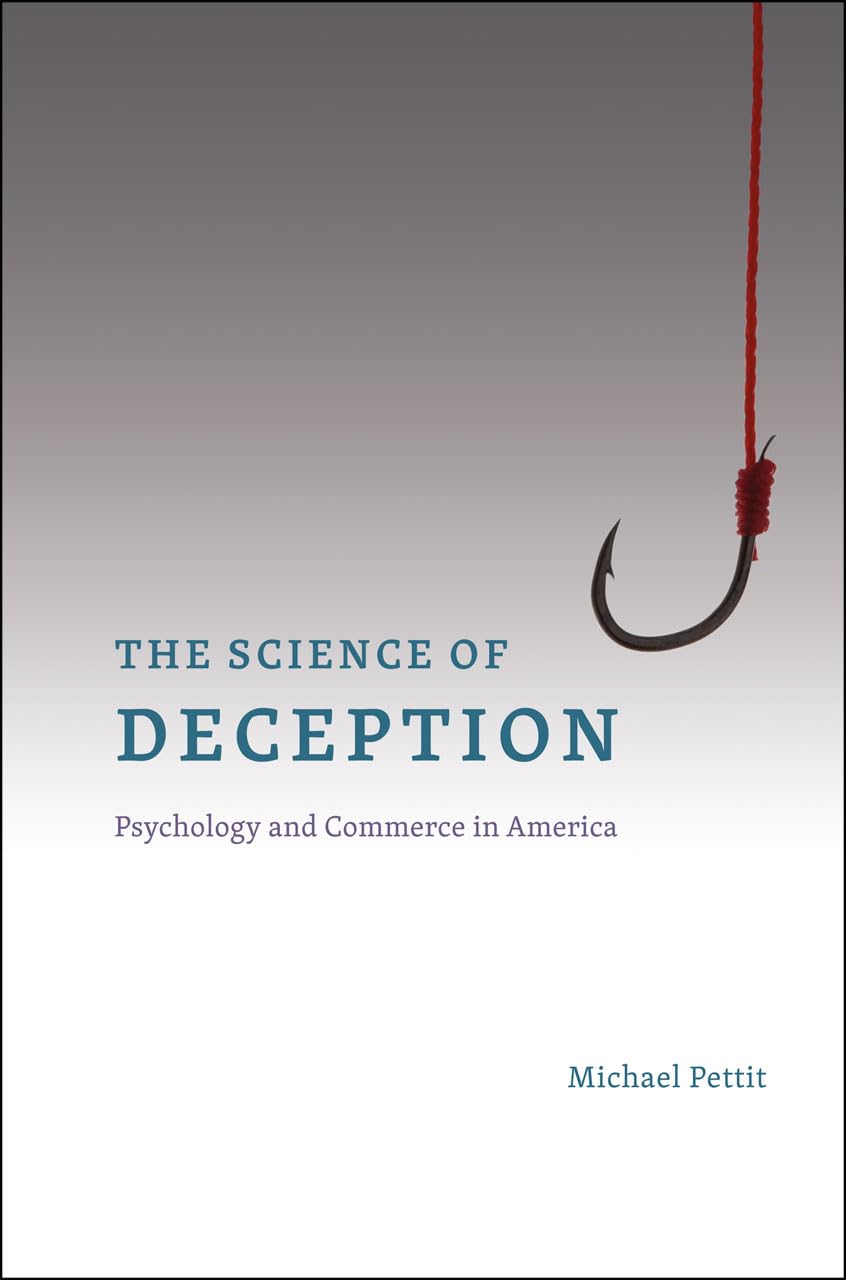
During the late nineteenth and early twentieth centuries, Americans were fascinated with fraud. P. T. Barnum artfully exploited the American yen for deception, and even Mark Twain championed it, arguing that lying was virtuous insofar as it provided the glue for all interpersonal intercourse. But deception was not used solely to delight, and many fell prey to the schemes of con men and the wiles of spirit mediums. As a result, a number of experimental psychologists set themselves the task of identifying and eliminating the illusions engendered by modern, commercial life. By the 1920s, however, many of these same psychologists had come to depend on deliberate misdirection and deceitful stimuli to support their own experiments.The Science of Deception explores this paradox, weaving together the story of deception in American commercial culture with its growing use in the discipline of psychology. Michael Pettit reveals how deception came to be something that psychologists not only studied but also employed to establish their authority. They developed a host of toolsthe lie detector, psychotherapy, an array of personality tests, and morefor making deception more transparent in the courts and elsewhere. Pettits study illuminates the intimate connections between the scientific discipline and the marketplace during a crucial period in the development of market culture. With its broad research and engaging tales of treachery, The Science of Deception will appeal to scholars and general readers alike.
⚠️ WARNING (California Proposition 65):
This product may contain chemicals known to the State of California to cause cancer,
birth defects, or other reproductive harm.
For MAP (Minimum Advertised Price) violations and Intellectual Property (IP) or Trademark concerns, please contact:
support@ergodebooks.com
⚠️ California Proposition 65 Warning: Some products sold on this website may expose you to chemicals known to the State of California to cause cancer, birth defects, or other reproductive harm. For more information, visit www.P65Warnings.ca.gov.