If you have any questions, you are always welcome to contact us. We'll get back to you as soon as possible, withing 24 hours on weekdays.
Customer service
All questions about your order, return and delivery must be sent to our customer service team by e-mail at yourstore@yourdomain.com
Sale & Press
If you are interested in selling our products, need more information about our brand or wish to make a collaboration, please contact us at press@yourdomain.com
Help
If you have any questions, you are always welcome to contact us. We'll get back to you as soon as possible, withing 24 hours on weekdays.
Customer service
All questions about your order, return and delivery must be sent to our customer service team by e-mail at yourstore@yourdomain.com
Sale & Press
If you are interested in selling our products, need more information about our brand or wish to make a collaboration, please contact us at press@yourdomain.com
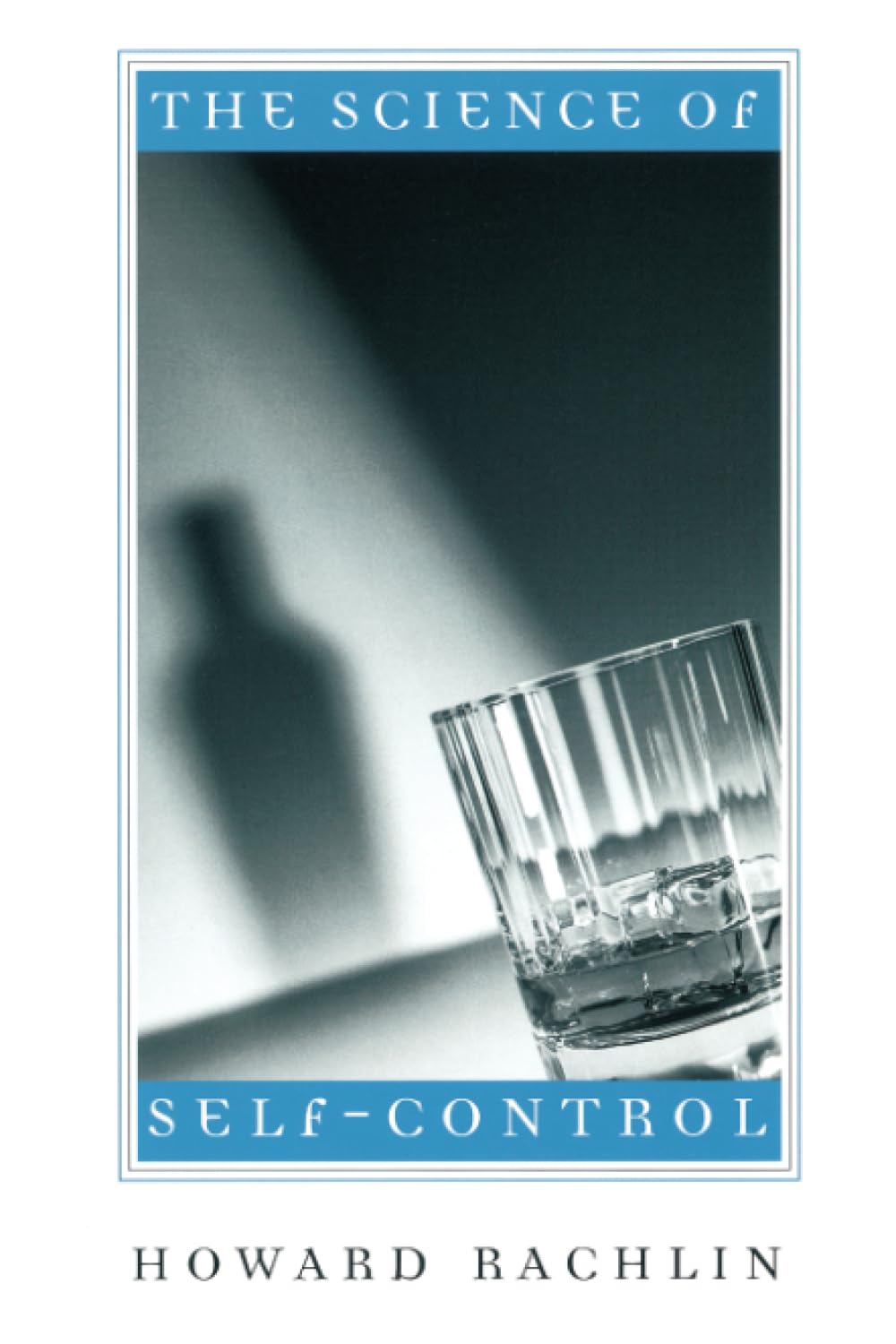
This book proposes a new science of selfcontrol based on the principles of behavioral psychology and economics. Claiming that insight and selfknowledge are insufficient for controlling one's behavior, Howard Rachlin argues that the only way to achieve such controland ultimately happinessis through the development of harmonious patterns of behavior.Most personal problems with selfcontrol arise because people have difficulty delaying immediate gratification for a better future reward. The alcoholic prefers to drink now. If she is feeling good, a drink will make her feel better. If she is feeling bad, a drink will make her feel better. The problem is that drinking will eventually make her feel worse. This sequencethe consistent choice of a highly valued particular act (such as having a drink or a smoke) that leads to a lowvalued pattern of actsis called 'the primrose path.'To avoid it, the author presents a strategy of 'soft commitment,' consisting of the development of valuable patterns of behavior that bridge over individual temptations. He also proposes, from economics, the concept of the substitutability of 'positive addictions,' such as social activity or exercise, for 'negative addictions,' such as drug abuse or overeating.Selfcontrol may be seen as the interaction with one's own future self. Howard Rachlin shows that indeed the value of the wholeof one's whole lifeis far greater than the sum of the values of its individual parts.
⚠️ WARNING (California Proposition 65):
This product may contain chemicals known to the State of California to cause cancer,
birth defects, or other reproductive harm.
For MAP (Minimum Advertised Price) violations and Intellectual Property (IP) or Trademark concerns, please contact:
support@ergodebooks.com
⚠️ California Proposition 65 Warning: Some products sold on this website may expose you to chemicals known to the State of California to cause cancer, birth defects, or other reproductive harm. For more information, visit www.P65Warnings.ca.gov.