
Title
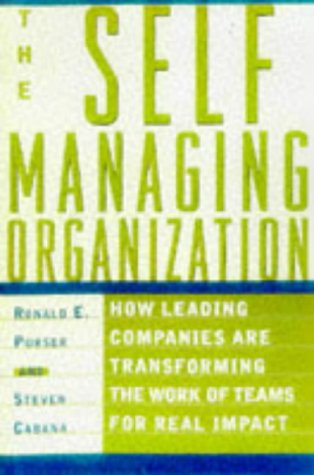
The SelfManaging Organization : How Leading Companies Are Transforming the Work of Teams for Real Impact,Used
Sold by Ergodebooks, an authorized reseller.
Returns accepted within 30 days | support@ergodebooks.com
Shipping Information
- Free Standard Shipping — United States only
- Processing Time: 3–5 business days
- Estimated Delivery: 6–10 business days after dispatch
- Double-boxed, fully insured & discreetly packaged
- Tracking number sent via email once dispatched
Returns & Refund
Returns accepted within 30 days of delivery.
Damaged or Defective Item
Free return shipping + replacement or full refund
Wrong Item Received
Free return shipping + replacement or full refund
Change of Mind
Return shipping at customer's expense · 25% restocking fee applies
Payment Option

Amazon.com Review Business consultants Ronald Purser and Steven Cabana argue that it's time for democracy to replace bureaucracy at work. In The SelfManaging Organization, they warn that hightech, knowledgebased businesses perform best with the flexibility, creativity, and information sharing that come with more freedom on the job. "We need the real medicine now: democracy at work," write the authors, consultants to such companies as Motorola and Procter & Gamble. Building on research by social scientists at the Tavistock Institute in London in the 1950s, Purser and Cabana explain the theory and provide examples of two selfmanaging techniques for improving work: Participative Design and the Search Conference. The Participative Design method asks workers themselves to determine what's wrong at the company and suggest solutions. And the Search Conference method has workers develop new business strategies to help the company succeed. The SelfManaging Organization thus offers provocative ideas to business managers and students. Dan Ring Product Description Based on the principles of "Participative Design," the authors explain why employees' participation is the key to successful corporate reorganization and present detailed case studies of major companies in which employees design and manage their own workplaces. From Booklist Using principles and methods drawn from case studies of such companies as American Express, Hewlett Packard, and Motorola, Purser and Cabana offer a blueprint for designing the selfmanaging organization. It is written for executives, middle managers, and frontline supervisors in all types of businesses participating in the new knowledge economy, which is dependent on knowledgeable workers. The book provides a set of tools that can be used at all levels of an organization to transform rigid bureaucracies into flexible work systems, with selfmanaging work groups serving as the basic building block. The authors explain and demonstrate how organizations can create social learning contexts, or "44 communities of trust," where people can engage in open dialogue and chart the future while redesigning their own work. The authors are consultants in the field of organizational behavior. They contend that their theories are not just another fad but essential to growth and profitability in the new corporate reality, where knowledge workers are the essential core of corporate activity. Mary Whaley Review Dawn Lepore Chief Information Officer, Charles Schwab Purser and Cabana's participative methods jumpstarted our IT strategy creation process and helped our team to have "ownership" of the outcome. Review Excerpt. Reprinted by permission. All rights reserved. THE END OF MANAGEMENT AND THE RISE OF THE SELFMANAGING ORGANIZATION What we call the beginning is often the end. And to make an end is to make a beginning. The end is where we start from. T.S. Eliot Management is coming to an end. We might liken the end of management to the fall of communism. When institutions get out of synch with the movement of history, they go into decline whether they are national governments or private enterprises. We believe that conventional management will be the next domino to fall. Conventionally, management has been focused on planning, organizing, directing, coordinating, and controlling human efforts. Managers were seen as the exclusive stewards of the business, occupying a distinct social role and fixed position in a bureaucratic hierarchy. For many years managers were internally focused, absorbed in operational details, controlling and coordinating the work of their subordinates and dealing with office politics. Management was sucked into acting as a troubleshooter and firefighter for the level below. This all just seemed like the natural order of things. And from such a perspective, it didn't make sense to question what seemed to be well established dogma. Manageme
⚠️ WARNING (California Proposition 65):
This product may contain chemicals known to the State of California to cause cancer, birth defects, or other reproductive harm.
For more information, please visit www.P65Warnings.ca.gov.
- Q: How many pages does the book have? A: The book has three hundred eighty-four pages. This length allows for a thorough exploration of its themes and concepts.
- Q: What is the binding type of the book? A: The book features hardcover binding. This type of binding enhances durability and provides a premium feel.
- Q: What are the dimensions of the book? A: The book measures six and a half inches in length, one and one tenth inches in width, and ten inches in height. These dimensions make it easy to handle and read.
- Q: Who is the author of 'The Self-Managing Organization'? A: The author is Roland E. Purser. He collaborates with Steven Cabana to present innovative ideas on organizational management.
- Q: Is this book suitable for business managers? A: Yes, this book is suitable for business managers. It provides valuable insights on transforming work environments for better productivity.
- Q: Can I use the techniques in different industries? A: Yes, the techniques are applicable across various industries. The authors draw from case studies in multiple sectors to illustrate their points.
- Q: How do I apply the concepts in the book? A: To apply the concepts, implement the Participative Design and Search Conference methods in your organization. These methods encourage employee involvement and innovative thinking.
- Q: Is this book appropriate for students? A: Yes, this book is appropriate for students. It offers foundational knowledge on self-managing organizations that is relevant for those studying business.
- Q: What is the main focus of the book? A: The main focus of the book is to advocate for democracy in workplace management. It emphasizes the importance of employee participation in decision-making.
- Q: What kind of case studies are included? A: The book includes case studies from companies like American Express and Motorola. These examples illustrate successful implementation of self-managing techniques.
- Q: How can this book benefit my organization? A: This book can benefit your organization by providing strategies to foster employee engagement and improve overall performance.
- Q: What is the primary theme of 'The Self-Managing Organization'? A: The primary theme is the shift from traditional management to self-managing teams. The authors emphasize flexibility and creativity in the workplace.
- Q: Does this book include practical tools for implementation? A: Yes, the book includes practical tools for implementation. It offers methods that can be easily integrated into various levels of an organization.
- Q: Is there a focus on corporate culture in the book? A: Yes, there is a strong focus on corporate culture. The authors discuss how fostering a participative culture can lead to better outcomes.
- Q: Are there any notable endorsements for the book? A: Yes, notable endorsements include praise from executives like Dawn Lepore of Charles Schwab. They highlight the effectiveness of the authors' methods in real-world applications.