If you have any questions, you are always welcome to contact us. We'll get back to you as soon as possible, withing 24 hours on weekdays.
Customer service
All questions about your order, return and delivery must be sent to our customer service team by e-mail at yourstore@yourdomain.com
Sale & Press
If you are interested in selling our products, need more information about our brand or wish to make a collaboration, please contact us at press@yourdomain.com
Help
If you have any questions, you are always welcome to contact us. We'll get back to you as soon as possible, withing 24 hours on weekdays.
Customer service
All questions about your order, return and delivery must be sent to our customer service team by e-mail at yourstore@yourdomain.com
Sale & Press
If you are interested in selling our products, need more information about our brand or wish to make a collaboration, please contact us at press@yourdomain.com
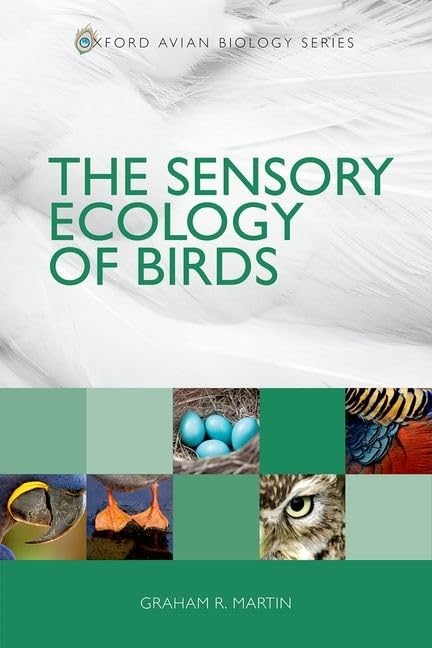
Birds are renowned for their exceptional vision and the way that this enables them to survive and navigate the world in such a unique way. However, it is now recognised that avian behaviour is guided by information drawn from many different senses which are then used in integrated and complementary ways to answer the many different sensory challenges posed by specific environments and particular tasks.Understanding how sensory information is used by birds has important applications in conservation, such as providing vital insights into why birds are prone to collisions with structures like power lines and wind turbines, and why so many diving birds become entrapped in nets. A sensory ecology approach suggests how these problems can be mitigated.The Sensory Ecology of Birds ranges widely across species, environments, and behaviours to present a synthesis that challenges previous assumptions about the information that controls the behaviour of birds. A bird may use a wide range and combination of sensory information that comes from sight, hearing, smell, mechanoreception, taste, and magnetoreception. It may also include specific refinements of senses, such as echolocation and remote touch from the bill. The book recognises that there are many complex and subtle tradeoffs and complementarities of information between different types of sensory information.This accessible text will be of interest to a wide ornithological readership, from undergraduates to researchers as well as a broader audience of behavioural ecologists and evolutionary biologists.
⚠️ WARNING (California Proposition 65):
This product may contain chemicals known to the State of California to cause cancer,
birth defects, or other reproductive harm.
For MAP (Minimum Advertised Price) violations and Intellectual Property (IP) or Trademark concerns, please contact:
support@ergodebooks.com
⚠️ California Proposition 65 Warning: Some products sold on this website may expose you to chemicals known to the State of California to cause cancer, birth defects, or other reproductive harm. For more information, visit www.P65Warnings.ca.gov.